Tag: Irish Youth Development

  • Irish Youth Football Development: Games vs Structure

    Irish Youth Football Development: Games vs Structure

    The majority of top players in the Irish senior squad came through the traditional schoolboy football system.

    “Many players who ended up in the senior squad came through this route before systems tightened”

    That system, while less structured, provided something critical to player development: game time.

    Players regularly played 30–50+ matches per season through league games, cups, and tournaments.

    This high volume of matches allowed players to develop decision-making, confidence, resilience, and creativity in real game situations.

    In contrast, the current League of Ireland (LOI) academy system has introduced a more structured and professional environment.

    Coaching standards, facilities, and tactical understanding have improved significantly.

    However, there is a growing concern:

    Young players are now playing fewer matches and, in many cases, getting less actual playing time.

    With larger squads and increased competition, some players are training frequently but not playing regularly.

    This creates a gap in development, as training alone cannot replicate the unpredictable and pressured environment of a real match.

    Development is built on:

    – Repetition

    – Match experience

    – Decision-making under pressure

    You cannot fully develop game intelligence without playing games.

    The key issue is balance.

    The old system provided volume and freedom.

    The new system provides structure and quality.

    But currently, there is a risk that we have improved structure while reducing opportunity.

    Some players are now training like professionals without getting enough chances to play like developing footballers.

    The concerns

    • Fewer games → more training, less match experience
    • Squad sizes vs minutes → some kids barely play
    • High competition early → players can be dropped too soon
    • Development vs results tension

    Some players are training like pros… without playing like kids

    🎯 The Core Issue

    It comes down to this:

    Development = minutes + repetition in real games

    Training is important, but:

    • You don’t learn decision-making without matches
    • You don’t develop resilience sitting on a bench
    • You don’t get “game intelligence” without game chaos

    – High-quality coaching

    – Consistent and meaningful game time

    🧠 What the best systems globally

    Top countries blend both:

    • High-quality coaching
    • Consistent and high game exposure

    Players might train 3–4 times a week…but still get meaningful minutes every week

    It seems we’ve improved structure, but we may have reduced opportunity.

    If Irish football is to continue producing top-level players, it is essential that young players are given sufficient opportunities to play, make mistakes, learn, and grow within real match environments.

    Main Picture: Credit The Times

    ——————–

    I always like to hear your opinions and views. If you feel you have something to say, please comment below or email me info@thecoachdiary.com

    If, you don’t have anything to add then please forward this on to a friend/coach. As always, thanks for reading.

    I’m also on twitter @Coachdiary and Facebook

  • StrikerOnLine E-Mag Launch

    StrikerOnLine E-Mag Launch

    StrikerOnLine and Eamon Scott are launching their E-Magazine TODAY!

    The new digital eMag is launching it’s a double edition with – nearly 150 pages of grassroots football from Ireland. It’s a very comprehensive overview of the game in Ireland with coaching to feature as a core element within the pages. 

    • Subscribe for only €2.49 every 2 weeks!
    • New Articles & Photographs
    • Interviews, Match Reports & Updates
    • All National Leagues Covered + More!
    • This is a subscription publication, the price of a cup of coffee every two weeks.
    • For more information contact Eamon Scott – STRIKERONLINE 

    WATCH VIDEO HERE: https://drive.google.com/file/d/1ILyDlRbs3owuFQnXGHt0yJ0-2dHuJiEU/view

    eSTRIKER is the latest addition to the STRIKERONLINE Social Media family. It’s your gateway to all that is best about Irish Grassroots soccer and brings our reporting and coverage to a new level of development.

    REGISTER BELOW
    https://www.strikeronline.ie/striker-magazine

    -END

    We always like to hear your opinions and views. If you feel you have something to say or content to share, please comment below or email me coach@thecoachdiary.com 

    If, you don’t have anything to add then please forward this on to a friend. As always, thanks for reading. I’m also on twitter @Coachdiary and @LetTheKidPlay

  • Where you are born matters for football development…

    Where you are born matters for football development…

    This is the second part of a study conducted by: Laura Finnegan O’Halloran a Lecturer in Sport Management and Talent Development in Waterford I.T, MA in Sport Psychology and currently undertaking a PhD on organisational structure and practice in Irish football (with Liverpool John Moores University).

    Laura has done this study in partnership with Liverpool John Moore University with Dave Richardson, Martin Littlewood and Mark Nesti. All of which have significant experience in youth development and identifying and managing critical transitions within youth football. 

    What influences what we play?

    Lots of sociological and environmental factors influence what and how we play, all worthy of a blog in themselves (e.g. culture, environmental issues, what your parents/family played, socioeconomic factors, peer influence, gender, ethnicity, education)…all in good time. Place of birth is another factor that can influence not only what we play but how likely we are to succeed in that sport. As in the example above, where you are born can dictate what sportyou’re likely to play (it will generally be the sport that’s valued in that setting, your school values it and wants to succeed in it so resources are found for it, clubs have a stronghold in the community, your parents/extended family/local role-models played it (often down to the specific position you want to play… I’m looking at you goal-keepers from Donegal!!) and can influence how successful you are (and organically drive these ‘hothouses’ of talent development, like the Skibereen rowers or NI golfers).
    Studies have looked at the birth place of professional athletes, analyzing athletes according to whether they were from large cities right down to those being from small rural areas. Those that were from small cities were most likely to make it into the professional game, but results depended on the context. There seems to be a sweet spot of the ideal size of a development area, where there are enough quality coaches, resources, teams, structures and opponents, balanced with being compact enough to develop relationships/socialise into particular sports, allow for informal play on streets/green areas, get enough game time and not be overlooked in favour of a larger cohort of earlier maturing players (see more about the Relative age Effect here https://talentdevelopmentinirishfootball.com/2017/06/27/relative-age-effect-in-irish-elite-youth-football/).

    What does this have to do with Irish football?

    density & crest

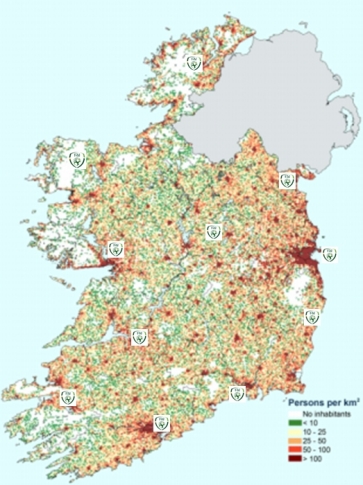
    Map of Ireland, showing population densities with FAI ETP centre locations

    For those not familiar with Irish football, the Emerging Talent Programme is the primary talent development mechanism run by the governing body for football in the Republic of Ireland, the FAI. It has undergone some restructuring lately but at the time of research it consisted of 12 centres countrywide, where the players identified as most talented in the surrounding 32 leagues combine for extra training. The location of these centres can be seen by the FAI badges plotted on the map, along with the population density of the country.

    I’ve looked at the county of birth for all of the ETP players over a 6 year period and analysed how likely you are to get onto the programme (compared to the relative populations). In the below map, the darker the county colour, the more likely a player is to make the ETP programme (ranging from A counties down to the more poorly represented E counties in white).

    We are delighted to be able to blog her research and share it with you: You can read the rest of Laura’s article by going directly to her website Talent Development In Irish Football

    -end

    I always like to hear your opinions and views. If you feel you have something to say, please comment below or email me info@thecoachdiary.com If, you don’t have anything to add then please forward this on to a friend. As always, thanks for reading.

    I’m also on twitter @Coachdiary and @LetTheKidPlay