Blog

  • Football – Soccer the player’s game?  By Chris Panayiotou

    Football – Soccer the player’s game? By Chris Panayiotou

    After posting “A Players Message To Parents” I got sent a fantastic video and poem:

    Football – Soccer the player’s game?

    I dream of being like my heroes Messi, Hamm, Ronaldo, Heath, Ackers and Rooney, ah the fame

    I dream that 80,000-90,000 fans are screaming my name,

    I want to ask the stars, with all those people screaming your name….

    How does this affect your game?

     How do you think? –

    When coach yells, the sidelines screams directions I just freeze and shrink

     They say that soccer is the player’s game

    I just can’t concentrate when the adults yell my name

     I want to play where it’s nice and quiet

    Not where a referee misses a call and induces a riot

     I want to play where I’m free to make mistakes

    Not when that happens the adult berates

    The parents yell boot it, punt it, whack it clear

    I just want to dribble keep the ball near

    After all, the ball is the world’s favorite toy

    I am not a grown man, just a small boy

    Unisex -part They continue to yell and go absolutely wild

    I’m not a grown up just a small child

    People are yelling pass, pass, pass

    Tell me dribble and I will be the top of my class

     I want to dribble and touch the ball

    I want to be free from the noise and try it all

    Dad when you were young how and what did you play?

    Did your parents come and watch you, what did they say?

    The ride home is at times what I dread

    Because what you say I should do, is not what coach said

    Today is my day, to learn and embrace,

    All that I can from my coach and teammates.

    From me to you, and you to me,

    the way forward is clear to see.

    These six words mean the world to me.

    Mom, Dad, there is no better way for you to say,

    “I loved watching you play today.”

     These words I hear, and never fear –

    are true and kind and full of cheer. –

    Kick around with me, show me what to do

    Let me take part in pick-up games like you used to

    I am still a young person not a professional player

    I need support and praise not a nay-sayer

    Thank my teachers and coaches for their time

    They are trying to help my skills be sublime

    Praise my effort, grit, determination and will

    Let me develop, try new things, gain a skill

    Sit back, relax, enjoy this ride

    This is my journey let me fill you with pride

    ==

    Chris Panayiotou is Developmental Director of Coaching Virginia Rush Soccer Club and Developmental Technical Director Rush Soccer.

    -End

    I always like to hear your opinions and views. If you feel you have something to say, please comment below or email me info@thecoachdiary.com If, you don’t have anything to add then please forward this on to a friend. As always, thanks for reading.

    I’m also on twitter @Coachdiary
  • A Players Message To Parents

    A Players Message To Parents

    I’m not sure of the originality of this I think I first saw it on a Youth Football Scotland back in 2013 but I have since edited it.

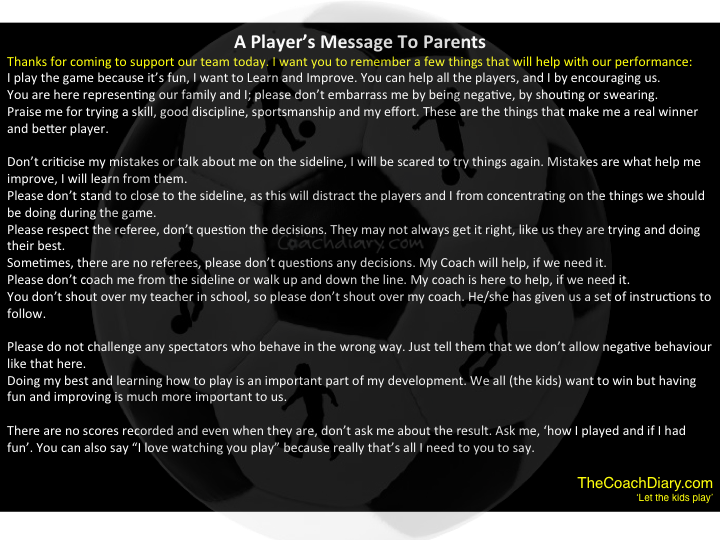
    Thanks for coming to support our team today. I want you to remember a few things that will help with our performance:

    I play the game because it’s fun, I want to Learn and Improve. You can help all the players, and I by encouraging us.

    You are here representing our family and I; please don’t embarrass me by being negative, by shouting or swearing.

    Praise me for trying a skill, good discipline, sportsmanship and my effort. These are the things that make me a real winner and better player.

    Don’t criticise my mistakes or talk about me on the sideline, I will be scared to try things again. Mistakes are what help me improve, I will learn from them.

    Please don’t stand to close to the sideline, as this will distract the players and I from concentrating on the things we should be doing during the game.

    Please respect the referee, don’t question the decisions. They may not always get it right, like us they are trying and doing their best.

    Sometimes, there are no referees, please don’t questions any decisions. My Coach will help, if we need it.

    Please don’t coach me from the sideline or walk up and down the line. My coach is here to help, if we need it.

    You don’t shout over my teacher in school, so please don’t shout over my coach. He/she has given us a set of instructions to follow.

    Please do not challenge any spectators who behave in the wrong way. Just tell them that we don’t allow negative behaviour like that here.

    Doing my best and learning how to play is an important part of my development. We all (the kids) want to win but having fun and improving is much more important to us.

    There are no scores recorded and even when they are, don’t ask me about the result. Ask me, ‘how I played and if I had fun’. You can also say “I love watching you play” because really that’s all I need to you to say.

    You can download a pdf of it HERE

    -End

    I always like to hear your opinions and views. If you feel you have something to say, please comment below or email me info@thecoachdiary.com If, you don’t have anything to add then please forward this on to a friend. As always, thanks for reading.

    I’m also on twitter @Coachdiary
  • Parents in Sport Week – PLAY YOUR PART – 3-9th October

    Parents in Sport Week – PLAY YOUR PART – 3-9th October

    Parents in Sport Week will take place from 3 to 9 October 2016. This week will focus on how parents can greatly influence a child’s experience in sport through their actions, both positive and negative. 

    In the build-up and during parent’s week 2016, we hope sports organisations make sure the message regarding a parent’s or carer’s role within sport focuses on the positive impact that they have on their child or children.

    All too often we only hear negative stories about extreme poor behaviour from the side-lines. This negative parental behaviour takes away from a child’s experience of sport or their desire to continue participating within sport, as they no longer see taking part in sport as fun.

    Child Protection In Sport Unit want help from sports organisations to raise awareness of the crucial role parents have in helping a child reach their full potential.

    3 key outcomes

    The key outcomes that Parents in Sport Week aims to achieve are:

    1. To encourage sports organisations and clubs to promote the positive role parents play in helping children reach their full potential
    2. To empower parents by sharing information regarding key roles they can do as a sports parent in supporting their child’s participation, success and fun, and therefore retaining a child’s interest in sport
    3. To assist coaches and officials to understand the crucial role parents have in a child’s participation and continued involvement in sport

    They have useful guidance for coaches regarding welcoming and appreciating parents, to assist in those initial conversations about roles and expectations, but also on how to have difficult discussions when things are not going well.

    Further information

    Related resources

    Book a place on the free webinar, Promoting positive parenting in sport, which covers how parents can support children to enjoy sport and achieve to the best of their ability. It takes place on 7 October 2016.

    -End

    I always like to hear your opinions and views. If you feel you have something to say, please comment below or email me info@thecoachdiary.com If, you don’t have anything to add then please forward this on to a friend. As always, thanks for reading.

    I’m also on twitter @Coachdiary
  • Spanish UEFA B license Courses

    Spanish UEFA B license Courses

    I received this from a fellow coach who is working with RFEF and their Pro Licenced Coaches in La Coruna.

    We are currently organising the first ever English Language UEFA ‘B’ Coaching course based on modern Spanish Coaching Methods and held in Spain! Yes, in Spain and in English….

    Course Content

    Application form here Spanish_UEFA_B_Feedback_Form_Ireland


  • Sideline supporters have no right to direct negative talk towards the players…

    Sideline supporters have no right to direct negative talk towards the players…

    Parents, Adults or any person in fact have no rights to abuse or sound negative towards children playing the game they love. I have had issue with some of my own parents and I’be witnessed many others who have verbally abused a player whilst playing the game. These parents might think they mean well and could assume they are developing mental toughness…. but they are so far from the truth – what they are really doing is destroying the child’s love for the game.

    What gives these Adults the right to criticise children trying to make decisions in a pressurised environment. If you screamed and shouted at a child outside youth sports environment you would be apprehended immediately but why do we allow this to happen in what children also see as a playground??

    The worst offenders are ego-driven parents who take personally any slights to their children on the pitch. Any decision gone against their child, any foul; a pass that should have gone to their future star instead it didn’t arrive or it went to someone else; a free-kick or a corner taken by someone else. These are all situations when the ego-parent goes nuts and vents their anger.

    All that a side, their are some absolutely brilliant parents out there who give up so much time to bring their kids to and from training and never interfere in their kids football, but these can be mostly few now.

    Clubs and coaches need to do more and come down hard on Adults who criticise kids from the sidelines. Maybe we should pre-warn parents and tell them, “you might get angry on the side lines and attached are some tips to deal with it’. Below are some excerpts from a study about parent behaviour on the sidelines, mostly from the US.

    A recent study showed – by Jay D. Goldstein

    Overall, about half of the parents in the study reported getting angry during games, and nearly 40 percent of the angry parents made their emotions known. These sideline expressions ranged from muttering or yelling comments to walking onto or near the pitch.

    “Their own sense of their personal worth gets wrapped up in how their children are doing in these ball games,” said Edward Deci, a psychologist at the University of Rochester in New York. ” And so the parents feel intense, internal pressure to see their kids performing because the kids are like extensions of themselves.”

    Coach: ” so what is your favourite position? “
    Player: ” Center Midfield”
    Coach: ” Interesting. Is that because you see yourself as a good playmaker and stopper? “
    Player: ” No its because my dad is one side and my coach is on the other and sometimes if i’m in midfield, I can’t hear either of them”.

    340 parents of 8- to 15-year-old soccer players were evaluated on personality and ego characteristics, feelings of anger and pressure, and aggressive behaviour. The Results showed:

    • 47% of parents reported no anger-causing events while watching their kids play.
    • 53% did get angry.

    Of those who did feel anger, what made them flare up?

    • 19% blamed the referee.
    • 15% said they got angry at how their kid’s team played.
    • 7% said the opponents behaved badly.
    • 5% reported hostile remarks set them off.
    • 5% blamed coaches.

    Researchers concluded that the effect of ego defensiveness and taking things personally was strongly linked to feelings of anger and aggressive actions. Those who were more “control-oriented” were more ego defensive. They viewed actions in the football game as attacks against them or their children.

    “In general, control-oriented people are the kind who try to ‘keep up with the Joneses,’” Goldstein said in a news release.”They have a harder time controlling their reactions. They more quickly become one of ‘those’ parents than the parents who are able to separate their ego from their kids and events on the field.”

    Goldstein calls parents who are more even-keeled and able to regulate their emotions “autonomy-oriented parents.” They get angry too, he says, and when they do it’s because their ego gets in the way.

    “While they’re more able to control it, once they react to the psychological trigger, the train has already left the station.”

    HERE ARE SOME TIPS: To ease anger on the playing field, Goldstein suggests these tips:

    • Take deep breaths (inhale for 4 seconds and exhale for 8 seconds).
    • Suck on a lollipop. (Occupies your mouth and reminds you that you’re there for your child.)
    • Visualize a relaxing experience like floating on water.
    • Repeat a calm word or phrase.
    • Do yoga-like muscle stretches.
    • Replace angry thoughts with rational ones, such as “This is my child’s game, not mine,” or “Mistakes are opportunities to learn.”
    • Don’t say the first thing that comes into your head. Count to 10 and think about possible responses.
    • If you did not see the game, first ask your child “How did you play?” rather than “Did you win?”
    • Praise your child’s effort, and then, maybe, comment on the results.
    • Use humour, but avoid harsh or sarcastic humour.

    Mistakes are part of the process: and kids shouldn’t be ridiculed for trying. The level of abuse, bullying and over coaching in kids sports is now at an all time high. We need to educate adults on stages of development and stop forcing the process. As ADULTS we expect far too much from children at a very young age. Children are not mini-adult. We need to get away from the Yell and Tell culture that is now rampant in our kids game. It is better to give positive encouragement, refrain from criticism (constructive is ok) and leave the instructions to the coach. Even continually shouting positives messages can have a negative impact as it thwarts the child’s concentration. Make constructive criticism kid friendly, by coaching it in positives and always giving the feedback in private. When kids make a mistake, help them move past it by having them adopt a “mistake ritual,” a quick action that helps them move beyond the mess-up.

    • Children when given control over their game are more likely to enjoy the game more and stay playing for longer and will embrace the process more rather than focus on the result.
    • This can also allow them to focus longer on getting better and to develop an interest outside of training, where they will challenge themselves to work harder and get better (=More success). Children will learn to value their game more.
    • Kids CAN control their effort, their commitment, and their emotions, and as parents if we focus our pushing on those areas we will not strain our relationship with our them.
    • If you find yourself saying “we scored 3 goals today, we won that game, we won the league” chances are you have not let your them go.  Let the game belong to them!

    Conclusion

    More needs to be done in the area of parenting in sport. Parents don’t shout over the teacher in school, so why do they feel they have the right to shout over the coach. They don’t shout at kids in the playground or young children standing idle because if they did they would be reported and labeled as a bully.

    How many times, have you seen a team where the coach has decided to have their defence drop when they lose the ball, so that the midfield can recover but then the parents on the sideline are screaming “press”, “press”? The players become confused the distraction could be critical in the teams play and players concentration.

    Ask any child, ‘what they think about their parents shouting on the sideline’? and you will get some very interesting answers.

    Some that come to mind, “it’s so embarrassing”, “I hate it”, “he doesn’t know what he’s talking about”, “I wish they wouldn’t come to my games”

    “By constantly coaching and correcting our kids in the game we are unconsciously, but almost certainly, guaranteeing poor and deteriorating performance. We are taking them away from that unconscious, focused mental state where they need to be to excel”. – Inside Soccer

    Parents need to educate themselves with the help of the clubs and leagues on how to behave pitch side. I don’t understand how parents think it’s ok to verbally abuse children on a playing field yet they wouldn’t dream of telling a kid off in a playground. Well, just in case you didn’t notice or weren’t told ‘the football pitch’ is also a play ground, guys!

    Just because things happened certain way when they were younger, it doesn’t mean it has to happen that way now. I think it’s about time some parents kept quiet and let the kids play…. We are adapting to a different generation of children, so back OFF!!!

    Here are 20 guidelines for what is appropriate on the Sideline:

    1. Children should be seen as people first and players second.
    2. Be patient. Not all kids progress at the same rate and learning the game of football takes more time than most people realise.
    3. Praise their effort and decisions making. These are the things they can control. They can’t control winning or losing.
    4. Do not ridicule a child for making a mistake, not performing to their best or losing a game.
    5. Never criticise a child over their performance – they won’t always play their best. Help them see past the bad performance by providing constructive feedback.
    6. Remain calm on the sideline at all times. Losing the plot will only embarrass them and make you look like a total fool.
    7. Prowling the sideline like an angry Tiger and questioning every single decision and coaching your child through the game is definitely something you should NEVER do.
    8. Support the coaching staff and refrain from criticising them at all times.
    9. Parents need to look at what these coaches do, how much effort they put into helping other peoples children. Without them we would not have a game, so don’t be quick to judge them. As a parent, once you are confident that your child is in a safe learning environment, one of the most important things you can do as a parent of a young player is to let them go and let their sports experience belong to them.
    10. Never use derogatory comments towards players or coaches. You might feel others are agreeing with you but really they are now talking about you and it always gets back to the coaching staff in the end.
    11. Whilst watching the game, back off and let them play. Stand back away from the action and enjoy the moments.
    12. Parents should say less and see more. Your child wants you there but they don’t need your input every-time they look your way. A simple thumbs up can inspire your child in any given game.
    13. What they see and what you see is a different picture learn to understand that the game looks different from the sidelines.
    14. Children make two conscious DECISIONS per second. Sideline information prevents children from making a quick decision or deciding on one. The brain works in milliseconds and the game in seconds.
    15. Under no circumstances should you use foul and abusive language.
    16. Don’t get drunk on your kids success.
    17. Allow the kids fall in love with game.
    18. Allow them to be children, enjoying all the FUN elements of the game, so that they can mature into the adult game gradually and naturally.
    19. If you control everything your child does, they will never take on responsibility.
    20. Respect the officials and remember the opposition are children and the coaches are volunteers.


    Research: Inside soccer, University of Maryland, Dr. Goldstein, Changing the game project

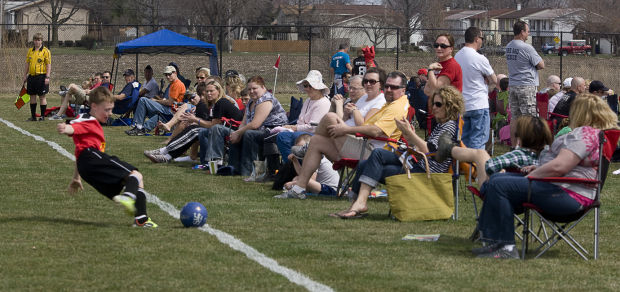
    Pic and Video: shows top actor Ray Winstone playing a shouting parent for the English FA Video.

    -End

    I always like to hear your opinions and views. If you feel you have something to say, please comment below or email me info@thecoachdiary.com and if you don’t have anything to add then please forward this on to a friend.

    As always, thanks for reading. I’m also on twitter  @Coachdiary

  • One Good Adult

    One Good Adult

    In 2012, Headstrong  and the UCD School of Psychology conducted the My World Survey, a National Study of Youth Mental Health.  The survey showed how different elements and experiences of a young person are related to their mental health. 14,500 young people participated in the study and the main findings suggested that mental health difficulties emerged in early adolescence and peaked in the late teens and early 20’s.

    The major finding was that ONE GOOD ADULT is important in the mental well being of young people. having one good adult present in a child life, has the following impact:

    • One caring adult in a young person’s life can buffer against stress and lead to positive psychological functioning.
    • One good adult instills higher levels of optimism and increased self esteem (self esteem plays a major protective role for mental health).
    • The presence of one good adult enhances the ability to cope and increases likelihood of active coping (talking etc) as opposed to destructive coping (alcohol misuse).
    • Low levels of support from one good adult correlate to low levels of life satisfaction.
    • Low levels of support from one good adult correlate to significantly higher levels of depression and anxiety.

    Building Positive Clubs 

    Donegal Sports Partnership @ActiveDonegal have used this information and designed a programme/toolkit to create a positive environment throughout youth sports. The aim of the initiative is to create a culture of positivity within sporting clubs and communities. It’s about promoting positive mental wellbeing through sport by developing an ethos of respect within the clubs. The Charter encourages clubs to understand the importance of effort rather that the win at all costs attitude – promoting inclusion, communication and most importantly enjoyment when partaking in sport at any level.

    Finn Harps and Donegal Sports Partnership piloted the “Building Positive Clubs” in 2014, The programme aligns with the Charter for Positive Mental Well-being which was developed in 2014 by Donegal Sports Partnership. Read about it here

    Not all athletes will reach an elite level in the game. In fact less than 1% will.

    Be Patient
    Be Realistic
    Allow them to reach their full potential not yours.

    – End

    I always like to hear your opinions and views. If you feel you have something to say, please comment below or email me info@thecoachdiary.com If, you don’t have anything to add then please forward this on to a friend. As always, thanks for reading.

    I’m also on twitter @Coachdiary

    Reference:

    • Headstrong & UCD School of Psychology – My World Survey
    • Donegal Sports Partnership – Building Positive Clubs Resources

  • For the Diary: Coerver Diploma 2 & Michael Beale Liverpool FC

    For the Diary: Coerver Diploma 2 & Michael Beale Liverpool FC

    Two great events worth going to this month. First up Coerver Coaching Youth Diploma 2. I’m a big fan of isolated exercises, especially at the younger ages. I have seen huge benefits in repetition exercises with added input from the coach.

    Coerver Youth Diploma 2 coach education course that will take place in DKIT Dundalk, on the Saturday 12th & Sunday 13th of March. It’s a two day workshop.

    The course will be delivered by Coerver Coaching co-founder Alf Galustian

    The Coerver® Coaching Youth Diploma 2 course expands on the knowledge gained from the Youth Diploma 1 course with a focus on how to develop a team style through individual and small group skills teaching both in and out of possession.

    The Coerver ® Coaching Youth Diploma 2 is a 2-day course that has been broken down into 4 modules that will be presented through lecture presentations & practical demonstrations:

    1. Module 1- The Coerver® Approach to Team Play (Theory) Developing the Coerver® Player “Code” (Practical).
    2. Module 2- The Coerver® Team Code – Box/Trap Defence (Theory) The Box/Trap Defence (Practical).
    3. Module 3- The Coerver® Team “Code” – The Box/Trap Attack (Theory) The Box/Trap Attack part 1 (Practical).
    4. Module 4- The Benefits of the Coerver® Team Style (Theory) The Box/Trap Attack Part 2 Finishing (Practical).

    Youth Diploma 2 Course Instructor – Alfred Galustian and special guests over the weekend.

    Alfred Galustian started his soccer career as a young player for Wimbledon. He is the Co-Founder and International Director of Coerver® Coaching, and has been largely responsible for building the program Globally.

    To date Alfred has worked as a Coach Instructor with 17 national federations including the French, English, Japanese and Australian.

    Alfred has also worked with over 50 top professional clubs including Bayern Munich FC, Manchester City FC, Real Madrid CF, Olympique Marseille, Arsenal FC and AC Milan.

    During the 2010/11 Season Alfred was the Specialist Skills Coaching Advisor to the Premier League.

    Alf was appointed Specialist Skills Advisor to the Premier LeagueTM during the 2010/11 season, assigned to help develop the next generation of Elite football coaches in this country, further endorsing his reputation for expertise in technical skills teaching.

    Alf says of the course

    “I am very happy to introduce our new Youth Diploma 2 course which is especially designed for coaches who have attended Youth Diploma 1. In this new course, we are going to focus on developing a team style; what skills individually and in small groups do players need? What do you teach them? How do you teach them?, not only the skills and tactics, but also the mental and attitude aspects” “During this course I’m going to share with attendees ,some of my personal experiences from working with some of the greatest clubs and federations in the world”.

    “A particular focus of the course is to show you how to develop individual players that are multi-positional, both attackers and defenders, with all practices and games being adaptable to players of all ages and abilities”.

    “We are really looking forward to delivering this new course and believe that our approach to developing a team style will be of great benefit to you, no matter the level you work at”.

    Coaches Get:

    • 2-days of expert tuition from Coerver® Coaching Co-founder Alfred Galustian
    • Top Training facilities;
    • On-line access to the Youth Diploma 2 practical session video content;
    • Course Book resource full of drills and
    • Games for your sessions (64 page book);
    • Coerver® Coaching Youth Diploma 2 Certificate of Attendance

    Contact Stewart info@coerverleinster.ie for more information or to register your place.

    NDSL Coaches Workshop: 

    Who: Michael Beale – Liverpool U21 manager 

    When: Saturday 26th March – 1.00pm to 5pm.

    Course details: Practical / theory workshop on how the Liverpool link academy through u21’s and into the  first team.

    Michael is the current under 21 Liverpool Manager and he has written extensively on Player Development; having worked previously at Chelsea FC, he has written and designed many sessions on young players development through the small sided games. Michael is renowned for his excellent delivery of coaching sessions which can be applied across all age groups.  This event will be both Theory and Practical along with lots more information about Liverpool FC.

    Interview with Michael Beale

    COST / TICKETS FOR EVENT.

    • The cost is €25 per person or Club Special 5 Coaches 100 Euro.
    • Tickets can be purchased in the NDSL Office prior the event
    • Pay on the – Easy Payments – system on NDSL Home Webpage under Michael Beale Event.

    Contact Mitch Whitty @ 087 9513624.

    Includes: 25 + practical sessions in the workshop. As always this is open to all leagues and coaches

    -End

    I always like to hear your opinions and views. If you feel you have something to say, please comment below or email me info@thecoachdiary.com If, you don’t have anything to add then please forward this on to a friend. As always, thanks for reading.

    I’m also on twitter @Coachdiary