Blog

  • “Kids are overcoached”- Rangers & Scottish International Barry Ferguson

    “Kids are overcoached”- Rangers & Scottish International Barry Ferguson

    BARRY reflects on his time coming through as a teenager at Ibrox and claims the biggest problem with the current system is that youngsters are being OVERCOACHED.

    SO Gordon Strachan’s plan for the future of Scottish football is to turn the clock back 30 years? Well, let me be the first to say he’s got it absolutely spot on.

    Thirty years ago I was seven. And every day was the same. Run home from primary school, dump my bag, get my joggies and T-shirt on, grab my goalie gloves, boots and ball and straight back out.

    An hour and a half later I’d hear my dad whistle and I knew it was time for dinner. Run back home, square sausage and chips. Bang.

    “It’s like they’re living in a completely different world. They’ve got all the latest kit, washed and ironed for them, the new boots, the slicked-back hair and everything is laid on for them at the best facilities. But when I look at their wee faces I don’t see the same enjoyment I felt at that age”

    Scran it down, run straight back out the door, start playing again, get a stitch, feel sick, lie on the grass for five minutes then get back on the park. A couple of hours later I’d hear another whistle and knew it was bath time. That was it. That was my whole life. And I couldn’t have been happier.

    Funnily enough, I bumped into an old neighbour a few weeks ago and the first thing he said was: “I remember you kicking that ball of yours around at all sorts of times under the streetlights.”

    I wasn’t allowed to play with it inside because my dad used to threaten to toe me up the a*** if I smashed anything, so I’d take a pair of his old socks, roll them up into a ball and cover them in masking tape. Then I’d try to do overhead kicks with it on the couch.

    That was how I grew up and how I fell in love with playing football. And Strachan is right – the sooner we get back to something similar, the quicker we might start developing some proper football players again.

    These days I watch a lot of the Under-20 games and, like Strachan, I’m not a fan. I can’t help but look at these kids and think they’ve been over-coached.

    I’m not having a go at the coaches because they are trying their best. But the problem goes deeper. It’s more to do with modern life and the way our youngsters are growing up.

    From a very early age all they want to do is mess about on iPads, laptops, Xboxes or Playstations. They have forgotten what it’s like to make their own entertainment.

    It breaks my heart every time I drive past a piece of grass and don’t see a kid with a ball on it. It makes me think back to my own childhood and how different things were back then. I grew up in a scheme in Bellshill. There was another scheme half-a-mile away and we would organise games against each other. But that was just a part of it.

    I’d be out there with my mates building goalposts out of scrap wood. We would borrow a lawnmower from someone’s dad and cut the grass ourselves. Then we’d nick a bag of sawdust from somewhere and put down lines. It was just a field we were playing in but, for us, it felt like we were running out at Hampden.

    Now I look at these 10-11-12-year-olds who are already signed up with clubs playing pro youth football and I wonder what they would have made of us.

    It’s like they’re living in a completely different world. They’ve got all the latest kit, washed and ironed for them, the new boots, the slicked-back hair and everything is laid on for them at the best facilities. But when I look at their wee faces I don’t see the same enjoyment I felt at that age. Half of them look as if they are bored to death and going through the motions. As if they’d rather be at home playing FIFA 2016.

    I can’t blame them either because I watch the way these training sessions are being put on and I shake my head in disbelief. When I was a boy I used to enjoy coaching sessions and I really loved the drills we got.

    But they were much more simple back then. These days it’s as if the coach is trying to be the star, setting up drills that are so OTT and so complicated that half the time the kids don’t know what’s going on.

    For me, these passing drills should be set up in order for every boy to get a touch of the ball every three or four seconds. But I’m now watching passing drills where the youngsters are standing freezing cold in long lines getting one touch every minute. That drives me crazy.

    By the time the kid gets his turn he’s either standing there, shivering with his sleeves over his hand, talking to one of his mates about how bored he is or daydreaming about what’s for dinner that night. You can see them losing interest in front of your face.

    With my boys, I make it so simple they are always getting a touch of the ball, always on the move. That way they are always concentrating. Their minds are always on the drill. That’s the way to make them enjoy it.

    What you want to do is make them feel the way we used to as boys – make them desperate to come back again tomorrow. I don’t see that in many of today’s youngsters.

    Gordon is right. Somewhere along the line we have taken the fun out of football and if he can find a way to bring that back then he’ll be doing our entire game a massive favour.

    Give these kids a ball. Give them simple instructions and let them play. Let them try to copy Cristiano Ronaldo and Lionel Messi and don’t criticise them when they do a
    stepover or try an overhead kick.

    Yes, from time to time you might tell them not to try these things inside their own penalty box – there’s a time and place – but the whole point is we need to let these kids express themselves and enjoy playing the game.

    I’m sick of watching 10-year-olds playing in a rigid 4-4-2 or a 4-2-3-1, terrified to get caught out of position in case they are told off by the coach.

    “Today’s youths have gone soft but I don’t blame them. I blame the system they are being brought up in. If Strachan can change all that then, yes, he really might manage to fix Scottish football”

    No wonder they get fed up with football. By the time they reach Under-20s they have been completely conditioned into playing the game a certain way. They are not individual football players, they are clones.

    And that’s why, if I could speak to Gordon about his plans, I would encourage him to scrap this system and bring back reserve football. Because that’s where I learned some of the greatest lessons of my life.

    I was eight stone. A wet lettuce. And here I was, at 15, playing against real men,
    experienced pros with hundreds of senior games under their belts. In my own dressing room were guys like Ian Ferguson, Ian Durrant and Ally McCoist.

    I must have learned more in five or six reserve games than today’s youngsters learn in 10 years of pro youth. They are being developed in a bubble, not exposed to the real world of professional football. Just listening to the experienced guys talk in the dressing room and watching the way they handled themselves was an education.

    I’d go home after being kicked up and down the park and realise how much work I had to do to get to where I wanted to be.

    I’d understand why Archie Knox kept banging on at me to eat porridge for breakfast. I’d go in the next day and scoff three bowls of the stuff even though it almost made me sick. I knew I had to produce if I wanted to take the next step up.

    Yes, we still produce talented boys but I’m not sure they are made to want it the way we did. I see them giving the ball away and not working hard to get it back and it kills me. I want to see young boys who would run through brick walls to make the grade.

    Today’s youths have gone soft but I don’t blame them. I blame the system they are being brought up in. If Strachan can change all that then, yes, he really might manage to fix Scottish football.

    Written by Barry Ferguson – Article from Daily Mail Friday 13th November 2015

    -End

    At times I do feel I have over coached my team. Time to reflect.

    I always like to hear your opinions and views. If you feel you have something to say, please comment below or email me info@thecoachdiary.com If, you don’t have anything to add then please forward this on to a friend. As always, thanks for reading.

    I’m also on twitter @Coachdiary

  • Stick at it!! Is a great life lesson to teach any kid

    Stick at it!! Is a great life lesson to teach any kid

    I receive emails and messages from parents and coaches all the time and I’m always delighted to receive them because I know how much effort it takes for people to write them and then hit the send button.

    I got one this morning after a mother had read the Please Don’t Quit post. Her son was being harshly treated and not getting a fair chance to play.

    In her words:

    Good morning,
    I just read the article on don’t Quit, I just want to say it’s very good. We have been through a really hard time with our 10yr old son who was playing with a well known club since he was in their academy. In his last year his manager treated him horrendously, constantly picking on him & two other boy’s.

    Refusing to play them, leaving them standing in the cold, telling them they were not as good as other players, not fit enough for a full game etc etc.. They we’re all equally as good as each other the seven player’s on the team including the manager’s son played every minute of every game. I could go on all day with a list of thing’s!

    The effect that the bullying had on our son was horrible, he was very sick & very self conscious he wasn’t eating for us or interacting with family or friends. It really was an awful time for everyone.

    We did go to the club & to the child welfare officer about the situation & he was well aware of what the manager was like as he had a reputation for it and had done the same to a lot of kid’s and  moved them on.

    They tried their best to get rid of him from the club, they had a committee meeting and he was saved by two votes. Which was an absolute joke, they knew the kid’s were been bullied so he should have been removed from the club.

    We had to wait until the end of the season to move our son and we did, he’s now playing for another well know club and he’s absolutely striving. He is like a completely different child, oozing with confidence again and getting plenty of playing time with his new team mate’s!!

    His school teacher called us a couple of weeks ago and asked us if we had done something different with him, as he was like a new child. We explained what had happened and that we moved him to a new club, she said it was like a puzzle coming together all his school work had improved.

    The bullying had a really bad effect on him and everything was suffering because of it. Moving him was the best move we ever made, we had thought about taking him out all together but he’s so happy again. I think it has made him a stronger person and he knows himself what went on and realises that he stayed strong, fought through it and didn’t let it knock him back.

    Most of all he never Quit …!!

    I can’t fit everything into this email as there is so much….

    But I definitely don’t think there is not enough awareness about bullying in schoolboy football, it could have been a lot worse for our son but we saw the signs early & got help as quick as we could.
    He still talks about it every now & then I don’t think it will ever leave him, but like I said I hope it makes him a stronger person.

    I hope you don’t mind me sending this to you!

    A Mother and Sideline Supporter

    -End

    I always like to hear your opinions and views. If you feel you have something to say, please comment below or email me info@thecoachdiary.com If, you don’t have anything to add then please forward this on to a friend. As always, thanks for reading.

    I’m also on twitter @Coachdiary
  • Soft Eyes Make You A Better Player

    Soft Eyes Make You A Better Player

    Wendy Murdoch is an internationally recognised equestrian instructor and clinician of over 30 years. She is the author of many books and DVD she is one of the most skilful teachers ever encountered in any equestrian discipline, Wendy’s desire to understand the function of both horse and human, curiosity and love of teaching capitalised on the most current learning theories in order to show riders how to exceed their own expectations.

    Now you might be wondering, what the hell has equestrian got to do with football coaching. Well, i’m going to tell you, well actually – Wendy is!! You see, I was searching the web for articles on players with tunnel vision, as I see so many players unable to scan in possession, unable to look long and see short at the same time. In this article she refers it to soft eyes. Which is a new term I will be using now!

    Here’s what Wendy says:

    Sally Swifts concept describes “The essentials of Soft Eyes in Centered Riding as “wide-open eyes and peripheral awareness, awareness of your entire field of vision and feeling sensations from within.”

    However Wendy further defines concept of (in her words) “Soft Eyes using some images and suggest some corollaries that I often equate with this concept.

    Let’s start with Soft Eyes vs. Hard Eyes. Find an object to focus on somewhere near you.

    It may be a book on the table or a chair in your living room. Now stare at that object with all of your concentration. Notice what happened to the muscles in your face and your breathing when you stare at the object.

    Then, instead of staring at the object, “look” at it. Allow yourself to see the other things in the room while you continue to look directly at the initial one. Notice that as you open up your field of vision the tension in your face decreases and your breathing returns. This is the difference between over-focusing on an object and looking at it. By over-focusing, you create unwanted tension in the body, which will inhibit other parts from functioning fluidly (i.e.: breathing, hip joints, legs and hands). This intense staring is “Hard Eyes” and the broader looking is “Soft Eyes.”

    In Soft Eyes you have maintained your observation of the particular object you picked, however you are not putting 100% of your attention on only that object. You are now simply observing it as a central theme amongst everything around you, therefore you are allowing yourself to use both the central and the peripheral parts of your vision.

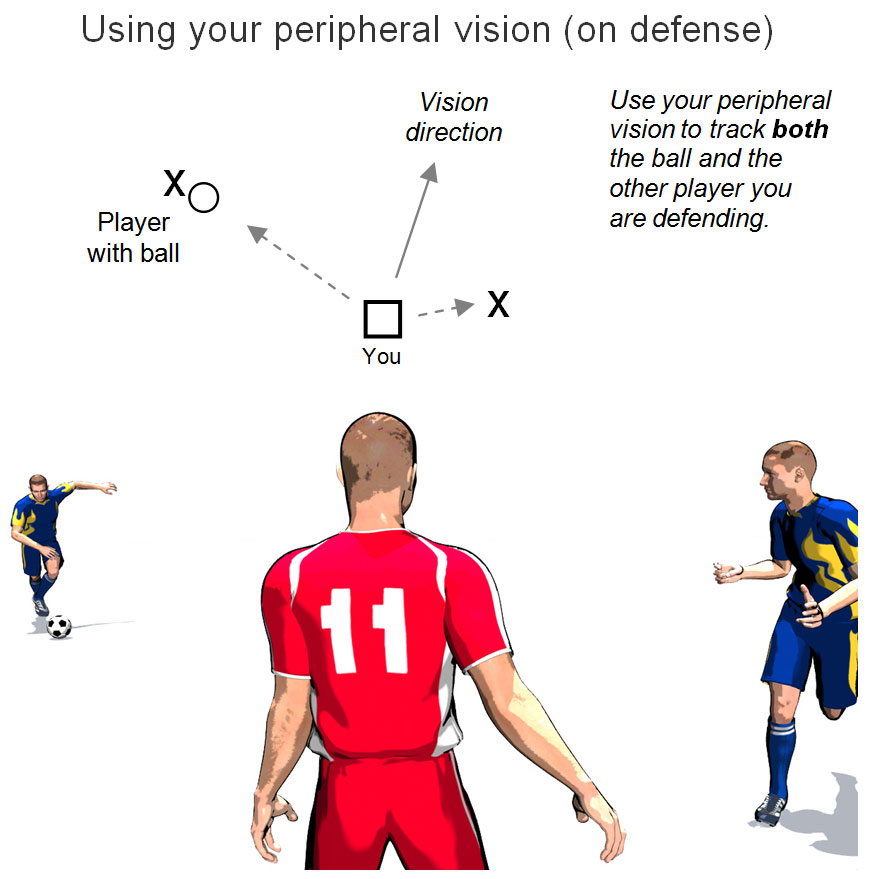
    There are two parts to vision, central (detail) and peripheral (scanning). When someone is said to have “tunnel vision” it means that they are only using the focusing or detail part of their vision. When someone appears to be “staring off in space” they are only using the peripheral part.

    Remember the last time you drove home from town or the barn? Did you suddenly find yourself in your driveway and wonder how you got there?

    Obviously you were watching where you were going so that you made the correct turns to get home but, you were not really aware of it because you were “lost in thought.” The conceptual (pheripheral) part of your vision took over and made sure that you did not get in an accident by scanning the road ahead and informing you if any action needed to be taken. Now think of the last time you drove in heavy traffic or in a snowstorm. Suddenly all of your attention was on the road ahead of you. By the time you got home you were exhausted because you remained super-focused for the entire drive. You were only using the central (detail) part of your vision and not allowing any scanning to occur. Maintaining that kind of focus for hours is exhausting”.

    Why do players have tunnel vision? Is it because of pressure? Is it because of the fear of making mistakes?  When kids play with less pressure they are more relaxed and don’t suffer fear of making mistakes. Fear & pressure can cause players to play with tunnel vision as they are tense and not relaxed. 

    Again this can be transferred to playing sport, Wendy goes on to say:

    “What you will probably observe is that by using Soft Eyes, both you and your horse will find it easier to accomplish the task. It required less effort on your part and your horse was more cooperative. You might also have noticed that your horse was “more forward” because you were creating a space for him to move into by looking out in front of you. Also, you may have found that it was easier to keep your balance because, by looking beyond your horse, your head is more balanced over your seat”.

    “These are two images that can assist you in creating a direction to follow so that your plan takes you through figures in the arena. By allowing yourself to clearly “see” the image in front of you and using your peripheral vision take in your surroundings you can “flow” through the exercise effortlessly rather than struggling and hauling on your horse”.

    “So in this first instance of Soft Eyes vs. Hard Eyes, using your peripheral vision along with your central vision, you are able to have “wide-open eyes and periperhal awareness, and awareness of your entire field of vision.” This allows you to observe your surroundings more like a horse, so that you can “see” the larger picture. As you grasp the larger concept, you can allow the individual pieces to fill in, creating a detailed understanding of the concept. By seeing in this manner you will be able to have a relaxed awareness of your surroundings without anxiety of whether you are going to “get it” or not. This mode takes the stress out of learning process and you no longer have to go into a reactive “flight” mode because you can see what is approaching instead of being surprised because something   “snuck up” on you”.

    “In this regard, one of my corollaries to Hard Eyes vs. Soft Eyes is the concept of Intense vs. Intent.

    When you are intense, things are strained, harsh, overbearing, demanding and unpleasant. The person who is intense is always trying to “make it happen” even when it is clear that it just isn’t right. Kind of like trying to put a square peg in a round hole, the intense person often won’t let go of something until it has been broken or beaten to death”.

    “Intent, on the other hand, implies that you know what you want to accomplish and you don’t feel the need to force it. Someone who is intent is quietly directing the process as it unfolds even if momentarily it seems like it is not going in the desired direction because they know that ultimately the outcome is going to be what they want. The desired result may even change in the short term in order to accomplish the task in the long term. The person with intent will be able to sit back and relax as events occur, observing without reacting. He will alter the program as required make things easier. He will get the peg to ultimately fit in the hole because he put the peg in the right hole”.

    She goes on to say,

    “The person who is intense often does not trust the process and anticipates or attempts to avert perceived failure. Whereas the person who has intent is secure enough to know that they are going to succeed regardless of how long it might take or how much they will have to adapt to the situation. In this regard, when you observe someone who is a “good hand” with a horse, notice that there are several predominant features. The “good hand” remains calm in spite of how the horse is behaving, they quietly, calmly and consistently shape the situation to accomplish the task and they never lose sight of what it is they want the horse to do in the first place. In this way, the “good hand” has clear intent and allows the horse sufficient time to understand what is desired. They assist the horse in the process of learning rather than forcing to horse through the situation”. Again what can we take from this, the player that is calm performs better and makes better decisions. 

    She says, “Having clear intent before approaching your horse gives the horse a sense of security. When you approach the horse lacking confidence the horse will question you and feel unsure. What you get from the horse is exactly what you put out – confusion, fear and poor results. Coming on like gangbusters, full of demands and deadlines can create a highly reactive situation because your goals feel overwhelming to the horse. They are too difficult, not because the task is hard but because the intensity in the approach caused the horse to react instinctively, triggering the “fight or flight” reflex”.

    “A large part of intent is knowing what you want to accomplish before you ever catch your horse. If you are unclear about the outcome then it is virtually impossible to create it. In other words, it is important to have a clear concept of what you are looking for before you begin. According to a Feldenkrais principal (Feldenkrais is a form of body work for humans that develops body awareness and mobility) everything that your body needs to do to perform a task happens when you clearly think about it. So before you ever get out of a chair, the act of thinking about getting out the chair causes your entire nervous system to perform the task on an infinitesimal level so that when you get up everything works properly”.

    Screenshot 2015-11-06 12.55.57

    “So this means that if you want to do something, the clearer you can visualize it the more likely you will be able to achieve the desired outcome because your body has already performed the task. No you can understand why I will not let my students jump a course of fences until they can visualize their lines, turns and jumps in their mind’s eye”.

    “However, not everyone can visualize. So, while visualization is a great way to practice your riding, if you don’t have that skill there are other ways to have clear intent. Intent can be in the form of an image, feeling, thought or sound. In other words, you may know what the feeling is even if you don’t quite know what it looks like. Or it may be that you know what it will sound like when you get there so your intent is to recreate that sound. This is particularly true when uncovering lameness. By listening to the sound of the footfalls on a hard surface you can discover where the problem lies. So while visualization can help in defining your intent, there are other senses that can be involved in the process”.

    Taking Wendy words in a player context: Focus on getting your players use your expanded field of vision in game situations. Use your inner eyes to visualise what you want to do and where you would like to go, while allowing your “outer” vision to encompass all that is around you. In possession encourage the player on the ball to always look long first and you they see short. Getting them to scan their environment ahead. A good exercise to see who is looking all around them is to stop the possession game and ask players to tell you who is behind them, to the left and the right outside of their field of vision. Another one is to play a SSG with no bibs, so both teams have the same colours. One common principal in football for this is to ‘get your head up’ and not be focused on the ball, whilst trying to think one step and making a quick decision early.  Ultimately it’s down to fear. Fear of making mistakes, fear of failure which as we know damages a players mindset and makes them not trust themselves and kills performance.

    Going peripheral with soft eyes is also very helpful in reducing stress, as it promotes a more relaxed, yet attentive, perspective and helps to free our breathing which is often constricted when we are feeling tense. I hope these information helps, it certainly gave me something to think about and answered a lot of what I was searching for.

    Find out more on Wendy’s Facebook page  or Website

    -End

    I always like to hear your opinions and views. If you feel you have something to say, please comment below or email me info@thecoachdiary.com If, you don’t have anything to add then please forward this on to a friend. As always, thanks for reading.

    I’m also on twitter @Coachdiary

  • Irish Based Catalan Elite Football Philosophy

    Irish Based Catalan Elite Football Philosophy

    Catalan Elite Football began this summer in Ireland. Based out of Parnells GAA in Coolock and running every Friday from 7pm to 9pm and catering for kids aged 6 to 14 years.

    Catalan Professional coach Marc Miquel writes about his experiences so far in Ireland, in his own words:

    Introduction
    After four months coaching in Dublin I’ve noticed many differences beetwen Football in the Catalan region and the football that is practiced here in Ireland. I can say that there’s a lot of work to do, its going to be a challenging process in order to reach the targets in which we have set for ourselves.

    “Our focus in Catalan Elite Football is to develop tactical qualities of the players as individuals”

    Our main focus is to change the mentality of Irish people and players both on and off the pitch. We want them to consider said that this process possible for us to develop more intelligent players.

    Our main focus in Spanish and Catalan football is to develop the cognitive qualities of the players, to use the brain in the game. In Ireland from my experience so far, players think about the game a lot less than that of Catalan players. Maybe one of the reasons is the fact that they do not have a professional league with professional players on their doorstep to watch on a weekly basis. For this reason I have found that players need continuous reminding of the concept of training. We hope that we can make a small difference towards this, like our Academy Director says,

    “every process starts with a little change.”

    This process will acquire different methods to make the things, develop the qualities that the smartest players have (based around tactical elements) or start to produce different players.

    “The players do not recognise the training as a training, it is more like going to enjoy time with their friends. They don’t think to improve as a players and as a team in every training, it appears this is the coaches problem”.

    Our focus in Catalan Elite Football is to develop tactical qualities of the players as individuals. The company’s founder, Colm Barron, studied the different football methodologies around Europe and specifically in Futbol Salou and the Tecnifutbol Academy. After meeting with Albert Vinas and studying the smartfootball methodology he decided with the support of Albert to reproduce the methodology in Ireland in the Catalan academy. In one of the last travels he visited Complex Esportiu Futbol Salou where I was working and spoke to both Albert Viñas (Complex boss) and Colm, they decided to give me the chance to help the academy to introduce the Catalan methodology. Our work started there….

    Trainings And Matches
    I’m gonna talk about the general level which we could see in our academy, in different pitches around Dublin and clubs where Catalan Elite Football started to work in (Knocklyon United, St. James Athletic and Park Celtic).

    “When I came to Ireland I imagined strong players with really good physical qualities, showing aggressively to the ball, but they do not! They aren’t aggressive to the ball, it’s hard to see two players fighting powerful for the ball”.

    Like I mentioned above the players do not recognise the training as a training, it is more like going to enjoy time with their friends. They don’t think to improve as a players and as a team in every training, it appears this is the coaches problem. Many of them are parents that find the players enjoyment to be more important, not the learning sense. Of course for us it’s really important that the players enjoy in the sessions, but they have to enjoy learning about the game with the games the coaches purpose. Our thinking is to help the players to develop their qualities within the trainings and out of it, as a player but as a person first. We understand the youth football as a person formation to develop useful skills for their life, trying to instil our passion for the game and the attitude to fight for your dreams and improve every day.

    The training mentality is to play all versus all running behind the ball without thinking anything more. I was surprised because I used small sided games (2v2/3v3…) as a real match in a different pitch size and they don’t understand this game as a match. We are trying to explain to the players that by using these types of games they can reproduce a similar competition game in unreal spaces, but they are going to touch the ball more which will allow them to improve as players.

    To review what I have seen in trainings, players don’t show passion and attitude for the game, and the tactical content is not introduced in the majority of the sessions. These things are some of what make the process harder, the process to understand the game. In order to create smart players, they must make mistakes within the sessions, they have to experience different game situations that they can find in the competition. Trying to reproduce the competition in the training where the players have to use the brain to beat opposite team.

    Related with the previous problem, they don’t have collective sense, team sense, because they play as an individuals inside the squad. If you think as an individual you just want to run closer to the goal to score but will never think as a team, and with this mentality it’s impossible to develop the cognitive element. For this reason there’s a lot of transitions in the games that I watch in Ireland and this seems to be the same in the national teams. The coaches want the ball far from their goal and if the striker is lucky he will get options to score. If not, the other team will try to clear again, for this reason it is rare that any team will control the game.

    What’s the problem if there’s a lot of transitions?

    The problem is that the players lose their positions and nobody is organised. Everybody want a to run with ball and they don’t think where the defenders are, where their mates are, and where is the best space to play. The collective options disappear.

    For the last part in this point I want to talk about the biggest surprise that I received. When I came to Ireland I imagined strong players with really good physical qualities, showing aggressively to the ball, but they do not! They aren’t aggressive to the ball, it’s hard to see two players fighting powerful for the ball. I think they have really good physical qualities which they have to transfer to the game and be aggressive to compete every ball, after that start to introduce technical and tactical elements to become better players.

    More from Miguel in the coming weeks…

    You can follow the Academy on Twitter @catalanelite Facebook at Catalan Elite football
    or straight to their website www.catalanelitefootball.com

    -end

    Part Two

    Competition System
    The competition has to be a part of the formation process for players. This competition needs to a part of both trainings and the games. I find it difficult to understand when parents struggle to accept the opinion on the levels of the players. All around the world in football and life, people are categorised by their current level. The best work with the best to become better, and other who are below that level at the time work harder to become a part of that group. This is soccer all over the world. It does not mean that the player of lesser ability at that time cannot improve past the others, it may just take more time.

    “Of course everybody always wants to win, but it doesn’t have to be the most important. If you lose you have to learn about your mistakes and if you win you should keep working in the elements that you made good”.

    The match day formation has a part of player learning. Practice in the match should be focussed on the work realized during the week. It’s a chance for checking if the players are improving and develop the competitive sense. Competition is a part of sport and players must learn to compete, not just compete to win because this thinking I feel is wrong. They have to use the competition to experience everything that is involved. The opposite pressure, the fans clapping, sharing your passion with the team members, sharing a dressing room, developing the cognitive and creative elements into the game because it’s reproduced in the game as a maximum expression.

    “We have competitive leagues from u8 in Spain. Again this is the real game, there is no problem with competitive leagues from the earliest age, the problem is the environment that surrounds this”.

    In this moment what appears to be the biggest problem is that everybody wants to win without focus in the players formative process. It’s a world problem, but the problem is in the adults not the kids, because the adults alter the kids mind. Of course everybody always wants to win, but it doesn’t have to be the most important. If you lose you have to learn about your mistakes and if you win you should keep working in the elements that you made good.

    The competition in Ireland is difficult to understand, the governing bodies doesn’t have the elements structured and the rules which they play are not really established. For example the youngest kids don’t have league qualification, this is not really important, but it can be used in the right way as feedback for the players and you can introduce different targets in their learnings.

    We have competitive leagues from u8 in Spain. Again this is the real game, there is no problem with competitive leagues from the earliest age, the problem is the environment that surrounds this. If the environment is professional and the parents are educated then there is no problem with this competition, in fact I think it is quite important for young players.

    In Ireland they split the players in four categories, 5, 7, 9 & 11 a –side. I think it’s a good idea for the players development to play in progressive players numbers, but sometimes they play 6v6, 6v5, 11v14 because the difference in the score is huge. The rules in the federation doesn’t seem really clear! Do you think it’s a good decision to create 9-a-side game just for one year (under 12’s)? I think no, because you have to set up one different size pitch just for one year??!! I’m not sure how this fits into the development model for players!

    I have never thought about the offside rule before, now I am thinking about it everyday. I think it’s an essential part of the game because the players must think in the game, if not they just can wait closer to the goal line. Offside is a rule from the earliest age in Catalonia, It’s a nice rule to learn to move into the space, work the defensive line as a team, make the passes in the right tempo with the right weight,… I have heard people say that the youngest players will “not understand” the offside rule. In our Catalan Academy we work with players from aged 6-15 and we introduce the offside rule in any tactical game related sessions of which there are many, and we incorporate offside. Now we have 7 year olds asking “can we play offside”, and they enforce the rule themselves. This is the real game and prepares the players for the real 11-v-11 game.

    The last element I’m going to talk about are the referees. It’s a controversial role in the football world but really important at the same time because the referee has to make decisions about the game. In Ireland, the coaches or parents are the referees in the 5-a-side, other categories have the referee but they don’t exit the sidelines in the youth football. I consider that the referee federation has to be connected with the football federation, to create a competitive and air environment like the structure we have in Spain or around different European countries.

    Marc Miquel
    Catalan Elite Football & Complex Esportiu Futbol Salou
    Cambrils (Barcelona), Spain.

    You can follow the Academy on Twitter @catalanelite Facebook at Catalan Elite football
    or straight to their website www.catalanelitefootball.com

    -end

    I always like to hear your opinions and views. If you feel you have something to say, please comment below or email me info@thecoachdiary.com If, you don’t have anything to add then please forward this on to a friend. As always, thanks for reading.

    I’m also on twitter @Coachdiary

  • Please Don’t Quit

    Please Don’t Quit

    We have all heard the stories of kids quitting. Research suggests that around 70% of children are dropping out of organised sports by the age of 13 and the stats are even higher for girls.

    Many other things contribute to kids leaving sport, but the number one reason is it was no longer FUN!!

    Now fun can be categorised into lots of meanings. It’s still the number 1 reason they leave.

    In a 2014 study for George Washington University, researcher Amanda Visik interviewed numerous athletes and asked them why they played sports, and 9 out of 10 said the 1 reason they played was it was fun…

    They defined fun:

    1. As trying their best,
    2. Being treated respectfully by coaches, parents and teammates,
    3. Getting playing time.

    They listed eighty-one characteristics of fun, and winning (#48), playing tournaments (#63) and practicing with private trainers (#66) did not finish high on the list.

    Here is what kids wanted What kids say is most fun!

    The reason for this post is that I came across and great response from a coach to a child (Chris) age 11 who wanted to quit playing football.

    It’s starts Here > Hello Coach Leath, 

    My dad says I can’t quit my team, but I don’t want to play football anymore. All I do is sit on the bench during the games. What should I do?

    Your Friend,

    Chris, 11

    Dear Chris,

    Congratulations on making the football team. Believe it or not, the first year I tried out for football I did not make the team. I remember how sad I was when the coach read off the names of the kids who would be playing that year. I tried out the next year and sat on the bench during most of the games, only playing a few plays. But I knew I would not play in the games. The other players were bigger and better than I was, so why would coach put me in?

    So, instead of complaining about playing time, I decided to make practice my games. Every Tuesday and Thursday I would prepare for practice as if I was going to be playing a game. I went all out on the scout team, knowing that the harder I was to block in practice, the better my team would do in the game. When they did well in the game, I took pride in knowing I helped them prepare.

    Practice was hard, Chris. I got knocked down, a lot. I was scared, but I tried not to let the other players know how scared I was. Some of the players hit really hard and the noise alone made me want to quit.

    After a few weeks I got better and was less afraid. I made some friends on the team and started to have fun. I still got knocked down, and I wasn’t very good, but I realized what a privilege it was to be on the team. I promised myself I would finish the season and then decide if I wanted to play again.

    Also, I thought I was letting my dad down by not starting. When I told him I was embarrassed because I sat the bench, he told me he was proud that I made the team, and that he loved to watch me go all out in practice. That helped a lot knowing that my dad just loved to watch me practice.

    The next year, you know what? I was one of the best players on the team. I was voted team captain and rarely came out of the game. I am not saying this will happen for you, but I am telling you that in order to be good at something, you have to be okay with being bad at it first. Then you get better. Always aim to get better, no matter what you do in life.

    I want to encourage you to finish the season. You don’t have to play next year, but you should follow through with your commitment and try to have as much fun while you are there. Please don’t quit.

    Stay Curious,

    Coach Leath

    -End

    the noral of the story is never quit, never give up and alsways finish something you’ve started. See it out where at all possible.

    You can check out James Leath blog here and he’s also on Twitter @jamesleath

    I always like to hear your opinions and views. If you feel you have something to say, please comment below or email me info@thecoachdiary.com If, you don’t have anything to add then please forward this on to a friend. As always, thanks for reading.

    I’m also on twitter @Coachdiary

  • Level 1 Coaching with Performance Analysis

    Level 1 Coaching with Performance Analysis

    The course has been tailored for coaches and managers.

    Building on the fundamentals of sports analysis and shaping key performance indicators to demonstrate how analysis can be translated into the coaching process as a highly effective teaching aid to significantly improve player learning and performance.

    “Coaches can only recall around 30% of live performance factors”

    The course includes:

    • What is notational analysis.
    • The rationale for performance analysis.
    • Key factors in player-coach communication techniques.
    • How to develop key performance indicators (KPIs).
    • Introduction to Performa Sports software & creating coaching playlists.
    • €30 credit towards our Level 4 CPPD module in Applied Performance Analysis.

    “LEARN HOW TO SEE MORE, INCREASE LEARNING AND IMPROVE PERFORMANCE THROUGH ANALYSIS”

    When: Monday 12th October

    Where: Croke Park Hotel, Dublin

    Cost: Course fee is €65 per person. 

    “Players who self-analyse increase their learning by over 70%”

    To confirm your place please complete the form below:

    Level 1 Course Booking Form

    Next you will receive a short pre-course survey that will help them prepare for your place.

    For further information contact joe@performancesports.com  or call +44 (0) 771 943 6178

    You can follow them on twitter @performasports

    -end

    I always like to hear your opinions and views. If you feel you have something to say, please comment below or email me info@thecoachdiary.com If, you don’t have anything to add then please forward this on to a friend. As always, thanks for reading.

    I’m also on twitter @Coachdiary

  • Ten rules for parents from 1974

    Ten rules for parents from 1974

    I got this information Glenn Mulcahy and it seems not much has changed in terms of parents involvement in their child’s sport.

    “Ten rules for parents of athletes” below written by Lloyd Percival, a coach in Canada during the 50’s and 60’s who worked with numerous athletes who became national champions or Olympians, He also published “The Hockey Handbook” which is argued by many to be one of the best hockey instructional books ever written published initially in 1951 although he only coached for one season of hockey.

    He credits his wife for the initial groundwork but the final rules he published in the Sport and Fitness Instructor (The Canadian Fitness Institutes monthly journal) in 1974 is a result of his interaction with numerous athletes and their parents during his tenure of coaching over 2 decades including his radio coaching on the Sports College for CBC’s National Radio Program.

    Since he published the ten rules, numerous sports bodies have incorporated variations of same, thought you would appreciate if had seen any of the variations the original ten rules I found posted by the author of Lloyds biography.

    Ten Rules For Parents of Athletes – Lloyd Percival – 1974

    1. Make sure your child knows that win or lose, scared or heroic, you love them, appreciate their efforts and are not disappointed in them.
    2. Try to be completely honest with yourself about your child’s athletic capability, competitive attitude, sportsmanship and actual level of skill.
    3. Be helpful, but don’t “coach” them on the way to the track, diamond or court … on the way back … at breakfast … and so on.
    4. Teach your child to enjoy the thrill of competition, to be “out there trying” to be working to improve their skills and attitudes … to take physical bumps and come back for more.
    5. Try not to re-live your athletic life through your child in a way that it creates pressure; you fumbled too, you lost as well as you won. You were frightened, you backed off at times, and you were not always heroic. Don’t pressure your child because of your pride.
    6. Don’t compete with the coach.
    7. Don’t compare the skill, courage or attitudes of your child with other members of the squad or team, at least in range of him/her hearing
    8. You should also get to know the coach so that you can be assured that their philosophy, attitudes , and ethics and knowledge are such that you are comfortable with them taking a prominent role in the development of your child.
    9. Always remember that children tend to exaggerate, both when praised and when criticized.
    10. Make a point of understanding courage and the fact that it is relative.

    -end

    I always like to hear your opinions and views. If you feel you have something to say, please comment below or email me info@thecoachdiary.com If, you don’t have anything to add then please forward this on to a friend. As always, thanks for reading.

    I’m also on twitter @Coachdiary