Author: The Coach Diary

  • Children First & Child Protection: Is your club compliant?

    Children First & Child Protection: Is your club compliant?


    Almost every day there’s a new article in the Media regarding Tusla, and the Children First Act 2015. It is only a matter of time before all Sports and recreational Organisations come under the spotlight. If a Tusla inspector visited your Club today would you be Compliant? Have you got your housekeeping in order? Unfortunately the answer here is most likely no, as most clubs are unaware of what this means for them and their service.

    On the 11th of December 2017 new statutory obligations were added to the existing Children First Act 2015 (C.F.A.2015) the focus is now on the wider community to recognise, record and report concerns of child neglect and abuse. It is now the legal responsibility of all relevant service providers to prepare and implement a ‘child safeguarding statement’ which must be made available for inspection by Tusla, service users, and the public within 3 months. i.e. 11/3/18. Failure to draft this statement may lead to inclusion on the non- compliance register which is available to all service users and the general public.

    Tusla state that this Child safeguarding statement (CSGS) must be displayed in public within the club and on the clubs website. It is the responsibility of Club officials to ensure that all persons working/volunteering with the club must receive adequate and appropriate Child welfare and protection information and training so that they can recognise key indicators of abuse and neglect.

    Mandated persons working within the organisation or club must be identified under the C.F.A.2015 and also given appropriate training so that they know how to accurately record and report child protection concerns to Tusla. Mandated people include professionals such as GP’S, Nurses, midwives, all medical staff including physio’s, teachers, Gardaí, probation and welfare officers. It is a criminal offence for a mandated person not to report concerns of abuse or neglect.

    A Designated Liaison Person (DLP) must also be appointed with a deputy on hand when the DLP is unavailable. This DLP could replace the former Child welfare/liaison officer and should be known to all members of the club and their parents/guardians.

    For the purpose of this article I googled the websites of 8 well known Dublin soccer clubs and nowhere did I find any evidence of a CSGS, in fact all bar one have no policies displayed on their webpage at all. The one policy available was on team/player selection. While these websites are frequently updated with club news, fixtures and results, adverts ,club shops along with online payment options, The general information relating to the running and workings of the club is stale and outdated if in existence at all. Lists of managers and coaches but rarely a Child welfare officer mentioned, no history of Garda vetting or club policies. Likewise any club I have visited in the past 6 months as a spectator has failed in my search for a copy of their CSGS or DLP. Notice boards are however filled with newspaper cuttings of wins and other club news but again lacking in policies or contact information. On Occasion when I have raised policy issues etc with revelant people in charge, I have been greeted with a very old school attitude… ’Sure the club runs itself’ or ‘we use the FAI policies’. The FAI policies are pertaining to a far bigger organisation and therefore it is incumbent on each club to draft their own policies relating to the running of that club. Among these policies the important ones that should be on display and which Tusla will look for on inspection are the CSGS, Evidence of DLP, Health and safety, Fire safety, Adult/child ratios, Bullying statement and Garda Vetting.

    Garda Vetting is another grey area for many people. It is a criminal offence for any persons who work/volunteer or have access to children not to be vetted. The vetting bureau has a number of compliance officers who carry out unannounced visits to business and organisations to ensure the law is being followed. Non- compliance can carry fines of up to €10,000 and 5 years in prison. Personal/individual vetting is not available in this country at present therefore it is the responsibility of every club to ensure all staff in whatever capacity are vetted. This includes the café staff, the groundsperson, caretakers, cleaners, all personal within the club. If you are a coach, manager or volunteer make sure you are vetted, if you gives lifts to training or matches, if you are the parent who helps out occasionally, the parent who takes the team photos, whatever your role no matter how minimal my advice is ask to get vetted. E Vetting is a painless process with a 5/7 day clearance. The service is free but that piece of paper could be worth its weight in gold. For every club or organisation you are involved in, you must have vetting for each one. Vetting must be renewed every 3 years and while the club may inform you of the renewal it is advisable to keep a track of time yourself in case the admin is not up to date. Protecting children means protecting workers also, by eliminating

    risks and providing them with support will make for a healthier safer club for everyone.

    While I acknowledge and applaud all these men and women who give up their time and commitment to running our clubs and coaching our kids, it is the Duty of care of us all to ensure that the clubs environment is safe, positive and child centred. Vodafone Ireland the main sponsors of Irish rugby use a slogan which is simple, effective and inclusive #teamofus. We should all adopt this mantra so that our clubs become all-inclusive and we are all part of the bigger team. Change will happen if we want it too. I would encourage all parents/guardians next time you are in your club ask to see the ‘child safeguarding statement’ enquire who the Designated Liaison person is and inform your kids, Find out if the manager/coaches training your child are garda vetted. You pay the fees you are entitled to these answers to know your child’s needs are being meet in every way. If you are fobbed off, refer them to this article or to the Tusla website.

    Our goal as Parents, Educators and Trainers should be to raise children who don’t have to recover from their childhood, this in a small part may help atone for the previous decades of horrible abuse and brutalities inflicted on our forefathers.

    Tusla offer a free E-learning programme. ‘An introduction to children first’ it takes approximately 1.5 hrs to complete, once registered you do not need to complete in one sitting. A certificate is issued on completion. It is a valuable source of information and I would recommend anyone with any contact with children to take the time and inform yourself.

    START Children First E-Learning course NOW

    This article was written by Helen Kelly – Child Protection Expert

    -End

    I always like to hear your opinions and views. If you feel you have something to say, please comment below or email me info@thecoachdiary.com If, you don’t have anything to add then please forward this on to a friend. As always, thanks for reading.

    I’m also on twitter @Coachdiary and @LetTheKidPlay

  • Football ‘tug of war’: When choosing means losing.

    Football ‘tug of war’: When choosing means losing.

    A tweet from Carlow GAA made headlines last week when it outlined the ultimatum issued to the Carlow/Kilkenny u15 football (soccer!) players regarding the inflexibility towards playing both football codes. The purpose of this piece isn’t to analyse that decision but instead to focus the discussion on the implication of a similar action if it is replicated for the new u13 National League, players being asked to specialise in one football code at age 11/12. The league is starting so the focus of this piece isn’t to argue for/against it but to start a conversation about best practice when it does, with a particular focus on early specialisation.

    What are our youth footballers playing?

    Whether either organisation like it or not, we have a very limited pool of players from which to engage in our sports. A scarcity of resources (in this case, players) can often fuel a hoovering up of youth for the purpose of discouraging them to play other sports and/or a fear of losing out on players, with various codes attempting to do the same it can lead to a ‘race to the bottom’ [1] where organisations/clubs attempt to identify ‘talent’ at an increasingly earlier age.

    The irony is that we often admire cross-sport attributes at senior level, when Niall Quinn saved a penalty for Man City in 1991 we lauded his GAA background, people from Louth discuss Rob Kearney’s fielding skills in rugby as being honed during his days playing GAA for Cooley Kickhams. Yet there is often a culture of distrust between organisations and feelings of ‘ownership’ and exclusivity over players at under-age level.

    Follow link to author Laura Finnegan to continue reading the rest of her piece:  https://talentdevelopmentinirishfootball.com/2018/03/04/football-tug-of-war-when-choosing-means-losing/


    -End

    I always like to hear your opinions and views. If you feel you have something to say, please comment below or email me info@thecoachdiary.com If, you don’t have anything to add then please forward this on to a friend. As always, thanks for reading.

    I’m also on twitter @Coachdiary and @LetTheKidPlay

  • To be or not to be, it’s all down to you!

    To be or not to be, it’s all down to you!

    You don’t send a player to the a professional academy to finish of their development. Going their they should already have Professional Habits. All the best players in the world, have these habits. They have a level of hard-work and commitment that is required to get to the elite level (paid to play). I listen to parents and players all the time saying they want to go to a pro academy to be a professional footballer but they aren’t even close to the commitment and lifestyle change required to even get noticed. 
     
    They say, “My kid is talented”. 
     
    I ask them,
    ok, so he’s talented….. “what is he doing to try and achieve this the level required to play in a pro academy?”
    If they don’t already have self managing skills and professional habits, then the professional club will probably be too much for them. We see this all the time, young players going over to the UK and coming back because they can’t handle what it takes to be stay in with the very best or to even perform at the Elite level (Paid to play I’m talking about).
     
    Along with having the talent to play….the player must also have responsibility, accountability, self management, drive, commitment, attitude and belief.
     
    Questions to can ask any teenage player looking to have a career in the game: 
    1. Did you get enough sleep or are you getting enough sleep before and after games or practice.
    2. Did you have a nutritious breakfast and did you prepare it yourself?
    3. Did you pack you’re own bag or did you mum do it?
    4. Are you drinking enough water and eating the right foods every day?
    5. Do you get to training early to start you’re warm up, dynamic stretching etc etc?
    6. Do you ask the coach to show up early to help you practice on some specific areas of the game to help you be fully prepared for the game or practice?
    7. Do you ever run home from practice to get an extra bit of fitness training in?
    8. Do you pack any half-time snacks, to help you recover?
    9. Do you pack any after game/practice snacks to help you recover.
    10. Do you ever stay back and do some extra technique training or do you ask the coach to help out after training?
    11. Do you ask the coach what you need to do to get better and are you using this advice?
    12. Do you ever ask other teams at the club if they are stuck for a player and if so to call you? (Messi played for the 1st, 2nd and 3rd teams at Barca).
    All of above are some of the behaviours you will find in players who have made it to professional academies. If a player is not showing any of the above then they do not have the passion, drive or commitment to be outstanding. So moving your kid to the best team or travelling half the country to get them playing at the best level, will not make them better.  The player must decide that this is what they want to do. They must have the commitment, desire to be the best in everything they do and it starts with answering YES to most of the above. 
    Facilities, money and equipment won’t make you successful. The commitment, being 100% committed and being obsessive about what you do and how you train, what you eat and how prepared you are, might..
    They need to be obsessive about getting better, 1% every time they play and train. Getting the most of there talent in every part of their preparation, to be the best they can be. That is what is required and more and then you need a lot of luck, the correct amount of nurture and nature will also have a say.
    So much of the success you want as a coach and your players want, is down to your coaching and guidance. This all happens with change and connections. Coaching is the art of emotional connection. We are in the business of making dreams but we need to be realistic with our players. Unless they are stepping outside of the norm they are unlikely to see that dream come through.

    -End

    I always like to hear your opinions and views. If you feel you have something to say, please comment below or email me info@thecoachdiary.com If, you don’t have anything to add then please forward this on to a friend. As always, thanks for reading.

    I’m also on twitter @Coachdiary and @LetTheKidPlay

  • u8s trials… The race to the bottom!

    u8s trials… The race to the bottom!

    This weekend clubs are holding u8 trials for 2010 kids who are starting fixtures January 2018.

    My question to all those clubs is, why are you holding “trials” if you already have kids in your academy who all believe they will be the make-up of the u8s team for 2018?

    Why are we grading children at age 8, you cannot predict at age 8 if a child is going to be good enough to go to the UK at u16s because let’s be honest thats why we are grading in the first place.

    Are you going to be telling the kids who have been with you for 2 years, that they are no longer welcome? Sorry,  but we have another u8s who is better. How ridiculous does that sound.

    This is a quote taken from Rovers Website, which is just utter nonsense saying you have 220 ELITE players from 8 to 19. u8s and so on are not Elite players.

    “The Shamrock Rovers Academy is the first professional youth academy in the history of Ireland with 220 elite players between the age of 8 and 19”

    This is a great image taken from Footblogball.wordpress site by Mark O’Sullivan. He uses this Parent Education Workshops. He say, “Though, for me the real value is within the discussions that emerge as the material is absorbed”

    “As many as possible, as long as possible in the best environment possible”

    In his article he makes two points about the club, the children and the parents:

    • This is a club for children, young players and their parents. Without parent support and involvement there is simply no club. We understand the importance of parents engaging themselves in the club. Therefore, it is vital that the club provides the parents with a clear and transparent picture as to how the club operates.
    • If we only see children as players, then we will view the family separate from the club. By this we mean that the family is expected to do its job and leave the football education solely to the club. If the club sees the young players as children, then it is possible to see both family and club as partners in the child’s learning and development. 
    • The coach and the parent are often the same person in many grassroots clubs
    You can read his article here, i'd highly recommend it for anyone involved with coaching children:  https://footblogball.wordpress.com/2017/01/25/the-race-to-the-bottom-adventures-in-early-and-earlier-talent-id/

    Finally with the season just over, I’ve heard from lots of coaches who are not happy about clubs now holding trials a week after the season has finished. We have just finished a long year of football and holding trials now is just extending it even longer.

    As always would love to hear your views?

    -End

    I always like to hear your opinions and views. If you feel you have something to say, please comment below or email me info@thecoachdiary.com If, you don’t have anything to add then please forward this on to a friend. As always, thanks for reading.

    I’m also on twitter @Coachdiary and @LetTheKidPlay

  • SWANSEA CITY’S ACADEMY WILL HOST AN EDUCATION EVENT FOR COACHES IN IRELAND THIS DECEMBER.

    SWANSEA CITY’S ACADEMY WILL HOST AN EDUCATION EVENT FOR COACHES IN IRELAND THIS DECEMBER.

    A team of Swansea City coaches, led by Swansea City’s Head of Academy – Roy Thomas and Ireland Coordinator – Aaron McNeill, will deliver presentations and practical sessions on our foundation and youth development phase at the club.

    Places on the event cost £40 per coach and will include lunch, refreshments and a certificate of attendance.

    CLICK HERE to book your place.

    Bookings close on Thursday 30th November.

    This event has been awarded 5 external CPD points for coaches who hold UEFA licences with the Irish Football Association (IFA).

    List of Swansea City Academy Coaches attending:

    Roy Thomas – Head of Academy Coaching & Coach Educator
    Andrew Sparkes – Head of Academy Goalkeeping
    Ollie Jefferies – Foundation Phase Academy Coach
    Harry Spratley – Academy Analyst
    Aaron McNeill – Ireland Coordinator

    Further details:

    Day: Sunday 3rd December 2017
    Location: Pavilion, Stormont Estate, Belfast BT4 3TA
    Time: 10-5pm
    Cost: £40 per coach (includes tea/coffee, light lunch and certificate of attendance)

    For further details please contact – aaronmcneill@swanseacity.com

    -End

    I always like to hear your opinions and views. If you feel you have something to say, please comment below or email me info@thecoachdiary.com If, you don’t have anything to add then please forward this on to a friend. As always, thanks for reading.

    I’m also on twitter @Coachdiary and @LetTheKidPlay

  • Coaching with Performance Analysis Module, Mon 9th Oct 2017

    Coaching with Performance Analysis Module, Mon 9th Oct 2017

    Designed by Ulster University and Performa Sports, this short course has been tailored for coaches and managers. Building on the fundamentals of sports analysis including shaping key performance indicators (KPIs), they demonstrate how analysis can be used as a highly effective teaching aid to improve player learning and performance.

    Who is the module for?

    • Coaches, Managers, Coach-Analysts, PE Teachers and those interested in the area of performance improvement through analysis
    • Performance Analysts who are interested in learning more about the transition of analysis to coaching and performance communication

    What will I gain?

    Venue details

    • Location: Croke Park Hotel
    • Where to meet: Main reception
    • Parking: Complimentary hotel car parking

    What to bring

    If you have access to an iPad, download Performa Sports from the App Store and register your free 21-day trial, please bring this with you. Training iPads will also be available if required.

    Course outline

    • What is notational analysis
    • The rationale for performance analysis
    • Key factors in player-coach communication techniques
    • How to develop key performance indicators
    • Using performance analysis software – Performa Sports

    For further information contact joe@performancesports.com  or call +44 (0) 771 943 6178

    www.performaSports.com and www.youtube.com/performasports

    -End

    I always like to hear your opinions and views. If you feel you have something to say, please comment below or email me info@thecoachdiary.com If, you don’t have anything to add then please forward this on to a friend. As always, thanks for reading.

    I’m also on twitter @Coachdiary

  • Where you are born matters for football development…

    Where you are born matters for football development…

    This is the second part of a study conducted by: Laura Finnegan O’Halloran a Lecturer in Sport Management and Talent Development in Waterford I.T, MA in Sport Psychology and currently undertaking a PhD on organisational structure and practice in Irish football (with Liverpool John Moores University).

    Laura has done this study in partnership with Liverpool John Moore University with Dave Richardson, Martin Littlewood and Mark Nesti. All of which have significant experience in youth development and identifying and managing critical transitions within youth football. 

    What influences what we play?

    Lots of sociological and environmental factors influence what and how we play, all worthy of a blog in themselves (e.g. culture, environmental issues, what your parents/family played, socioeconomic factors, peer influence, gender, ethnicity, education)…all in good time. Place of birth is another factor that can influence not only what we play but how likely we are to succeed in that sport. As in the example above, where you are born can dictate what sportyou’re likely to play (it will generally be the sport that’s valued in that setting, your school values it and wants to succeed in it so resources are found for it, clubs have a stronghold in the community, your parents/extended family/local role-models played it (often down to the specific position you want to play… I’m looking at you goal-keepers from Donegal!!) and can influence how successful you are (and organically drive these ‘hothouses’ of talent development, like the Skibereen rowers or NI golfers).
    Studies have looked at the birth place of professional athletes, analyzing athletes according to whether they were from large cities right down to those being from small rural areas. Those that were from small cities were most likely to make it into the professional game, but results depended on the context. There seems to be a sweet spot of the ideal size of a development area, where there are enough quality coaches, resources, teams, structures and opponents, balanced with being compact enough to develop relationships/socialise into particular sports, allow for informal play on streets/green areas, get enough game time and not be overlooked in favour of a larger cohort of earlier maturing players (see more about the Relative age Effect here https://talentdevelopmentinirishfootball.com/2017/06/27/relative-age-effect-in-irish-elite-youth-football/).

    What does this have to do with Irish football?

    density & crest

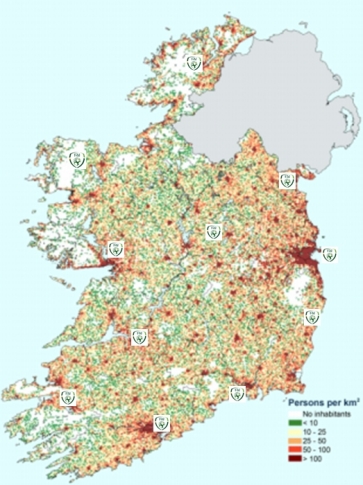
    Map of Ireland, showing population densities with FAI ETP centre locations

    For those not familiar with Irish football, the Emerging Talent Programme is the primary talent development mechanism run by the governing body for football in the Republic of Ireland, the FAI. It has undergone some restructuring lately but at the time of research it consisted of 12 centres countrywide, where the players identified as most talented in the surrounding 32 leagues combine for extra training. The location of these centres can be seen by the FAI badges plotted on the map, along with the population density of the country.

    I’ve looked at the county of birth for all of the ETP players over a 6 year period and analysed how likely you are to get onto the programme (compared to the relative populations). In the below map, the darker the county colour, the more likely a player is to make the ETP programme (ranging from A counties down to the more poorly represented E counties in white).

    We are delighted to be able to blog her research and share it with you: You can read the rest of Laura’s article by going directly to her website Talent Development In Irish Football

    -end

    I always like to hear your opinions and views. If you feel you have something to say, please comment below or email me info@thecoachdiary.com If, you don’t have anything to add then please forward this on to a friend. As always, thanks for reading.

    I’m also on twitter @Coachdiary and @LetTheKidPlay