Blog

  • What Are Calories?

    What Are Calories?

    When people talk about the calories in food, what do they mean? A calorie is a unit of measurement — but it doesn’t measure weight or length. A calorie is a unit of energy. When you hear something contains 100 calories, it’s a way of describing how much energy your body could get from eating or drinking it.

    Are Calories Bad for You?

    Calories aren’t bad for you. Your body needs calories for energy. But eating too many calories — and not burning enough of them off through activity — can lead to weight gain. (have you noticed how much you child eats versus how much energy they burn?)

    Most foods and drinks contain calories. Some foods, such as lettuce, contain few calories (1 cup of shredded lettuce has less than 10 calories). Other foods, like peanuts, contain a lot of calories (½ cup of peanuts has 427 calories).

    You can find out how many calories are in a food by looking at the nutrition facts label. The label also will describe the components of the food — how many grams of carbohydrate, protein, and fat it contains.

    Here’s how many calories are in 1 gram of each:

    • carbohydrate — 4 calories
    • protein — 4 calories
    • fat — 9 calories

    That means if you know how many grams of each one are in a food, you can calculate the total calories. You would multiply the number of grams by the number of calories in a gram of that food component. For example, if a serving of potato chips (about 20 chips) has 10 grams of fat, 90 calories are from fat. That’s 10 grams x 9 calories per gram.

    Kids can benefit too

    Some people watch their calories if they are trying to lose weight. Most kids don’t need to do this, but all kids can benefit from eating a healthy, balanced diet that includes the right number of calories — not too many, not too few. But how do you know how many calories you need?

    How Many Calories Do Kids Need?

    Kids come in all sizes and each person’s body burns energy (calories) at different rates, so there isn’t one perfect number of calories that a kid should eat.

    But there is a recommended range for most school-age kids: 1,600 to 2,500 per day.

    When they reach puberty, girls need more calories than before but they tend to need fewer calories than boys. As boys enter puberty, they will need as many as 2,500 to 3,000 calories per day. But whether they are girls or boys, kids who are active and move around a lot will need more calories than kids who don’t.

    Most kids don’t have to worry

    about not getting enough calories because the body — and feelings of hunger — help regulate how many calories a person eats. But kids with certain medical problems may need to make sure they eat enough calories. Kids with cystic fibrosis, for instance, have to eat high-calorie foods because their bodies have trouble absorbing the nutrients and energy from food.

    Kids who are overweight might have to make sure they don’t eat too many calories. (Only your doctor can say if you are overweight, so check with him or her if you’re concerned. And never go on a diet without talking to your doctor!)

    If you eat more calories than your body needs, the leftover calories are converted to fat. Too much fat can lead to health problems. Often, kids who are overweight can start by avoiding high-calorie foods, such as sugary drinks, sweets, and fast food, and by eating a healthy, balanced diet. Exercising and playing are really important, too, because activity burns calories.

    How the Body Uses Calories

    Some people mistakenly believe they have to burn off all the calories they eat or they will gain weight. This isn’t true. Your body needs some calories just to operate — to keep your heart beating and your lungs breathing. As a kid, your body also needs calories from a variety of foods to grow and develop. And you burn off some calories without even thinking about it — by walking your dog or making your bed.

    But it is a great idea to play and be active for at least 1 hour and up to several hours a day. That means time spent playing sports, just running around outside, or riding your bike. It all adds up. Being active every day keeps your body strong and can help you maintain a healthy weight.

    Watching TV and playing video games won’t burn many calories at all, which is why you should try to limit those activities to 1 to 2 hours per day. A person burns only about 1 calorie per minute while watching TV, about the same as sleeping!

    Reviewed by: Mary L. Gavin, MD – Pediatrician

  • Enjoy the football this weekend KIDS!

    Enjoy the football this weekend KIDS!

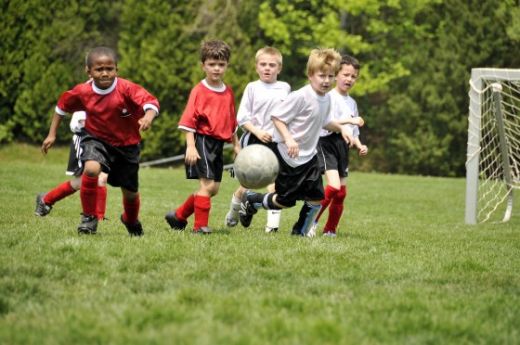
    Firstly best of luck to all the kids (kids means anyone u18s) playing this weekend. I hope they all get to play and enjoy this recreational sport!

    Could you imagine an under 8s/9s/10s etc game on a Saturday where we just let the kids play and didn’t shout at them every time a player touched the ball. Why do we get so caught up in a kids game, where the only thing at stake is a few points! Only 1 team can win the league….so why put some much pressure on these young kids and expect them to play like the pro’s

    How many games, did you win….who cares!

    I mean, do you actually remember how many games you won as a kid?, I certainly dont and I can assure you that all kids playing on a Saturday and Sunday don’t either, in fact they forget soon after the final whistle  and sometimes quicker, all depends on how long their parent goes on about how “they should have done this or that”.

    Its time we just “let the kids play”, its time to stop all this competitive football at under age, its wrong and all its doing is giving the parents and coaches satisfaction, its not good for the game, its certainly not good for players development.

    Lets change this now, for once lets follow structures that actually work and will benefit the Kids & the game in the long run. In work in Europe and in South America they produce vast about of technically gifted kids by allowing the kids to think for themselves whilst providing age appropriate coaching in a safe environment.

    Can our kids not be competitive?

    Non Competitive doesn’t mean the kids can’t be competitive, they always will and that will never change. Its means coaches and parents have nothing to play for, no league, no points; which means the kids can play and enjoy the game without being shouting at every-time they touch the ball! Parents and coaches can sit back and enjoy the game because that’s all it is….and a kids game at that!

    In the meantime whilst we push for Non Competitive at certain ages, age appropriate games, goals and balls…try and sit back and enjoy the experience of watching your child play. So when you start you pitch side prowling and barking this weekend, think about how this is effecting the kids in a negative way! It’s best to say nothing and don’t allow a certain few to control the line. The only voices that should be heard are the kids.

    “you don’t shout over your kids teacher at school, so why shout over your child football coach”

  • Manchester Bound

    Manchester Bound

    Last June we organised a Golf Classic with Man U and Liverpool legends to raise much needed awareness for Dyspraxia Ireland. The funds raised that night went towards bringing The Football for all kids to Manchester and this morning they set off for Old Trafford. The kids will spend 3 days in Manchester, where they will be coached by Manchester United Coaches and spend some time at the cliff. They will also take in a premiership game.

    Wishing all the kids a great time and fairplay to DB Sports Tours and Dyspraxia Ireland for organising the trip of a lifetime!

    The Football for all Logo belongs to the FFA campaign in Scotland

  • My Radio Debut on 2fm

    My Radio Debut on 2fm

    This Saturday 27th August I make my radio debut on 2fm Ballbusters, doing a slot discussing European Football. Tune in from 12 to 2pm every Saturday. The show is presented by Andrew O’Connor and Fiona Looney assisted by Diarmuid Byrne. I have to say I am very excited about this!!!

  • The Irish Sun – Coaching Section

    The Irish Sun – Coaching Section

    The Irish Sun are starting a coaching section in Saturdays Paper you will find it in the GOALS section. They hope to focus on Youth Development and keep readers and coaches up to date with events and coaching seminars. UEFA B coach Gavin Fleming is the man pushing the Coaching column.

  • Wim Koevermans FREE Session

    Wim Koevermans FREE Session

    Wim Koevermans doing a session tomorrow night. Details below

    Presentation: Wim Koevermans

    Date: Monday 22nd August – 7.00pm – 9.00pm

    Registration: 6.30pm Sharp

    Venue: Oscar Traynor Coaching Development Centre

    Session: Technical warm up, Functional Practices, Phases of play leading into 11v11 all relating to the 4.3.3 shape

    Please note that there is no charge for this event

    If you have any queries regarding the event please contact John Farrell for information on 0866860415 or NDSL 01-8488802

  • Tip….

    Tip….

    let the kids be the decider of who wins and who loses; all kids want to win, all kids are competitive…..Kids learn by doing, not just by listening, and they learn by being spontaneous, creative and by taking chance. Thus, training and games do not serve children’s needs if they discourage those natural instincts and create fears about making mistakes.

    “Winning isn’t everything, but the will to win is everything.”

    “If you’re not making mistakes, you’re not taking risks, and that means you’re not going anywhere. The key is to make mistakes faster than the competition, so you have more changes to learn and win.”