Month: October 2014

  • The Future Of Learning

    The Future Of Learning

    What is going to be the future of learning? Could you imagine a future where kids didn’t go to school, read books and learn to write! The way we teach is changing.

    This is an inspiring talk by Dr. Sugata Mitra, towards the middle of the talk he refers to the threat of learning and refers to neuroscience studies about the reptilian part of our brain which sits in the center of the Brain.

    He says,

    “When it’s threaten it shuts down everything else, it shuts down the prefrontal cortex the parts which learn. It shuts all of that down. Punishment and examination are seen as threats”

    I’ll let you listen to the rest of the talk below: talk by Dr. Sugata Mitra

    “It’s not about making learning happen, it’s about letting it happen”

    Here is a counter argument by Martin Robinson 

    -End

    See also : Every Kids Needs A Champion 

    I always like to hear your opinions and views. If you feel you have something to say, please comment below or email me info@thecoachdiary.com and if you don’t have anything to add, please pass this on to a friend.

    As always, thanks for reading. I’m also on twitter  @Coachdiary

  • COACHTALK: Johnny McKinstry

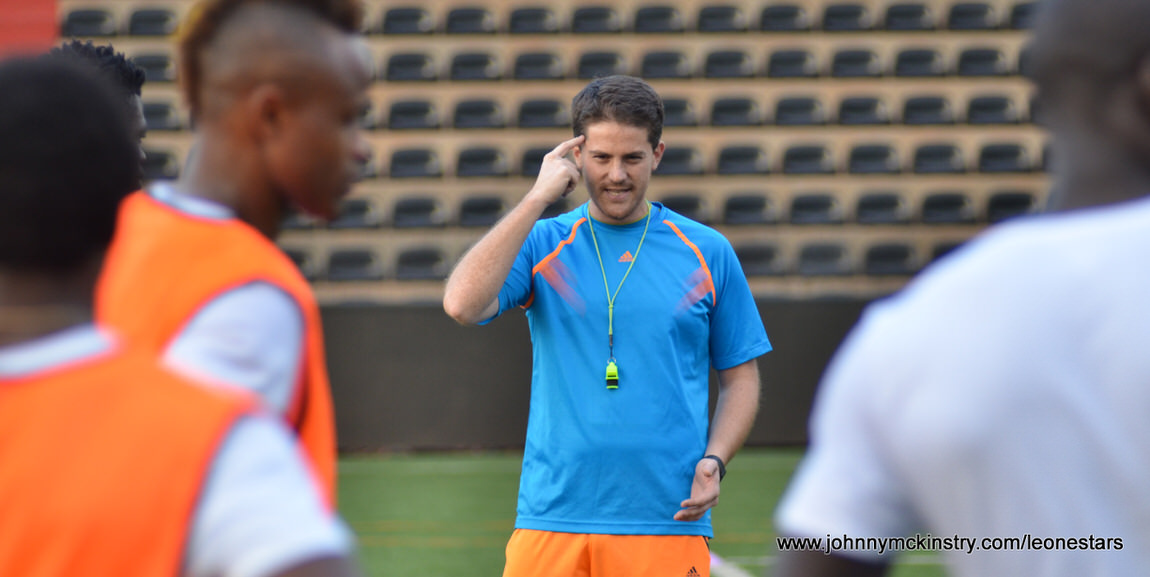
    COACHTALK: Johnny McKinstry

    Johnny is qualified at the highest level in Europe and America, holding  an Academy Managers’ Licence (English FA); Premier Diploma (NSCAA); and UEFA ‘A’ Coaching Licence (IFA) as well as a range of other academic and professional qualifications.

    He was Head Coach of the Sierra Leone National Men’s Football team from April 2013 – September 2014, at that time the youngest active Head Coach in international football (at only 27 years of age). He has achieved an awful lot and already has had extensive experience of coaching in Europe, North America and Africa.

    TCD: Did you play football when you were younger? 

    JM: Yes, growing up I played football along with a variety of other sports (Rugby, Cricket, Squash), but football was always my real passion.  Unfortunately I was not to go on to be one of the great Irish players of our generation – whilst I could play the game it was never a genuine prospect for me in terms of progressing into the professional ranks.

    TCD: When did you know that you wanted a career in coaching? 

    JM:  Football has always been a real passion for me and I have always felt I understood the game.  Growing up I could see patterns within the game and even as a kid playing I had opinions on how I thought my team mates and I should play, and on occasion would let the coach know those opinions.  When I accepted that the likelihood of becoming a professional player was not realistic, I was intent on having a role within the game and from a very early age, maybe around 16, I developed a firm belief that I could help make other players better.

    “Football is the most accessible game in the world. A ball (or something similar) and goal posts (or something similar) and you’ve got yourself a game” – J Mc

    TCD: What is your football philosophy? 

    • “Recruit & Develop of World Class People”……good people will do all within their power to not let you or their team-mates down. Therefore is we want to create a world class team, then we should invest time in recruiting and developing world class people
    • “Your Most Important Player is the one with the Ball at their Feet”……if we accept that every player can win the game for our team…to score the winning goal or to make a game changing tackle, then it will affect how we coach our athletes.  Think back to Tony Adams’ championship sealing goal for Arsenal against Everton.  Have we equipped our central defenders with the skill and composure to do that?  If that answer is no, then I think we need to ask ourselves why?
    • “Send Them to Work with a Full ToolBox”……you would not ask a mechanic to fix your car if they did not possess the correct tools in which to do so.  If we did, we would expect that something would go wrong eventually.  Yet we often rush pass the opportunity to equip our players with the correct skills (tools) in order to perform their roles on the field.  If we do this then how can we criticise when things go wrong.  We need to spend time in ensuring that all of our players are able to perform the wide range of skills required to succeed within the game
    • “They have to answer the question by themselves”……too often I see what I term ‘playstation coaches’ on the sidelines (at both junior and professional level) who constantly instruct from the bench, telling the players the decisions they should be making.  I firmly believe that we should structure our training programs to encourage decision making as often as possible.  Players must be able to play the situation they are presented with, and they often must do so within a split-second.  We have given them the tools to use, now we must give them the capacity to select when and how to use them.  This is no different that a student having worked with their teacher all year, and then sitting their examinations. Once they are to be tested, they have to do it for themselves.

    The above represent some of the key components of my beliefs about the game and how to develop winning teams and world class athletes.

    TCD: In your view what are the key traits of a modern coach? 

    JM:  I think that the modern coach must be extremely knowledgable in so many different aspects of the game.  That is not to say that they must micro-manage all areas.  At the top level we have analysts, nutritionists, sport scientists, various forms of coaching staff.  They all have their jobs and should be allowed to do them; but the coach must have an appreciation of each area.  By doing so it better places them to make the correct decisions for their athletes.  I also believe the modern coach should be very approachable for their players. That is not to say they are ‘one of the gang’. Not at all. But players should feel comfortable communicating with the coach, and discussing ideas, because after all it is they who are playing the game.  It is important that a coach realises that players need to be part of the process.

    TCD: Have you any mentors? 

    JM:  Over the years I have been fortunate to take guidance from a number of experienced coaches within the game.  That is not to say they have been the recognised names that people will see in the media; but having been part of coach education in Northern Ireland, England and the USA I have crossed paths with a great numbers of coaches who have a wide variety of experiences within the game.  The great thing about meeting colleagues in such environments is that everyone is very open about sharing their experiences, and that in turn helps you to refine your own view of the game whilst at the same time putting across your own opinions.

    TCD: You have travelled the world coaching, working with different cultures. How do these cultures (players) differ in terms of teaching the game? 

    JM:  First of all it is important to acknowledge that there is good quality everywhere.  I have been fortunate to work with elite level young players in the UK, USA and Africa; and being honest, on a technical level there is not too much difference between the very best in my experience.  You do of course get some environmental differences.  In Africa the young players tend to be very driven.  The game means so much to them as success will not only vastly alter their own lives, but also the lives of their families and communities.  So you can imagine the work rate that is often apparent at Academy level in Africa.  On the other side of this coin, I would say that tactical understanding tends to be more developed in European and American countries.  This is largely down to players exposure to the game on TV and live.  You don’t have to go far these days to have the nuances of the game explained via football review shows with the likes of Gary Neville.  This means players come to training with a base level of understanding for you to build on.  In Africa and the worlds developing nations this education is more firmly routed on the training pitch and a key responsibility of the coach.

    TCD: 4 years in what some might say is a remote part of the world must be a huge challenge, how did you end up in Africa? 

    JM:  An interesting opportunity was presented to me to put it plainly.  I was working with the New York Red Bulls back in 2009 and I got a phone call from someone I knew who wanted to put me together with the people setting up a football academy in Sierra Leone.  It just peaked my interest.  I have always sought out challenges in life, and I viewed the opportunity here in Sierra Leone as just that.  I also saw it as an opportunity to have a significant impact on football in a country that I knew would be football crazy. It was definitely a good decision.

    TCD: Is African football evolving and if so in what way? 

    JM:  Yes, I believe it is.  One of the biggest drawbacks in Africa has often been the tactical development of the game.  Technique and fitness have never really been an issue; but through the lack of exposure to the global game through TV etc, the tactical level was somewhat lacking.  However through an increased access to watching the game from all over the planet, young players in Africa are able to see exactly what their peers in the rest of the world see.  The great teams and players  and the way the game is played.  Exposure to things like this naturally have a knock on effect of their understanding of the game.

    “My ambition has always been to coach at the highest level – the Premier League, the Bundesliga, La Liga, Serie A”.

    TCD: Do kids still play on the streets or is gaming etc a factor also? 

    JM:  Yes, absolutely.  Football is the most accessible game in the world. A ball (or something similar) and goal posts (or something similar) and you’ve got yourself a game.  Kids do have access to computer games through local gaming centres, but this costs a small amount of money so is only an occasional thing for most.  It is very common to see people of all ages playing football in the street and on bits of waste land.

    JMCK 2TCD: Not many people coach an international team at 27, how did you end up coaching Sierra Leone? 

    JM:  At the time the post of National Team Coach became available I had been living and working in Sierra Leone for over three years.  I had watched the Leone Stars regularly during that period, and I had a real belief that if I could get in the room with the decision makers at that time, that I would be a strong candidate for the job.  I had my UEFA ‘A’ licence, I had worked all over the world, and I knew the game.

    We arranged a meeting and in the two days leading up to it I watched the last couple of Sierra Leone games, as well as video of Tunisia (our next opponents) several times over and put together a presentation and dossier on how I would develop the team and how we would go about winning the upcoming game.  No detail was left out….it was very thorough.  Between my presentation and interview, the association decided that I was the right man for the job and two days later was invited back in to agree terms,

    TCD: You left that role in September, what are you doing now? 

    JM:   As I have said, my time working here in Sierra Leone extends back further than the National Team…almost 5 years now.  Since 2010 I have managed a football academy located about an hour outside the capital city of Freetown where we work with the countries best young talent between the ages of 11 and 18, offering them around 12 hours training per week as well as full time education working towards their international GCSE.  During my time with the National team I combined both the roles, so now that my time with the Sierra Leone team has come to an end I am concentrating entirely on the next generation of players once again.

    TCD: You’ve achieved a lot for such a young person, what has been your best achievement to date? 

    JM:  Taking Sierra Leone into the top 50 of the FIFA World rankings was a great achievement.  That set a new record high for us as a country, and on a personal note placed us above both Northern Ireland and the Republic of Ireland which made me smile somewhat.  I think however the moment that meant the most to me was seeing one of my young academy players here in Sierra Leone make his debut for the u20 National Team.  Having only just turned 17 we had worked together for 4 years, and he was the youngest player on the pitch that afternoon.  I felt very proud that day.  I still do.

    TCD: Whats the plan for the future, how long will you stay in Africa

    JM:  It’s hard to say.  A football life often entails not knowing what is around the corner.  For me, I am happy to be working with the excellent young players we have here at the Academy, but you are always keeping an eye out for potential new challenges and opportunities.  6 years ago living in New York I could not have foreseen how the next half-decade would have developed; but it has been excellent.  I hope the years to come will bring equal amounts of opportunity and enjoyment.  Wherever I go next I am sure it will be a challenge, as I seem to enjoy those….it always seems more fun when you can upset the odds.  For now, I am eager to get moving on completing the UEFA Pro Licence, and I am currently in the middle of a MSc degree in Performance Coaching. So plenty of learning going on in preparation for anything that should come along.

    TCD: Whats the dream? 

    JM:  My ambition has always been to coach at the highest level – the Premier League, the Bundesliga, La Liga, Serie A.  I want to achieve something in those leagues.  Not just to work in them, but to achieve success.  That is what this game is about ultimately – winning.  I believe I can develop a winning team at the highest level.  It maybe won’t come tomorrow, but I know if I can marching forward that it will come.  I just have to make sure I am ready for it.

    TCD would like to thank Johnny for taking the time to speak with us. You can find out more about Johnny on his website  he’s also on twitter @johnnymckinstry

    Images by Darren McKinstry

    -End

    I always like to hear your opinions and views. If you feel you have something to say, please comment below or email me info@thecoachdiary.com and if you don’t have anything to add, please pass this on to a friend.

    As always, thanks for reading.

    I’m also on twitter  @Coachdiary
  • He was hoping to put 17 goals (u11s) past the opposition!

    He was hoping to put 17 goals (u11s) past the opposition!

    Whilst tonight was absolutely fantastic for both the Republic and the North, our game at Grassroots level is still a long way away from being perfect. I received this email yesterday from a fellow coach.

    Start>

    I frequently go on your site to check out what is happening around the country regarding schoolboy soccer etc.

    I saw something at the weekend and it’s made a big impression on me. Sadly, it’s all bad. And if things are like this in other parts of the country then football in this country is doomed. I don’t want to be too obvious and I don’t want to name the league so please bear with me.

    To make a long story short a club coach rang me on a Friday afternoon asking if I could possibly referee an under 11 game on the next Saturday morning. I didn’t really want to do it but told him if he was really stuck that I would step in for him. The coach who rang me, I’d like to add is also an Inter League coach who I know quite well. I know he is “competitive” so in my conversation with him I asked him if both teams were of similar ability. He told me that they weren’t and that his team were much better and that he was hoping to put 17 goals past the opposition. With this I decided I wanted nothing to do with it as I think this sort of attitude from any coach and especially an underage coach is ridiculous.

    I agreed to do the game only if there was absolutely no-one else available. I told the coach that if I had anything to do with the game his team were not going to absolutely murder the opposition. I tried my best to get my point across that a beating like this was of no value to either team (Please remember, this guy is an Inter-League coach responsible for developing our underage players).

    Saturday Morning

    So, 11 o’clock came on Saturday morning. Boots checked, shin guards checked, both Managers met and spoken to. The weaker team put up a valiant effort for the first 5-7 minutes and then the onslaught came. I, as Referee tried to help the weaker team as much as I could, rightly or wrongly. Not blatantly but in a quiet way. I probably could have given a few penalties to the stronger team but didn’t, could have given some free kicks for hand balls but didn’t, I also disallowed a goal for the strong team for a player who kicked the ball out of the GK’s hands but he actually didn’t. I quietly tried to advise the weaker team when the opposing team were doing short corners etc.

    Second Half

    In the second half of the game I asked the Manager of the stronger team when they were 9-0 up to sort it out. I asked the manager to come up with something, anything. Left leg only, count consecutive passes but no, he continued to drive on. (Not the kids fault I might add) I should have already mentioned that the strong team started what would be considered their very best 11 and only made changes in the last 15 mins. Should this not have been an occasion to start their weaker players and bring on the stronger guys if it was necessary? I really don’t need to answer that because I know the answer. What was even more frustrating was that I could sense that some parents were buying into this coach’s methods and ideas. With the score at 11-0 I blew the game up 5 mins early after the losing team’s manager asked me.

    After the game I asked could I speak to both teams in the dressing rooms. To the losing team I mentioned that these things happen and not to be so down. I tried to explain that we’ve all been through it and they’ll laugh at it in 10 years time.  But the fact of the matter is that these little guys might not stick around that long. Would you if you were being beaten 11-0? And in the winning team’s dressing room I tried to explain to the 11 year olds why I was possibly helping the other team. I tried to explain that the game was a little easy for them and that I was trying to challenge them. This was as much for the coach’s ears as theirs. 11 year olds will be 11 year olds and they just want to score goals, I understand that totally.

    I spoke with the coach after the game and tried to put my point across and I know it fell on deaf ears. As long as this continues in Irish football we are going nowhere. And we’re getting there fast. I think in the case above both teams just wasted 1 hour of their lives. It would have been very easy for this coach to challenge his players to make them better. You can’t shoot unless you get 10 consecutive passes or left leg shots only. Concentrate on playing out from the back, two touch passing etc. Would or could this challenge his players and prepare them for future better opponents? Yes it could.

    I know it could be argued that both teams shouldn’t have been in the same league and this is another issue. I agree that they shouldn’t. But it could have been handled better. Coaches like this should not be anywhere near schoolboy/grassroots football. I’m 100% convinced that the players are not number 1 priority here. Who gives a shit who wins the under 11 orange League. In ten years time will anyone care? There is so much wrong in current grassroots football that it’s hard to know where to start. But I do think that the SFAI need to get their heads out of their backsides and sooner rather than later.

    From an Unnamed coach.

    -End

    It’s important we highlight the wrongs of this coach. He may mean well by his players. No one wins in these situations. Maybe the coach himself might be reading this and hopefully this can change he’s focus on what’s important in relation to developing players. Big numerical beatings certainly are not!

    I always like to hear your opinions and views. If you feel you have something to say, please comment below or email me info@thecoachdiary.com and if you don’t have anything to add, please pass this on to a friend.

    As always, thanks for reading. I’m also on twitter  @Coachdiary

  • El Rondo

    El Rondo

    I first heard of the meaning of ‘Rondo’ back in 2011, when Albert Benagies (Former head of Youth Development) came to Ireland with two FC Barcelona coaches. They put on two magnificent days of coaching for over 300 coaches.

    It was unbelievable experience to get that close to the Barca ethos & philosophy (particularly at a time when they were dominating football). Much of that was seen in Albert Benaiges, one of the men responsible for this footballing philosophy at the club. Benaiges was the head of Barca’s Youth Academy (La Masia) for two decades, responsible not only for seven of the 11 that won the Champions League final 2011 (and Pep Guardiola, the coach) but for the Barcelona way.

    “I pass and I move, I look, I open up the pitch,” Xavi said as a tribute. “The one who has the ball is the master of the game. That’s the school of … Albert Benaiges …”

    The most remarkable thing of all was that Albert didn’t speak a word of English, yet he was able to control, teach and entertain for two full days by merely teaching, demonstrating, pointing and occasionally grunting. He was warm, affectionate and he made you want to listen. He had a commanding presence that made everyone gravitate towards him. I’ll never forget how amazing the weekend was.

    I still have the handbook from the event and it includes the most simple game related exercises of which the majority are ‘Rondos’ possession games.

    “At Barcelona, there has been a formation of historical players,” says Benaiges. “When I was 18, a coach called Laureano Ruiz arrived in 1970. Later [Johan] Cryuff arrived. Then there was [Jose Ramon] Alexanko. The result of all those collaborations is what you see in today’s Barcelona.”

    What is a Rondo? It’s a game where one group of players has the ball while in numerical superiority (generally the most popular are 3v1, 4v2, 5v2, 6v3…etc) over another group of players. The basic objective of  the players with the ball is to keep possession of it while the objective of the players chasing the ball is to win the ball back as quick as possible.

    Rondos differ from say regular possession games in that the rondo is a game where the players occupy a preset space as opposed to various spaces with a possession game. Generally you are static in a possessional sense, but moving on the balls of your feet and reacting to the space and pass.

    Things that happen in a Rondo and how the players benefit:

    • You pass and stay or move.
    • One or two touch passes.
    • Fast rhythm and tempo.
    • You create good passing lines.
    • Improved passing and control.
    • Short passing.
    • Passing lines.
    • Improvisation.
    • Good Habits.
    • You communicate with your hands, eyes and voice.
    • You have less time to think.
    • To create space you try and pass to the furthest foot away from the defender.
    • Play into feet or into space.
    • Disguise passes.
    • Keep the ball rolling.
    • Nearest player presses.
    • Pressing systematically.

    “One of the core principles taught at the Barcelona school is that results are secondary always.”

    The Rondo is great warm-up game! While you set-up your session, the game allows the kids to chat and joke amongst themselves before the session starts. It also allows them to get plenty of touches of the ball in a tight area. You should always start your session with a rondo.

    Rondo

    “Everything that goes on in a match, except shooting, you can do in a rondo. The competitive aspect, fighting to make space, what to do when in possession and what to do when you haven’t got the ball, how to play ‘one touch’ soccer, how to counteract the tight marking and how to win the ball back.” Johan Cruyff 

    How does the ‘Rondo’ help our players:

    BRAIN TRAINING : In rondos the player is constantly perceiving and making decisions with respect to his teammates, opponents, position of the ball etc. … For this reason the capacity to make the correct decisions, at speed and with minimal touches will help define and develop their game intelligences, quickness and cognitive skills. You have to think on your feet and know where to place the pass in a split-of-a-second.

    TECHNICAL : Due to the way that the rondo is set up, it is necessary to have good physical movements and technical skills otherwise you will spent quit a lot of your time chasing the ball. Players have to be fully concentrated, moving and thinking on the balls of their feet. This fast paced game punishes those who aren’t fully concentrated.

    COMPETITIVENESS : In the development of the rondo, the player’s competitive nature is improved. Players have to fight to make space, learn how to counteract marking and how to win the ball back. Nobody wants to be the one making the mistake which leads to more time in the middle.

    TEAM ENVIRONMENT : With the type of work done in rondos, the understanding and bond between teammates is improved, and the sense of “team cohesion” is also built. There are very few games that get all the players laughing, joking and improving at the same time. Coaches can also get involved and players love any opportunity to humiliate (nutmegs come to mind) the coach. Above all this game is a lot of fun.

    CREATIVITY : The nature of the rondo, with its limited time and space, forces the players to use various technical and tactical abilities in order to solve constantly changing problems within the game. This helps develop creativity. However you won’t see this improvement unless you consistently do Rondos.

    PHYSICAL : With rondos a team may work anaerobic resistance by varying the space, time and number of players involved. Rondos should always lead into a progression with bigger area and various  conditions.

    Below is footage from FC Barcelona’s warm-up Rondo in Champions League Final 2011

    Rondos don’t need to be the main part of your session and can be used after the warm up to begin to implement certain aspects, under pressure in a condensed setting, before moving into a bigger area of the pitch or even an attack v defence directional practice. The great thing about Rondo is that their are so many variations for what your trying to achieve.

    I know we can’t adapt everything from the Spanish game but this is one exercise we can and it will certainly benefit our players. The most important thing to remember is repetition, repetition, repetition.

    I highly recommend this book Possession: Play Football The Spanish Way

    -End

    I always like to hear your opinions and views. If you feel you have something to say, please comment below or email me info@thecoachdiary.com and if you don’t have anything to add, please pass this on to a friend.

    As always, thanks for reading. I’m also on twitter  @Coachdiary
  • The Real problem with Irish football…….. @MiguelDelaney

    The Real problem with Irish football…….. @MiguelDelaney

    Miguel Delaney writes a great piece on the problems within Irish Youth Football and the disconnect between the FAI (Football Association of Ireland) and SFAI (Schoolboy Football Association of Ireland).

    For anyone reading this from outside of Ireland, basically the SFAI run schoolboy football in our country and the Schoolboy clubs have more pull & power than League of Ireland clubs.

    We have a completely disjointed pathway, yet still able to produce good players. Imagine what we could produce with a national pathway that everyones buys into!!! Iceland are an example of how it can be done with very small numbers.

    *Headings (apart from the first one) are not part of the original article.

    Miguel starts here:

    Part One: Politics of failure

    It was the moment when Wim Koevermans, the man that John Delaney had in 2009 described as the most important appointment in Irish football history, first wondered whether the job was worth the trouble.

    In February 2010, the recently-installed FAI High Performance Director was at a meeting with the Schoolboy Football Association of Ireland to discuss the implementation of 51 recommendations from the 2009 underage review. Most of the items were “common-sense stuff” like small-sided and non-competitive games for children under 11. As one figure at the meeting explained about the benefit of such changes, “they’re the kind of the things the Spanish and Germans have been doing for years”.

    The response to that from a senior SFAI official was alarming: “What the fuck would they know about Irish football?”
    It could be argued that very quote reveals enough about Irish football, except for the merciful fact it is a single administrator. That obstinate resistance did ensure the guidelines were shelved, however, and that in itself points to a crux that has conditioned our game.

    What we definitely do know about Irish football are a number of broad truths. If Germany have put in place the perfect football structure, Spain the finest coaching, and Belgium and Holland have found a way to apply both for smaller countries, Ireland still remain some way off such ideals.

    “I’m here because I’ve come from a country with a big history in youth development. I’m not here to copy that system but I’m here to instil some principles of development, which are all over the world the same… you need to have a pyramid structure, one way or another”

    One widely respected European official said in 2011 he’d “never seen a football structure as crazy” as in this country. That framework ensures we are still ultimately producing a competitive international team by accident rather than design, despite some admirable changes to coaching across the spectrum.

    Quite simply, the current structure is not making efficient use of the talent that is there. Irish football remains hugely dependent on English clubs to finish the coaching of players older than 16, yet the statistics indicate fewer are going across than 15 years ago, and even fewer still to the top teams. That may well be down to fact so many of those top teams are now global super-clubs recruiting talent from all over the world, but that then raises the question of whether the mean standard of Irish player has risen at the same rate.

    One university study indicated that, between the crucial formative ages of six and 16, central European players get an average of 14 times more touches than those from Ireland. Needless to say, that has a multiplying effect on fundamental technique, with the difference arguably seen at Euro 2012 and a number of recent squad call-ups. Research also indicates that a lack of playing time has led to a huge drop-off by the age of 11. These young players similarly suffer from a paucity of coaches consistently laying down modern training, given that there are estimated to be 10 times more coaches per player in the elite countries.

    A current Premier League manager confided that most Irish underage players “struggle to adapt”. The worry, as a Uefa analyst put it when asked to survey Ireland in the context of continental football, is that the country is “not keeping up”.

    “What matters at the moment is that there are better players coming from so many more countries than Ireland,” he said. “That must be tackled.”

    No Structure

    Alan Kinsella, who is seen as one of the most progressive underage coaches in the country and has recently moved from Templeogue United to Everton, echoes that concern.

    “I have a fear we’re going to be left behind… the bottom line is our kids don’t get enough contact time with the ball.”
    In theory, there should be no reason Irish football cannot do what Spain, Germany and so many other countries have done on our own scale. In theory, there is no reason Ireland cannot make the changes that see other countries talk about our technical ability in 10 years’ time the way they do about Belgium now. The question is whether that is actually possible in reality.

    Many within Irish football insist that finally sorting out the sport’s infrastructure and youth production is now the single most important issue the FAI face.

    At the least, it seems to be a view finally shared at the top of the association. The subject was the main item at a late 2013 board meeting, which was not the case at the previous eight. There is said to be a new will about the issue, and that many of the problems raised here are starting to be addressed.

    That’s what the FAI maintain.

    Almost four years on from that meeting that saw Koevermans get so frustrated, his replacement is sitting in a Dublin hotel lobby. Ruud Dokter is, by contrast, very optimistic.

    The new High Performance Director isn’t in the job long but recognises an atmosphere for change.
    “It’s a good time,” the 57-year-old Dutch official says. “We have a new management team, with Roy [Keane] and Martin [O’Neill].

    “There’s a huge desire to take it to the next level, that’s what I have found speaking to people, to leagues, observing games.

    “I’m here because I’ve come from a country with a big history in youth development. I’m not here to copy that system but I’m here to instil some principles of development, which are all over the world the same… you need to have a pyramid structure, one way or another.

    “You can do it.”

    The caveat to such a positive sense of purpose is we have heard such plans before, we have heard what must be done for so long, but we have so far seen no real effects.

    The wonder, and hope, is whether that is finally changing…

    At the very least, Dokter’s focus is clear, even if Irish football is not.

    “It’s about putting a point on the horizon and saying this is where we’re going to go and this is how we’re going to play it.”

    That end point is currently an ideal, but one Dokter has a fully rounded image of: it is the “uniform pyramid structure” that has been talked about since the Genesis Report.

    “That’s something very important,” Dokter says. “If you want to develop, we need to have certain principles, and a pathway from six to 21. You need a common philosophy.

    “How we play at the age of eight, 10, 12 should be in any league the same; same size of the field, same size of the goal, same size of the ball.

    “Anyone speaking publicly nearly has to have every phrase siphoned through a lawyer – one word could cause a political bomb.”

    “For me, it’s an important part of the puzzle, the pyramid structure. There should be national leagues for under-19s, 17s, 15s; at every level there must be a competition structure that allows, if you’re good enough, to go [to the next step].”

    Fundamentally, that means a local club playing in Bushy Park should be a certain number of promotions away from the League of Ireland. Similarly, a young player starting out in Bushy Park should – if good enough – have a clear pathway through schoolboy football to either a foreign club or League of Ireland academy.

    As it stands, and as elementary as that sounds, none of that is the case. Kinsella says there is still “no real alternative to England” for elite 16-year-olds. The feeling persists that positive initiatives like the Emerging Talent Programme still run alongside the structure rather than through it, that they are not a true tier.

    If the ideal is a pyramid, it is actually very difficult to describe what the current shape of Irish football is. It doesn’t even have fully joined-up lines.

    The polictical pillars of the game

    Broadly speaking, there are three main pillars: schoolboy (the SFAI), junior (the provincial FAs) and senior (the League of Ireland). Between those pillars, the links are unclear. Within them, there are even more disparate blocks and often multiple different leagues in the same county, some of them with no defined place in the structure.

    A kind view would call it an Escher painting. A harsh one would call it a mess.

    Rather than clear steps, there have traditionally been gaps and ceilings everywhere, with the situation historically complicated by endless political issues.

    It is for that reason that, while Dokter’s end point may be clear, the path there is not.

    One FAI employee tells the story of a meeting he was at in 2008, when a pyramid structure was being discussed. “Why bother,” came one response. “It’s a political nightmare.”

    That description would appear to be backed by the fact that, of 31 people approached to speak for this article, 11 would only do so off the record. As that same employee says, “anyone speaking publicly nearly has to have every phrase siphoned through a lawyer – one word could cause a political bomb.”

    Officials from the SFAI did not return calls, those from the Dublin District Schoolboys League did not want to talk because of the dispute with the SFAI over the contentious radius rule – whereby players are only allowed join a club within a certain distance of their registered school.

    That row actually reflects the entire problem. It would just never have existed if the structures were correct.
    Eight different figures, some of them currently working for the FAI, boiled the issue down to this: the FAI traditionally have not governed football in the way the German or Dutch federations do.

    All of them pointed to the crucial first step in the structure as one of the most important examples. The absolute key ages of development are between six and 12, yet the affiliation immediately in charge of those players have not always proven the most progressive. The SFAI rejected 44 of the 51 guidelines in that 2009 underage review, which remains untouched. Despite how important and obvious it seems, a significant number of leagues around the country for players under the age of 12 still involve 11-a-side matches as well full-size pitches and goals.

    Speaking in general, Kinsella says “it’s a crazy situation the SFAI have one rule and the governing body another.”
    When one FAI employee was asked why that was, he responded “you’d have to ask the schoolboy bodies”.

    “Power? Some within the SFAI seem fearful of the FAI having any proper control of underage football. If John Delaney tried to railroad those changes through, they could just say no, and then turn around to thousands of volunteer administrators and say ‘we’re against this’.

    “The Mé Féinism at local level goes right up, where you then have people at council not concerned about their county or affiliate, just their own club, and that’s of no value to a strategic approach to development.”

    The Leagues, SFAI & FAI

    One notorious story has rippled around coaching circles, and was repeated verbatim by four different sources. In January 2013, the coaches of the under-15 Irish team staged seminars in Dublin and Limerick to inform Kennedy Cup managers what they were looking for, since that squad is the first international age group. It was a logical and encouraging move, and should have precipitated wider integration.

    The SFAI, however, were not initially consulted about this. So, shortly afterwards, the affiliation sent a memo to their 32 leagues to disregard the seminars.

    The sessions went ahead, with 76 coaches attending in Dublin and 35 Limerick, but a number explained they wouldn’t be going because the SFAI had instructed them not to.

    “We have to get everybody more working together, collaboration.”

    As recent as that story is, the FAI insist things are changing. Senior figures stridently deny the association is as “political” as historically outlined. “The FAI run football in this country,” one official asserted when some of the above stories were put to him.

    For the FAI’s part, there is evidence supporting their stance. Early in Delaney’s tenure as chief executive, the voting power at council was changed. The SFAI lost out and the League of Ireland gained, but this always had to be a first step in re-aligning the power balance along European lines so the senior game becomes more influential than the amateur.

    One FAI figure also cited how the progressive DDSL wanted to leave the SFAI, but the governing body blocked that. Only a few years ago, too, the FAI would not have been able to put an exact number on the amount of clubs under their jurisdiction. It was much easier for a club to be formed out of nowhere to sidestep a political dispute or increase the voting power of a league. That has been tightened.

    On a player level, the FAI has remarkably never had a full central registration system for the amateur and underage game – preventing statistical analysis – although a deal was signed in mid-November 2013 for the implementation of necessary software.

    Leading FAI officials also believe criticism of the SFAI is “hugely unfair”, that there are a number of progressive people in the affiliation, and that the schoolboy body has “historically been very good for Irish football”.

    That history is relevant, and there is no escaping how much a complicated political past has conditioned the current situation. When the major sports were first codified over a century ago, football was unfortunate the GAA and rugby had more fixed foundations, particularly in schools. From that, their structures were more smoothly built. As the League of Ireland clubs have repeatedly found, the GAA almost completely appropriated local representation.
    Football had to find a different way to grow around such monoliths, which explains the formation of so many disparate affiliations, from the FAI Schools to the WFAI. While such a structure makes no sense compared to the modern fluency of the Dutch and German federations, it was an inevitable consequence of how football first laid roots in Ireland.

    One of many catch-22s at the core of any reform is that it may require a lot of individual bodies and competitions to decide whether they must exist.

    Evolution is rarely painless. Belgium found that during their own 2002 revolution. As their technical director Michel Sablon explained recently, “it took more than five or six years before everyone could bring themselves to accept… in the beginning it was terrible, but eventually they began to see it.”

    Before that, in the mid-90s, the Dutch federation took 20 regions all working independently and combined them into just six. Dokter was involved in that process, alongside the legendary Rinus Michels, but does not necessarily feel a combative approach is the right way here.

    “These competition structures are obviously a complex area,” he says.

    “It’s about consultation, a professional discussion. Yes, you need sometimes to think outside the box, and that’s the challenge.

    “We have to get everybody more working together, collaboration.”

    Structure

    That collaboration could be key because there is still so much separation and discord within Irish football. Even if every player under 12 was to enjoy the perfect coaching environment, the next step is fraught with further political complications.

    If the ideal is that elite kids go through a schoolboy club to either England or a League of Ireland academy, many involved can still not stomach the idea of linking up with traditional rivals for players. There is a historic lack of trust – even “hatred” – from schoolboy and junior clubs towards the senior domestic league.

    One primary aspiration for some clubs is to make money from selling players on, but one corresponding major fear is other teams poaching the finest candidates. Disputes over compensation remain rife.

    Again, actual blame is somewhat difficult to apportion given the situation is so shaped by history as well as the gravitational pull of England, but that also makes it harder to untangle.

    To begin illustrating the dilemma, there is the very fact the five biggest schoolboy clubs are not also five of the biggest Airtricity League clubs. That is another situation almost unique to Ireland. Instead, those clubs are found at the top of the DDSL, and have produced the key proportion of internationals over the past few decades. In terms of pure coaching and style, outfits like St Kevin’s Boys and Belvedere are shining examples to the rest of Ireland – another factor in the dispute over the radius rule.

    “You cannot argue with how successful the DDSL have been to mine players,” says Dave Henderson, who has worked as a scout for Shelbourne and Aston Villa. “There’s something working there.

    “The Belvederes, the [Cherry] Orchards and Kevin’s, they’ve kept the international team going, so you can’t just say go away.”

    The crux is the long-term benefit of Irish football as a whole may require them to go a slightly different way. As many interviewed for this article state, the historic success of such teams has blurred the line between whether they are still just schoolboy clubs or effective “businesses” selling players abroad.

    In an ideal structure, those teams would be linked to League of Ireland academies. The likes of Cork City and Sligo Rovers should be umbrellas for all the clubs in their region, serving as a defined tier in the pyramid.
    Dokter supports this.

    “Building strong clubs is very important: financially – which is a problem – but also in terms of organisation, logistics, facilities.”

    The problem is not just asking the most successful schoolboy clubs to make a financial sacrifice. There is also the the reality that so many League of Ireland teams remain afflicted by necessarily short-term approaches, but that only reveals another crux. Initial small investments in youth structures would begin to have long-term benefits, gradually breaking the endless cycle of strife. Only a few clubs to do it, most notably Shamrock Rovers, Limerick and Waterford United.

    That tension between short term and long term runs right through this entire issue of restructuring Irish football, right to the core of taking hard decisions.

    When the idea of lowering the League of Ireland under-20s to under-19s was first broached a few years ago, there was “uproar”. Schoolboys clubs feared it was an encroachment into their territory; senior clubs worried about extra expenditure.

    Gradually, reform came. The under-19 Elite League of Ireland was announced in 2011, and is now encouragingly being filled by Emerging Talent Programme graduates. It stands to reason that, over the next few years, the technical level of the League of Ireland will rise.

    The FAI maintain that is proof Delaney’s gradual approach is the correct way to about this plan, and will secure sturdier foundations. “John will only make a move on something once he’s put the building blocks in first,” one association source said. “Things cannot just be done overnight.” Those close to the chief executive state he is conscious never to “burn a bridge with anyone involved”.

    The other factor that can’t be overlooked is the FAI cannot exactly afford to burn money either. Even the implementation of small-sided games from the 2009 underage review would have cost around €3m, and that at a time when funding was being cut. That slowed the process, but there is still the dilemma that the limited money invested will be used inefficiently while the structure has so many gaps. That, again, makes reform imperative.

    Critics of Delaney’s gradual approach argue that makes it all the more important he starts taking harder decisions with people; that the glacial pace will only lead to more rock-faces being formed, all while other countries stream away. Despite Delaney’s reluctance to risk future negotiations with a hardline attitude, some involved believe that is unavoidable. Three different high-profile sources stated that the chief executive now has a “golden opportunity”. They insist, however, that it is necessary to “grasp the nettle”, to draw a defined line in the sand like Germany in 2000 or Belgium in 2002.

    The FAI maintain that juncture was the appointment of Dokter as High Performance Director.
    of course, similar sentiments have been heard about his predecessor, but FAI sources explain they have learned from the 2012 departure of Koevermans; that they are now ready to rectify previous mistakes.

    For one, the job description has changed, given that Dokter’s requirements are now 70% domestic. Secondly, there is his personality. Whereas Koevermans would get frustrated with disagreement, Dokter is much more conciliatory.

    “I’m not here to say this is my law, so do this and this,” he states. “That’s rubbish. Our common point is the game – what is good for football.”

    “It’s about persuading, and that’s why I’m here – for the football, not the personal. We have to stand above that.”
    There are signs that may be having an effect. Previously, figures within the SFAI have been resistant to the idea of the Emerging Talent Programme incorporating players under 14. In January, however, Dokter’s recommendations that be changed will be put to the FAI board. It is expected to be waved through, in what one former association figure describes as a “big step”. It is also hoped the under-19 national league will be under-laid by an under-17 competition, as Dokter completes his technical plan. He will be assisted by a committee of coaches, and it is anticipated the SFAI will put forward John Devine, whose own proposals have earned praise.

    “There is a desire for change,” the optimistic Dokter re-iterates. “It has to be step by step, how we can implement the good things.”

    With Irish football, it’s hard to know.

    You can read Part Two Here: Why arguments about populations don’t add up

    -end

    The Coach Diary would like to thanks Miguel Delaney for allowing us to post his article. You can follow Miguel on twitter @MiguelDelaney or check out his blog migueldelaney.com 

    Here are some stats from a recent study by the Icelandic FA:

    • Iceland has a population of just over 323,000 and over 41% of their coaches hold a UEFA B licence.
    • They want every single coach in Iceland to hold a UEFA B license.
    • That’s 245,000 less people than Dublin City.
    • They have 71,500 players age 5-34
    • They do PE twice a week for 6-19 years
    • All children must learn how to swim (1x per week, 6-17yrs)

    We don’t need 20million people to make a large pool of quality footballers, what we need is a quality coach education (Huge improvements in this area are happening) pathway (that is age specific) which aim is to produce quality coaches. These coaches (clubs & leagues) then work off a national developmental pathway that is rolled out by our governing body (FAI) across Ireland.

    You can download the German FA’s 14 year plan > Germany 14 year plan

    I always like to hear your opinions and views. If you feel you have something to say, please comment below or email me info@thecoachdiary.com and if you don’t have anything to add, please pass this on to a friend.

    As always, thanks for reading. I’m also on twitter  @Coachdiary

  • I got more inspiration from ‘Silent Sideline Weekend!’

    I got more inspiration from ‘Silent Sideline Weekend!’

    The Silent Sideline Weekend inspired me to let my daughter play on her own. If the basis of the weekend was to let kids play without constant adult instruction, then why was I allowing my daughter to be instructed. This weekend has taught her and I that she doesn’t need to go to an organised Gymnastics to learn gymnastics.

    This weekend, whilst trying to convince people to get involved with the SSW by letting the kids figure it our for themselves.  I had my own moment of letting my daughter do just that.

    In-between radio interviews, roping pitches, putting up banners and my own game I tried to get my daughter into a gymnastics class. What was I thinking!!!

    When I arrived they told me there was a 4 month wait. We sat and observed for 30 minutes and I listened carefully to the instruction and watched how the kids lined up to take their turn. In the 30 minutes we were there the kids didn’t move very much and the instruction at times was somewhat negative. It certainly wasn’t constructive or progressive (these were paid coaches). What I mean was, there was lots of 1v1 teaching moments but the coach never addressed them. Sometimes silence is the best response.

    “If you control everything your child does, they will never take responsibility”

    After 30mins my daughter grabbed my hand and said, ‘lets go and buy our own matt’. Off we went to Argos and bought a matt for 30 euros; back to the house to get the ipod and around to the club we went.

    Whilst I spectated at 3/4 games (3+ hours of football), she did her own gymnastics, at her own pace, learning from her own mistakes. No coach, no waiting in line, no instruction, no one to tell she did that wrong or right. Free-play at her own pace. She was fully in control of her surroundings and movements. She was in control of the risk and I felt secure because I knew the surroundings were safe.

    Over the 3 hours, other kids entered the hall and got involved. At one point my daughter was coaching them and they were coaching her. What they did in 3+hours the kids at gym may not have done in an entire term, who knows. One thing is for sure, she didn’t need a coach.

    Kids Play

    Look at where we are now in relation to children and play. We have now come to a point where kids feel they need adults to help them learn and play. I haven’t been in favour of anyone under the age of 7 participating in organised sports (unless they are begging to go every-weekend), many reports show that early sport specialisation does not lead to the performance advantages over other kids. Rather, children who specialised at a later age performed better than those who specialised earlier. I believe we should instead be focusing on the fundamentals of multi directional movement and reaction but not even the schools allow for this anymore. 

    “Athletic skills such as speed, balance, mental focus, jumping and reacting are all stressed differently in different sports. These athletic skills will later transfer to the child’s primary activity, so everything a child does to become a better all-around athlete will make the child a better soccer player, for instance.”

    I plan to keep my daughter away from organised sports and instead push her to teach herself how to play, whilst providing opportunities for her to improve her fundamental movement skills at her own pace. I know there are coaching moments in my daughters (sport) upbringing, however each moment is not necessarily a coaching moment.

    There are many benefits to unsupervised outdoor play and experiences in nature, including a reduction in obesity and the symptoms of anxiety, depression and ADHD. Research has also shown that children learn self-control over their own actions and decisions in this time alone without their parents or coaches. Without time unsupervised, children may not develop a sense of self-control or an ability to judge and manage risk on their own. Free play allows for this.

    Playing without Adults

    So, joining the nearest sports clubs, gymnastics club, swimming club because your friends child has joined is not always the answer. What your child needs and what your friends child needs most certainly won’t be the same thing.

    Allow children to be active on their own, get them out of the house, out in the air. If you feel they’re safe, leave them on their own for a while and allow them to discover without you hovering (helicopter style parenting) over their heads.

    We talk about the death of street play but at the same time when we see kids playing on the road we see this as a treat. There has been many cases in the US and Australia of parents being arrested for letting their kids play unsupervised. Kids playing on their own is now seen as a crime in some parts of the world. Can you believe it!!!

    Parents have actually been arrested for allowing children to play in the park alone, walk to the park alone, and even just play unsupervised right outside their own home. How ridiculous is that!!!

    Outdoor play is vital for a child’s development and connection to the outside world but if we are arresting parent’s rather than encouraging this, what hope do our kids have. Am I doing the right thing?? It certainly feels right, even if it is a crime!

    Please do let me know what you thought of the Silent Sideline Weekend and most importantly what the kids thought? 

    -End

    I always like to hear your opinions and views. If you feel you have something to say, please comment below or email me info@thecoachdiary.com and if you don’t have anything to add, please pass this on to a friend.

    As always, thanks for reading. I’m also on twitter  @Coachdiary