
Below you will find the UEFA Study Group reports from the Danish and Norwegian Football Associations. The reports are all about Grassroots football in those respective countries.
Author: The Coach Diary
-

FCBarcelona V Manchester United
With just a few hours to go before we find out who will win this year’s Champions League final, FCB site look at some of the juiciest trivia surrounding the game at Wembley between FC Barcelona and Manchester United.
►This is their fourth Champions League meeting. They met in the group stages in 1994/95 and 1998/99. In the 2008 semis the Red Devils won and Barcelona got their revenge in the Rome final a year later (2-0).
Messi boots for the Champion League Final
►Since the competition has been called the Champions League (1992/93), Barça and United have scored and leaked the same number of goals (303 and 158).
►Of the nine games the Red Devils have played at Wembley (all in domestic competitions), five have been decided on penalties.
►Barça’s last official visit to the place where they won their first European Cup was in the group stages of the 1999/00 season. They beat Arsenal 4-2.
►The team has already played at the new Wembley. That was in two preseason games in 2009/10 against Tottenham and Al Ahly.
 ►Barça have scored the most goals in this Champions League, with 27, and Manchester United have conceded the fewest goals, 4.
►Sir Alex Ferguson’s side have taken the most corners (76).
► These are the two clubs with the highest possession in this year’s Champions League. The Catalans have 62% and the Mancunians 58%.
►Goalkeeper Edwin Van der Sar is retiring after the final. At 40 years of age, he already has two Champions League winners medals (1995 and 2009).
►Thanks to his 11 goals, Leo Messi will almost certainly be top scorer in the Champions League for the third season in a row. Only Gerd Müller and Jean Pierre Papin have achieved the same feat.
► The Argentinian is just one shy of the all time record under the current format. Ruud Van Nistelrooy scored 12 in 2003.
►Messi has taken the most shots in the competition (31) and is also the player who has been on the receiving end of the most fouls (30)
Who win prevail tomorrow night?? I don’t know about you, but I’m really looking forward to this!
-

“IS féidir linn.” – NDSL Take a huge step in the right direction..
“IS féidir linn.” Barack Obama tested out the Irish translation of the iconic ‘yes we can’ phrase which swept him into the White House.
It was an extraordinary day, a flash of green amid the global gloom, a beacon of hope in the midst of much change. And a sign that America will stand side by side with us as we strive to overcome the greatest economic challenge in our history. Being the week that it was it would be rude not to add my contribution to Americas President coming HOME! lol
“The NDSL the most forwarding thinking League in Ireland”
Now the NDSL has said “Yes we can” and decided to be the first Dublin league and I believe league in Ireland to make changes for the benefit of the kids that play and how we welcome these changes.
The format was taken from a recent trip to UEFA headquarters in which consisted of looking at models in place on the small sided games in Switzerland, Norway, Denmark and other Europen countries. This model is based on the European System of the highly successful GERMAN syllabus of underage Coaching.
This is huge step in Irish football and one that is very much welcomed by me.
The Format
As you know from my posts, in Europe their is a huge emphasis on non-competitive small sided games and most of the clubs operate a blitz style league, where clubs travel within their district every weekend and one club acts as the host club. The following week another club will act as host club and so on. There are no tables or trophies ceremonies.
The new NDSL format is very flexible and will be similar to the most European systems were “quote”
Age 4s,5s & 6s play 3v3s – Age 7s & 8s play 5v5s – Age 9s & 10s play 7v7s – Age 11s play 9v9s and then you move to 11 aside football at age 13s.
 Player Development is the winner…
The game is purely focused on game & player development, Players get roughly 2 hours of football games, with a player getting as much as 500 touches of the ball. No results are recorded and Coaches told to “let the kids play” no coaching on the sideline and parents are kept away from side of pitch.
The concept is to “Give the game back to the kids”. This will not take away kids winning mentality, kids will always have that, but it will stop winning at all costs mentality from coaches and parents.
The Focus is on Technique and getting kids more touches of the ball, which in turns makes it FUN for all that play, kids become better ball players.
Bloody Good Job
NDSL Honary Secretary Tony Gains, League Academy Director John Farrell and Technical Director Mitch Whitty and all the NDSL staff I salute you, for this very forward thinking and innovative step towards player development with player development the main focus. In fact the NDSL set up an underage committee 2 years ago with the aim to change the structure of the small sided games, this is something that the Under age committee have been working on for some time and they will continue to monitor the changes going forward.
The Underage Committee members are Pat Reilly, John Broughan, Brendan Renwick, Mick Bolger, Matt McGoldrick, Yvonne Cooper.
The NDSL will be running a workshop to help clubs, managers and coaches adjust to the new setup, see their site for further information.
“There is nothing wrong with change, if it is in the right direction”
If anyone wants Norway’s and Denmarks Grassroots Football plan click on this link https://www.thecoachdiary.com/?p=2283
Next week I will be speak to Honorary Secretary Tony Gains of the NDSL league
P.S Please tell me what your league is doing?
-

FAI Coaching Festival
Although this was mentioned in the Herald this week, I couldn’t find anything about it on the FAI website.
The festival will take place from the 7th to 10th July and is aimed at all levels of performance and will include workshops on Club Development.
The 4 days of coaching will cover the following: –
July 7 & 8th July – Volunteer and Club Development
9th -10th July – Senior Intro Coaching Course
Senior Intro Course
The senior intro coaching course is aimed at coaches/managers who coach adult players. Plan and implement functional practices and conditioned games for the 11 a-side game. Topics discussed include –
- Pre Season Fitness
- Diet
- Set-Pieces
- Attacking
- Defending
- Match Analysis
- Club Development
Presenters will include Wim Koovermans (Former Dutch Youth Coach & Current High Performance Director), John Morling (U16& 17s Manager), Gerry Smith (Ireland Junior International Manager) and others.
The Festival start on Thursday 7th July at 10am and finishes Sunday 10th July.
If you want to register for this course contact senior.workshops@fai.ie
Anyone interested in coaching or wanting to further their coaching career should get involved with this, there seems to be alot covered over the 4 days.
Just got this from the organisers, click on link to download the application form Amateur Festival Application
Don’t forget the Ajax coaching workshop this weekend in Johnstown house; starts Friday evening and runs all day Saturday.
-
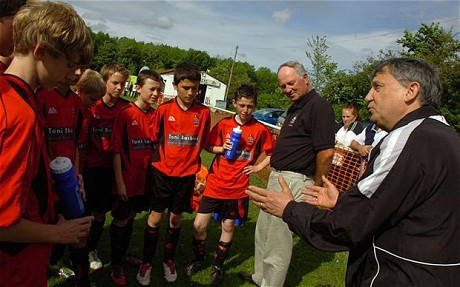
Graham Taylor fears for the English game’s future
Meeting a bunch of young footballers who were still toddlers when he walked away from his last job in football management at Aston Villa,
Graham Taylor sought to break the ice with a gag.
“How many legs has a dog got?” he asked the group, gathered on a playing field in the Birmingham suburbs.
“Four,” was the reply in unison.
“If it lifts one leg off the ground, how many does it have now?”
“Three.”There was a pause, then a collective groan at the realisation at what they had just said. Taylor grinned hugely, punched the air and did a little jig of triumph, delighted to have caught them out.
“Watching the former England manager in action as he visited a youth football club was to see an enduring football devotee at work”.
Chatting amiably, imparting wisdom, offering tips on keeping your head up or – to the older boys – treating the ball with the same care and attention you might your girlfriend, was to see someone still deeply in love with the game more than 60 years on from first engaging with it. And this despite that these days he earns a living working alongside Alan Green on Radio 5 Live.
 “The best player I ever worked with?”
he said when a small boy asked him the inevitable question. “Paul Gascoigne. When you saw Gascoigne you saw someone who was what I would call uncoachable. And as a coach, I loved that.”
Not that Taylor is entirely thrilled with the direction his sport is heading. After he had finished his coaching session, after he had posed for pictures and chatted with a woman whose friend was a landlady for Villa’s young professionals and would have killed her had she seen Taylor and not mentioned this fact, he explained his concerns over a cup of tea in the clubhouse, supplied by a smiley volunteer.
“But I do worry, yes I do.”
“I have to choose my words carefully,” he said, “because I don’t want to sound like one of those who goes on about how things were better in my day. In many ways football has never been better, the pitches, the fitness, the Premier League is fantastic, what a product. But I do worry, yes I do.”
The state of the game’s foundations is particularly exercising him. For the past four years he has been the star attraction at the Grassroots Football Show, spending a June weekend in Birmingham encouraging amateur coaches and players in seminars, lectures and practical sessions. The more he gets involved, the more alarmed he becomes about the state of football at its base.
 Why?
Why?“It’s been a lovely day today, the enthusiasm of the kids, the coaches, the parents, brilliant. That lady at the tea bar, fantastic. But if I’m honest, just look at that pitch they were playing on. I mean, shocking. Bumpy, patchy grass, full of holes. Look at this pavilion,” he said, pointing into the dark, fusty corners of the creaking old clubhouse.
“You go to Holland, France, Germany, every community, the tiniest village, they have magnificent, pristine sports facilities. Here, we’re struggling by on pitches that are a disgrace. Yet we’re told the game has never been richer. You have to ask yourself: why?”
It is a good question. Why is it that Manchester United can announce record turnover yet the schools in the shadow of Old Trafford barely have a football pitch between them? Why is it that Aston Villa’s training ground just up the road from where Taylor was speaking has pitches manicured as if by nail scissors, yet the surface on which the youngsters of the area are obliged to play puts them in danger of turning an ankle?
Divorce between the both
“There is definitely a divorce between the professional game and the grass-roots,” he said. “Having spent my life working in the game, I can understand to a certain extent that when you are in the professional game, working as a player, coach or whatever, then your mind is geared so much to the winning, you don’t get any sense of the bigger picture.
“And I do know some within the game are aware. The Football Foundation would have every pitch in the country improved if it could. But it’s just had its budget cut. What’s that about?”
Indeed, there are many in community departments at clubs such as Manchester City, Everton and Charlton Athletic working tirelessly in the attempt to bridge the gap to the local area from which they sprang. But community budgets are being slashed across the country. That seems odd given that the game’s income at the top increases every year.
 No Money for the communities…
“In the Premier League you’re guaranteed what, £50million minimum a season, yet we’ve got all these clubs in debt,” said Taylor. “And because they’re in debt, they say they haven’t the money to help their communities.”
Taylor has a theory as to how this has happened. “The biggest thing I’ve found since I left the game – and I’m glad I chose to leave rather than being sacked – is that so many people are in football for the wrong reasons. Not because they love the game, but because they smell money.
“People complain about the players being paid so much – and, yes, there are too many what I’d call mediocre millionaires. But how much are these chief executives and directors and so forth being paid and how much do they know about the game?”
It is a shame, perhaps, that he is no longer involved. “I got out with my dignity, if not my sanity intact,” he said with a smile, recalling his final days at Villa, when he cited the game’s financial pressure’s for his sudden departure. Now he would prefer to dwell on his success at Watford, whom he led from the fourth tier to the first. “Looking back, what I’d like to be remembered for is making Watford a family club. The supporters were so close to the players, it was such a close-knit thing there.
“Now you see with stuff like the booing at Arsenal or the fight at the West Ham party, there’s been a barrier put down. It’s such a shame. Football needs its roots, it needs its connection with the supporters. But those in charge seem to think they can do without them.” And that, sadly, is the problem defined in a sentence.
Article By Jim White the Telegraph
The System is the problem – “Do I not like that“
I reckon their is more to the problem then just manicured pitches, the problems lies in the grassroots coaching and development of kids. They way we coach kids in Ireland and England is totally different to the way they coach kids in Europe. For instance Technique and ball mastery are the number one goal at the early ages, do we do enough in Ireland in this department? “I say, no” the Winning at all costs and competitive leagues is a huge issue. Also aspects of the game should be introduced gradually as they go up the age groups and smaller numbers on the pitch so that kids get more touches of the ball, again extra numbers gradually and it must be age specific.
For us to succeed and improve the level of the game hear, we need to change our entire psyique without losing our identity. In other words, create a plan which is the journey and then have a destination which is the goal of how our national teams plays. England has fallen further behind and our best players go to England. If I was a pro footballer my dream would be to go to Spain, France, Portugal, Germany, Holland in these countries you have a chance to become a master of the ball, you will have a chance to succeed. We need to be looking at Europe not England.
Ajax
This weekend you can discover the Ajax way at Johnstown House Enfield Co.Meath The FCAI are doing a 2 day workshop for coaches. Hope to try and make it!
-

11 Values
The following are UEFA 11 core Values – Which Value to you relate with and why, any comments on these VALUES? Has your club and league got Values and if not, ask why?
Value 1
Football First – In everything that we do, football must always be the first and most important element that we take into consideration. Football is a game before being a product, a sport before being a market, a show before being a business
Value 2
Pyramid structure and subsidiarity – At international and European level, the autonomy of sport is reflected by the pyramid structure of football. FIFA, UEFA and the national associations work hand in hand, while respecting the principle of subsidiarity. This allows us to defend the interests of football in the best possible way.
Value 3
Unity and leadership – UEFA does not operate by dictate. We will continue to show strong leadership but operate in a spirit of consensus. In addition to the national associations, we will involve all stakeholders (leagues, clubs, players) in the decision-making process in European football, in particular through the Professional Football Strategy Council, so that the Executive Committee can take the right decisions. And we will aim for closer relations with football fans, without whom there would be no professional game.
 Value 4
Good governance and autonomy – UEFA and its member associations are committed to good governance. Good governance means openness, democracy, transparency and responsibility. In this spirit, UEFA defends the autonomy of sports structures, so that football bodies – with national associations in the lead – are the ultimate decision-makers in matters concerning football, with no undue interference from governments.
 Value 5
Grassroots football and solidarity – Football is based on the grass roots, played everywhere by men and women, boys and girls. The top professional level is just the tip of the iceberg. UEFA will continue with, and even strengthen solidarity, both to protect the future of football and to deliver the wider benefits that our sport brings to society as a whole. And it is also because the strength of football lies in its grass roots that we have to preserve the local, regional and national identities of our game, always in accordance with the law.
Value 6
Youth protection and education – As governing body of European football, UEFA has both a sporting and a moral responsibility. The international transfer of minors entails many risks. Let’s not forget that “players under the age of 18 are children or adolescents. We want to protect the future of children in football and stop them being uprooted to foreign countries when they are much too young”.
Value 7
Sporting integrity and betting – Betting is a source of funding but also a risk for football, especially to the integrity of competitions. It is only right that football obtains its fair share of income from betting. However, our primary focus must continue to be a total commitment to protecting sporting integrity and the proper running of our competitions, in order to preserve the true spirit of our game.
 Value 8
Financial fair play and regularity of competitions – UEFA supports fair play both on and off the pitch. Financial fair play means that clubs operate transparently and responsibly, to protect both sporting competition and the clubs themselves. Financial fair play means clubs not getting into a spiral of debt to compete with their rivals but rather competing with their own means, ie the resources they generate.
Value 9
National teams and clubs – National team and club football are vital and complementary elements of football. UEFA will remain committed to ensuring that this balance is maintained and even strengthened, as the development of our game at national, European and international level depends on it.
 Value 10
Respect – Respect is a key principle of football. Respect for the game, integrity, diversity, dignity, players’ health, rules, the referee, opponents and supporters. Our message is clear: zero tolerance against racism, violence and doping. Football unites people and transcends differences. The colour of the skin is invisible under the jersey and, for UEFA, this will always be so. Racism and any other forms of discrimination will never be tolerated. UEFA will not tolerate violence either on the pitch or in the stands. Football must set an example…Football has a long way to go before we can say we set the example….Rugby sets all the examples in SPORT today..
 Value 11
European sports model and specificity of sport – UEFA is a European body and we remain totally committed to the European model of sport, a model characterised by promotion and relegation, the solidarity principle, as well as open competitions and opportunity for all. This is what sport – and especially football – is all about. We have to protect this model because sport is not simply a business like any other and we cannot allow it to be treated as such. We will continue to defend the specificity of sport and are convinced that our arguments will prevail for the good of football.
These values are great, but soccer both pro and amateur has a long way to go before they can convince me that these values actually exist! A platform to build on, which is something.
Research – UEFA.com

