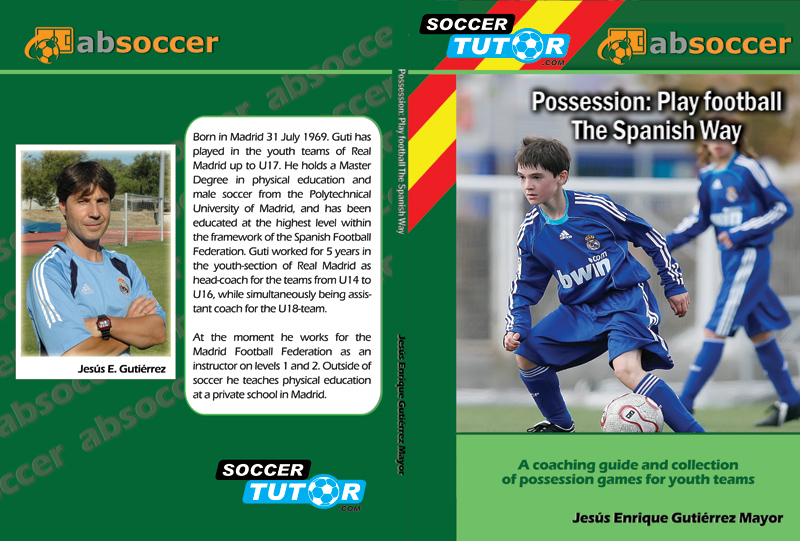
This is an interview by Mark O’Sullivan with Jesus Gutierrez.
Guti is educated at the highest level within the framework of the Spanish Football Federation. He worked for 5 years at the Real Madrid academy as head coach for the U 14- U 16 teams and is currently an instructor for coach education with the Madrid Football Federation.
His brilliant book – Possession: Play football the Spanish way is an insight into the philosophy of coaching young players, dealing with the practical and theoretical side of developing game intelligence. Mark started, by asking him about his work with his various football organisations.
FOOTBLOGBALL: Can you give us a brief account of your work in Futbolconcept and as technical director in Escuela Deportiva Moratalaz?
JESUS GUTIERREZ: Together with my 4 partners we have created a company with the aim to improve the coaching. We have our own approach to teaching football, we call it “TRAINING BY CONCEPTS”. We have developed special software for coaches, including a lot of training tasks that follow our ideas. It will be available in English really soon. My position in the company is Director of the International Department.
In relation to Escuela Deportiva Moratalaz, I’m the Technical Director. We are a very humble football school here in Madrid. We work with almost 700 players in 35 teams, with ages between 4 and 5 up to senior. We have an agreement with Real Madrid, so they can have first choice with our best players. My job is coordinating the coaching, following our “Training by Concepts” philosophy and being sure that everyone is working in the way we want and according to our Model .
FOOTBLOGBALL: Research suggests that young players only retain 18% of concepts that are learned passively but 68% of what which is learned actively. This implies a more player centered approach rather than coach centered one. Can you suggest how you can achieve this using your methods?
JESUS GUTIERREZ: No doubt ! The player should be the protagonist in his own learning. The idea of the coach giving all the information to the player is not a good one. Young players must learn to make their own decisions , analyse what’s happening around them ( teammates and opponents). Simple repetition is boring for children. They come every day to training because they want to enjoy themselves, they want to play football and, sadly, there’re a lot of times when we the coaches prepare very boring exercises for them. They don´t like standing around listening to the coach and repeating a lot of drills. They just love to play. It is very simple to understand. So we offer the players a very active training. We start with a small sided game. No worries about injuries. They don´t need a hard warm up. They arrive most days by running to training. So the first thing we give them is the ball and a game. After playing 5-10 minutes, they will pay more attention to what the coach is saying. All our training tasks are in relation to games situations (concepts). So we try to work with them according to their age and to the situations they are going to experience in the real game. Our main goal is helping the players to identify these situations and choose the right decision. Them all must learn to understand the game, to decipher what’s happening at every moment.
FOOTBLOGBALL: What are the basic and essential tasks that young players should often practice?
JESUS GUTIERREZ: Technique is very important in football, of course but we don´t need to perform the same passing and control drill 100 times. I can do that on my own, after school, when I’m free, during the weekend, in my garden, with my father…I need a real coach to explain the game to me, one who helps me to read the different situations I can find myself in. So the training tasks we create and use are always in relation to the competitive game: myself, the ball, my teammates, the opponents and, most of the time the goals.A big mistake is thinking that young players are not ready to play matches until they can perform most of the technical skills. Maybe it should be the other way around. Let’s put the players into the game, let’s check their weak points and then from the training session let’s prepare an individual plan for them in order to improve in those areas that we have identified. Possession games, position games, small side games, 1 vs 1, 2 vs 2. Attacking-defending (against real opposition), matches with tactical aims,…everything around the game. Replicating what they will experience in the competitive game.
FOOTBLOGBALL: In a possession based style that is the main feature of your book, perception is one of the most vital parts in the Perception- Understanding- Decision – Action chain. The ability to constantly take in quality information, enabling the player to deliver and perform the best action for a particular moment. How do you suggest that we introduce the value of perception in our sessions at grassroots level?
 JESUS GUTIERREZ: Maybe the answer is really simple: put the players into the real game situation. When players are practicing a dribbling exercise with no opponent they don’t need to pay attention to anything but the ball. Every time we introduce just a light opposition in the training we are forcing the player to analyse what is happening around him. Checking over his shoulder before receiving. Passing the ball to the correct foot or to the space in front. Playing with the first touch or creating time to control and turn; dribbling and protecting the ball. Players never have to take into account all these questions when you are training without opposition. They are performing nothing in relation to perception and decision-making!!
FOOTBLOGBALL: Do you think that there is a common misunderstanding with regard to small sided games? That sometimes they don’t reflect the real game that the player experiences on match day?
JESUS GUTIERREZ: We should understand there is not just a magical tool in training. All methods have both positive and weak points. Nobody should state that small side games are not good tasks for football training, but you cannot base all your training sessions on these kind of drills. If players get used to only playing in a 15 x 15 m area and in competition they must play in a 60 x 40 m (seven a side) field they will be lost. So we need to help them to feel comfortable in the space they will finally play.
FOOTBLOGBALL: Do you think that there is a need for isolated technique training for kids when they begin playing organised football? Some coaches feel it necessary but others think that it is more important to play and learn the game first with a focus on fun.
JESUS GUTIERREZ: In my opinion, first thing is “waking” the players’ interest for the game. Having fun while training. As I explained above, let them play and then analyse their performance, detect their mistakes and help them to improve. But first is the GAME!
FOOTBLOGBALL: During some recent work I did with RCD Espanyol a topic that we discussed was balance and coordination training for kids. It was felt that kids socialise and play in a different way now . They are rarely outside climbing trees playing street football experiencing free play etc …. It was felt that there is an even greater need to work on balance and coordination and general motor development of young players when they begin with organised football. Do you agree?
JESUS GUTIERREZ: I can agree with this way of thinking. Coordination, balance, stretching. Everything is covered in order to improve the players level. But remember, don´t “steal” time from the ball to attend to all of these other questions. In our football school we place a very high importance on coordination , but players come 15-30 minutes before their training session begins. So once they put their foot on the field, we forget about everything and concentrate on the ball and the game.
FOOTBLOGBALL: Can you tell us one thing through your work that you have learnt in 2013?
JESUS GUTIERREZ: Although I defend our training methodology, every way of training has something useful that you can use. Your ideas should constantly be checked. Don´t close your eyes to other opinions. A lot of top players reached the highest level practicing with very different coaches and methods. You must be always willing to learn from others.
Follow Jesus @Susen_31 and Follow Mark @markstkhlm
I base a lot of my training on the content of this book, the best €15 I have ever spent. I am planning to bring Jesus to Ireland in 2014; to find out more subscribe to the blog or join the Facebook Event Page
========
I always like to hear your opinions. Please comment below or email me info@thecoachdiary.com If, you don’t have anything to add then please forward this on to a friend. Thanks for reading. I’m also on twitter @Coachdiary