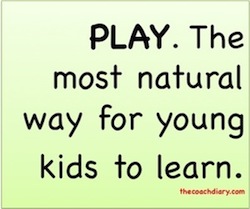
Below is a list of 20 things I’ve learnt from coaching kids and how they learn. I could probably put down 100 more things but I feel these 20 are some of the most important things to remember when working with children.
“Children need the freedom to play and learn on their own. Play is not a luxury. Play is a necessity.” – TCD
Working with children in sport and how they learn:
Children are not mini adults.
Children play sport because its fun. Social interaction and being with friends is an important reason why children take part.
Play and Fun is the same thing to young children.
Children don’t value winning as much as they value playing.
Children can learn MORE through play that is unsupervised and where they have created the rules.
Mistakes are how they learn.
Children develop at different stages.
Children brains loves to bookmark failure, therefore they don’t need us to remind them of failure.
You don’t need knowledge of the game to be a great coach.
Coaches should try to understand more about how children learn and how they should coach.
Up to age 7 we should be more concerned with the FUNdamental movement skills as they set the pattern for future development.
Some research suggests from ages 7 to puberty, children should be able to acquire more specialised skill, in more structured activities.
Children don’t learn from people they don’t like.
Children should be encouraged to play and practice on their own or with friends to help them to improve through repetition.
Observational learning is very powerful so structuring a session so that children can see others and compare themselves in an informal way can be very useful.
Having a ‘go’ without others watching is equally important.
A child that enjoys a sport is more likely to continue in that sport.
Children may forget what you said, but they will never forget how you made them feel.
The most important thing to remember is that children develop at different stages and we can’t force the process.
What would you add to the list?
-end
Next up is 20 ways parents can help their children have a better sports experience.
I always like to hear your opinions and views. If you feel you have something to say, please comment below or email me info@thecoachdiary.com and if you don’t have anything to add, please pass this on to a friend.
As always, thanks for reading. I’m also on twitter @Coachdiary
11th National Coaching Forum at the Institute of Technology Sligo, 26th-27th of September 2014. This Forum promises to be the biggest and most extensive gathering of professionals and volunteers involved in Sport Coaching. The Forum will attract coaches, physical education teachers, sports scientists, National Governing Body personnel and policy makers. Leading National and International presenters will take part in this event titled “Fun to Full Potential – Coaching the whole Athlete”
The 11th National Coaching Forum will combine Keynote speakers, with practical and applied sessions, with opportunities to network with coaches from different sports. Previous National Coaching Forum has welcomed up to 800 coaches, both National and international. The Forum has become a “can’t be missed” event on the sporting calendar, involving coaches at all levels from up to 48 different sports.
Key Note Speakers Include:
Billy Walsh: Title – Combat Leadership – Current Challenge Facing Coaches
Richard Bailey: Title – How People Learn (and how we should coach them) Applying Research Into Learning To Sport Coaches
Niels De Vos: Title – The British Atheltics Athlete Development Model- Ensuring Age Appropriate Coaching And Competition To Enable All Athletes To Deliver Their Best Performance As Senior Athletes
Albert Vinas (Football Salou) will host the NDSL Coaches Club: 24th September 2014
Vinas is a Spanish coach who has a wealth of knowledge in elite youth coaching, having spent 20 years developing some of Europe’s young stars of today. Throughout the workshop Albert Vinas will reveal the methods behind arguably the most successful style of football ever witnessed.
Vinas has not only helped develop some of the best players around, but coaches too. Vinas has mentored and assessed coaches such as the late Tito Vilanova who managed Barcelona before he died earlier this year, and Rodolfo Borrell, who previously at Barcelona’s famous academy La Masia, Liverpool FC and more recently been appointed Academy Director at Manchester City.
Vinas will be taking the workshop on Wednesday 24th at the Oscar Trainer Development Centre, Dublin 13.
Venue : NDSL – Oscar Trainer Development Centre
Date : Wednesday 24th September , 2014
Time : Reg @ 6pm – Workshop 6.30pm – 10.00pm
Cost : 25 Euro per Coach / Club Deal 5 Coaches for 100 Euro.
Contact : Mitch Whitty for Information @ 087 9513624.
SWIM IRELAND
National children in Sport Conference Sligo IT: 17 & 18 september 2014.
Highlighting
Examining
Exploring
Improving
SILENT SIDELINE WORKSHOP: Monday 29th September
Have you noticed children playing the game with fear of making mistakes?
Does your child’s coach constantly scream and shout at the kids and officials?
Has your child given up the game, because it’s no longer fun?
Are you a parent, a coach, a manager, a grandparent or a friend?
Have you said yes to one of the above? Then you need to attend!!
When: Monday 29th September:
Where: NDSL Oscar Traynor Coaching & Development Centre, Oscar Traynor Rd Coolock D.17.
Time: 7.30pm-9pm: Cost: €5
Content: Giving the game back; Mistakes; Playing with Freedom; Winning & Losing; Self control; Observation; Prevention; Intervention; Sideline Keeper.
I always like to hear your opinions and views. If you feel you have something to say, please comment below or email me info@thecoachdiary.com If, you don’t have anything to add then please forward this on to a friend. As always, thanks for reading.
If you want to promote a tournament, please get in touch or comment below or just email me info@thecoachdiary.com If, you don’t have anything to add then please forward this on to a friend. Thanks for reading.
The Role of the Coach and Player Centred Coaching is the the theme for the 11th National Coaching Forum will take place at Institute of Technology Sligo, 26th-27th of September 2014.
This Forum promises to be the biggest and most extensive gathering of professionals and volunteers involved in Sport Coaching. The Forum will attract coaches, physical education teachers, sports scientists, National Governing Body personnel and policy makers. Leading National and International presenters will take part in this event titled “Fun to Full Potential – Coaching the whole Athlete“
The Forum
The Forum will combine Keynote speakers, with practical and applied sessions, with opportunities to network with coaches from different sports. Previous National Coaching Forum has welcomed up to 800 coaches, both National and international. The Forum has become a “can’t be missed” event on the sporting calendar, involving coaches at all levels from up to 48 different sports.
To find out more click on the relevant links below.
The Coach Diary has 3 work shops coming up in August and September, to find out more go here
I always like to hear your opinions and views. If you feel you have something to say, please comment below or email me info@thecoachdiary.com If, you don’t have anything to add then please forward this on to a friend. As always, thanks for reading.
If you’re reading this post it’s because you’re either into coaching or you’re someone who is into learning about what makes a great one.
Take a look at Dr. Goldberg’s list of examples – of behaviours that characterise ‘bad’ coaching. Here is some sound advice for anyone involved with coaching kids.
There are a lot of “coaches” out there who don’t have CLUE about how to really coach. Unfortunately these individuals consistently do far more damage to young people than they do good.
They tear down self-esteem rather than building it up. They create an extremely unsafe learning environment for their athletes. They use fear, humiliation and demeaning, disrespectful behaviors as “teaching” tools. They are emotionally and sometimes (indirectly) physically abusive. They directly and indirectly pressure athletes to continue to play when injured. They regularly kill the fun and passion that their athletes once had for the sport. These coaches have lost their way and strayed terribly far from the true mission of coaching.
You’re NOT a good coach when you call an athlete out in front of the team and tell that athlete, “You absolutely suck! You’re the worst short-stop, quarterback, setter, forward, keeper, etc. that I have ever seen!”
How is this kind of a comment constructive? Does it help a child understand exactly what he/she is doing wrong and what they need to do to fix it and improve? How does it help a child learn? Does it motivate an individual to want to work even harder to improve? Does it help that individual feel good about themselves?
You’re NOT a good coach if you think that your most important job as a coach is to win games.
I don’t care what kind of pressure to win that you face from the administration. If winning is your primary goal as a coach you have significantly lost your way and as a consequence, you’ll actually win less!
Your mission as a coach is to teach young people and help them grow as individuals so that they become better people in the world, both on and off the field.
There are far more important things at stake here than whether a kid wins or correctly learns the x’s and o’s. Good coaches teach their athletes how to be better people in the world and they use their sport as nothing more than a vehicle for this teaching. The winning and losing outcomes are completely secondary to the teaching of valuable life lessons (playing as a team and sacrificing individual needs for the betterment of the team, handling adversity & failure, mastering fear & obstacles, working hard towards a faraway goal, learning to believe in yourself, being a good sport, playing by the rules, etc.)
You’re NOT a good coach when you place the outcome of a competition in front of the physical and emotional welfare of your players.
If you pressure your athletes to play when injured or if you demean and ignore those athletes who are too injured to play, then you are engaging in physical abuse. Encouraging your athletes to play hurt so that the team can win is reckless behavior for you as a coach. When you do this you are directly putting your players at risk. You are NOT teaching them to be mentally tough! Playing through pain is NOT a sign of strength. That is a ridiculous MYTH!!!!! Instead, it’s completely ignoring your body’s early warning signs that something is very wrong.
You’re NOT a good coach when you allow players on your team to scape-goat and/or demean each other.
Good coaches create a safe learning environment. There is nothing safe about being on a team where teammates regularly criticize and yell at each other. There is nothing safe about being on a team when you are picked on or ostracized by your teammates. It’s the coach’s responsibility to set very clear limits to prevent these kinds of “team busting” behaviors. There should be no place for them on a winning team.
You’re NOT a good coach when you play favorites.
Good coaches treat their athletes fairly. They don’t operate with two different sets of rules, i.e. one for the “chosen few” and one for the rest of the team. Coaches who play favorites go a long way towards creating performance disrupting dissension on their squads.
You’re NOT a good coach when you tell your athletes that under no circumstances are they ever to tell their parents what really goes on in practice, and that if they do, they are being disloyal and disrespectful to their teammates coach and the program!
Coaches who tell their athletes these kinds of things are terribly misguided and are trying to hide something. What they’re trying to hide is their abusive behaviors! Telling kids not to ever tell their parents is what child abusers tell their victims!
You’re NOT a good coach when you treat your players with disrespect.
I don’t care what your won-loss record is or how many championships you’ve won in the past. When you treat pre-adolescent and adolescent athletes disrespectfully you are NOT a good coach. Great educators don’t teach in this manner. They value their students and make them feel that value, both as learners and individuals. Your position and reputation should not determine whether you get respect from your team. What does determine whether people respect you is how you ACT! Your behavior is what’s paramount. Good coaches earn their respect from their players on a daily basis, over and over again based on how they conduct themselves and how they interact with their athlete and everyone else associated with the program. If you think that you’re too important to earn respect, then you are distinguishing yourself as a bad coach!
You’re NOT a good coach when you don’t “walk the talk.” What you say to your players means nothing if it doesn’t come from who you are as a person.
Simply put, your words have to closely match your behaviors. Great coaches are great role models in that they teach through their behaviors. They don’t operate on a double standard where it’s OK for them to act one way but hold their athletes to a different and higher standard of behavior. If you as a coach teach through the maximum, “do as I say, NOT as I do,” then you have distinguished yourself as a poor coach.
You’re NOT a good coach when you refuse to take responsibility for your behavior, when you refuse to own your mistakes and instead, blame others for them.
The mark of a great educator is that they present themselves as human. They do not let their ego get involved in the more important task of teaching. Therefore when something goes wrong, they are quick to own their part in it. Good coaches take responsibility for their team’s failures and give their team and athletes full responsibility for successes. Bad coaches blame their athletes for losses and take the credit for the team’s successes.
You’re NOT a good coach when you play “head games” with your athletes.
If you talk behind their backs, play one athlete off against another or are dishonest in your interactions with your players then you are doing nothing constructive to help your players learn and grow as athletes and individuals. Telling a player one thing and then turning around and doing exactly the opposite is not how you go about effective coaching. For example, promising a player more playing time if he/she does A, B and C, and then keeping them on the bench after they do everything you’ve just asked of them is a psychologically insidious game that will kill your athlete’s love of the sport, crush their spirit and destroy their confidence. This is NOT how great coaches motivate their players!
Alan Goldberg, PhD, was the sport psychology consultant to the 1999 NCAA Men’s Basketball National Champion University of Connecticut Huskies, and the 2000 men’s soccer NCAA champions. He is the former Sports Psychology Consultant for the University of Connecticut Athletic Department. As a nationally-known expert in the field of applied sport psychology, Dr. Goldberg works with athletes and teams across all sports at every level, from professional and Olympic caliber right down to junior competitors. Dr. Goldberg specializes in helping athletes overcome fears & blocks, snap out of slumps, and perform to their potential. His book, Sports Slump Busting (LLumina Press), is based on his extensive experience getting teams and individual athletes unstuck and back on track. Outside of sports, Dr. Goldberg works with performing artists, sales and business people, test takers, and public speakers.
Thanks to Podium Sports Journal for the content.
Do I need to say anything, I think Alan Goldberg has said it all!!
-End
I always like to hear your opinions. Please comment below or email me info@thecoachdiary.com If, you don’t have anything to add then please forward this on to a friend. Thanks for reading.
Too often I hear parents ranting about their child’s coach and if there is one thing I’ve learnt is not to judge and not to believe everything I’m told. One thing is for sure, adults get into coaching in kids football (sport) to help the team in question. Many enter with the right intentions, to try and improve the players they’re working with. The ones that choke under pressure are thinking about living up to the expectations of everybody else, instead of just doing their job the best they can.
“Parents, coaches and players should realise that they are all on the same team. Enjoyment and success can be assured if this is a harmonious 3-way partnership. When all three are working together for the benefit of the player and his development, there is a much greater chance that this young talent will reach his full potential”. – Horst Wein
I’ve also learnt that winning is not the be-all and end-all of everything you do. I would much rather see my team playing a beautiful brand of football and lose, than play horribly and win. That might see strange to most, but it’s true. I focus on performance, effort and most importantly the journey to get where we want to be. Don’t get me wrong, I love to win but, I coach my players to be successful and to do their best every-time they play. That is what success is, doing your best each and every time. This is under the control of the players with guidance from the coach. The very best coaches, do not coach the sport, they coach the child, they are able to connect with everyone and know that everyone is different.
“Those who are quickest to judge are often in possession of the fewest facts”
Judging
So what I’m saying is, judge the coach on how he’s teams plays, judge him on how well he/she prepares the team. Does he/she mentor the kids, is he/she a good role model. If he/she has improved the players both technically and personally, what more can you ask for. Parents (not all) put huge demands on voluntary coaches. Let us not forget these coaches don’t get paid for what they do. They give you their personal time to coach your child and in many cases they have children of their own – but they devote time to yours. Which in turn leaves less time for their own children (I’m speaking from experience).
Parents need to look at what these coaches do, how much effort they put into helping other peoples children. Without them we would not have a game, so don’t be quick to judge them. As a parent, once you are confident that your child is in a safe learning environment, one of the most important things you can do as a parent of a young player is to let them go and let their sports experience belong to them. Release them into taking control of that experience and allow his/her efforts belong to them. What ever success they achieve will be as a result of their hard-work. If you control everything your child does, they will never take responsibility. The worst thing you can do is compare what you want from your child experience with what they want. You can be sure that children do not have the same reason for playing as you might do. Children don’t value winning as much as adults do. Get them involved, allow them to take control, be supportive and back off.
“You can’t give 110%, you can only give what you have and you only have 100%”
Success
The problem with success in kids sport is that, the more you succeed the higher the expectations. As soon as you win something, everyone expects the same next year and when you don’t win it again, you’re deemed unsuccessful and people start to cast an opinion of what you’re doing. In some ways you’re better off coming just close, people tend to be less judgemental and they might even say “wait until next year”, ” you did great”. The higher the achieving team the more critical people are. The more they seem to know, then you.
I’ll refer back to the journey process. Life is a journey and we make some great decision and some wrong ones along the way. In life people tell you to ‘keep going and don’t look back’ but can the same be said for coaching in youth sport?
Don’t micro manage every single game, judge the coach on the entire season. If the kids are improving and having fun and if the coach is fair to everyone and has the best intentions of all the players. That is success, what more can you ask. There will be time during the season that he/she will make a wrong decision but that’s how we learn. Things don’t always work out. It’s also true in life.
“Don’t be over concerned what people think about you. Be concerned with what you think about yourself”
If we focus on the process (what you are doing) and less on the losing and winning, we are able to develop much more. If you are too competitive, then you are over worried about the final score. Development of a child in sport is a long journey, the process must be short steps to mastering the game. A successful (journey) one is where your real accomplishments lie is keeping the child in sport and loving the game.
That is why we must teach kids that ‘doing the best you were capable of doing is success’ that should be the message. Their best last week may not be the same as their best this week but if we focus on effort first then you will never lose.. You can never reach perfection but you can reach maximum effort through hard work, every-time.
“Children who are given control over their sport experience are more likely to enjoy the game more and stay playing for longer. They’re also found to embrace the process more rather than focus on the result. It can also allow them to focus longer on improving and develop an interest outside of training, where they will take upon themselves to work harder and get better (More success). This way children learn to value it because the game belongs to them not you”
The next time you think about criticising the coach, think about all he/she has done for your child. Your child probably won’t be the next supper star but who cares, he’s playing sport and there are a lot of benefits to playing sport in life. Think about how much this journey is worth in life lessons!!
I always like to hear your opinions and views. If you feel you have something to say, please comment below or email meinfo@thecoachdiary.comIf, you don’t have anything to add then please forward this on to a friend. As always, thanks for reading.
Andres Iniesta talks to FOURFOURTWO PERFORMANCE on picking the right pass and bamboozling the opponent, here are his six steps to success.
Receiving a pass
Before I receive the ball, I quickly look to see which players I can give it to. Always be aware of who is around you: if you feel them closing down, take a touch to move the ball away from them. Try and put yourself in space to get the pass: the more space you have, the more time you have to think. And when you get the ball, don’t move it towards the opponent. That said, sometimes I’m happy to run at a player and just hold the ball in front of him. That way I’ve moved the team forward.
‘Here they make you think from day one. The first thing you do when you join this club is rondo (the passing drill with one player trying to win the ball back and three or four players passing one-touch between themselves). It’s think, think, think, and it teaches you the responsibility of keeping the ball and the shame of losing it.
Playing the pass
Every pass is important. A bad pass loses possession and puts the team under pressure. Short passes build momentum and if you have the ball then the opponents can’t do anything. Know the time to make a killer pass. If you need a goal, search for the space to make the pass. If you’re protecting a lead, keep possession and play safer. Because we have played together for a long time to a certain system, everyone knows where to move. That makes my job easier, knowing where Xavi or Leo [Messi] will be.
For Xavi it starts in the stands with the difference between English and Spanish football culture. ‘You are a nation of warriors,’ he says. ‘If I go to Liverpool’s ground and someone puts the ball into the area and Carragher hammers it out of play then the fans applaud. In the Nou Camp you would never be applauded for that. ‘It’s a different culture that values different things. Here if they see you are afraid when you are in possession then you get whistled. It’s the world in reverse. Thinking on your feet
If you think before your opponent where the ball is going to go then you have an advantage. If you stay with the ball at your feet and think about what to do, you are going to lose the ball. The best players are the quickest thinkers. Where is my team-mate going to run to? Will he stay onside? Which one has space? Which one is looking for the ball? How do they like the ball – to their feet or in front? You can be the best passer in the world, but without your team-mates being in the right position, it’s no good.
‘You lift your head before you receive the ball, you look to see if you are in space, and who else is in space, and you play the ball first time. Modern football is so quick that two touches means too slow.’
Drawing a foul
Make the opponent think that you are going one way, then go the other. Confuse him. And when your opponent has the ball, close him down quickly. Put him under pressure before he’s even had time to think about an attack. Another thing: if the attack has gone, don’t waste energy playing catch-up. You can be as much use to the team as a defender if the ball comes back. Or you can move up more slowly and still be in a position to shoot if the ball comes back to you.
‘You spot a youngster who can lift his head and play a first-time pass and you think, “He’s worth something, let’s have him come and train with us”.’
Dealing with a giant
If I play against a big player, I play the ball quickly on the ground. Playing a quick one-two is also very effective as bigger players are slower to react and turn. I also keep a distance from them so that I can turn quickly and we don’t find ourselves going for the same ball. I only weigh 63 kilos so I don’t have weight to throw around. If you can get the ball past them a few times using a one-two they will be more reluctant to rush in and tackle, so you have more space to play. Barça is a small team, so we use our height well. It’s good for me to take corners, not just because I’m unlikely to win the ball in the air.
‘From the age of 10, they make you think of the shame of losing the ball’
Shooting from distance
I’m not a natural scorer, but if I see an opening, I’ll shoot. I shoot if I think I can score and I’ll aim for the part of the goal that’s most difficult for the goalkeeper. That’s what I did in the World Cup final – the corner near the post. And against Chelsea too [Champions League semi-final in 2009], because I saw a space through a crowd of players. Opposition players in front make it more complicated – for me but also for the goalkeeper – because they can’t see properly. And if there’s someone in a better position, I’ll pass. So you need to know who is around you all the time and where they are.
I always like to hear your opinions. Please comment below or email me info@thecoachdiary.comIf, you don’t have anything to add then please forward this on to a friend.
This website uses cookies to improve your experience. We'll assume you're ok with this, but you can opt-out if you wish. Cookie settingsACCEPT
Privacy & Cookies Policy
Privacy Overview
This website uses cookies to improve your experience while you navigate through the website. Out of these cookies, the cookies that are categorized as necessary are stored on your browser as they are essential for the working of basic functionalities of the website. We also use third-party cookies that help us analyze and understand how you use this website. These cookies will be stored in your browser only with your consent. You also have the option to opt-out of these cookies. But opting out of some of these cookies may have an effect on your browsing experience.
Necessary cookies are absolutely essential for the website to function properly. This category only includes cookies that ensures basic functionalities and security features of the website. These cookies do not store any personal information.
Any cookies that may not be particularly necessary for the website to function and is used specifically to collect user personal data via analytics, ads, other embedded contents are termed as non-necessary cookies. It is mandatory to procure user consent prior to running these cookies on your website.