Category: Irish Grassroots Football

  • Soft Eyes Make You A Better Player

    Soft Eyes Make You A Better Player

    Wendy Murdoch is an internationally recognised equestrian instructor and clinician of over 30 years. She is the author of many books and DVD she is one of the most skilful teachers ever encountered in any equestrian discipline, Wendy’s desire to understand the function of both horse and human, curiosity and love of teaching capitalised on the most current learning theories in order to show riders how to exceed their own expectations.

    Now you might be wondering, what the hell has equestrian got to do with football coaching. Well, i’m going to tell you, well actually – Wendy is!! You see, I was searching the web for articles on players with tunnel vision, as I see so many players unable to scan in possession, unable to look long and see short at the same time. In this article she refers it to soft eyes. Which is a new term I will be using now!

    Here’s what Wendy says:

    Sally Swifts concept describes “The essentials of Soft Eyes in Centered Riding as “wide-open eyes and peripheral awareness, awareness of your entire field of vision and feeling sensations from within.”

    However Wendy further defines concept of (in her words) “Soft Eyes using some images and suggest some corollaries that I often equate with this concept.

    Let’s start with Soft Eyes vs. Hard Eyes. Find an object to focus on somewhere near you.

    It may be a book on the table or a chair in your living room. Now stare at that object with all of your concentration. Notice what happened to the muscles in your face and your breathing when you stare at the object.

    Then, instead of staring at the object, “look” at it. Allow yourself to see the other things in the room while you continue to look directly at the initial one. Notice that as you open up your field of vision the tension in your face decreases and your breathing returns. This is the difference between over-focusing on an object and looking at it. By over-focusing, you create unwanted tension in the body, which will inhibit other parts from functioning fluidly (i.e.: breathing, hip joints, legs and hands). This intense staring is “Hard Eyes” and the broader looking is “Soft Eyes.”

    In Soft Eyes you have maintained your observation of the particular object you picked, however you are not putting 100% of your attention on only that object. You are now simply observing it as a central theme amongst everything around you, therefore you are allowing yourself to use both the central and the peripheral parts of your vision.

    There are two parts to vision, central (detail) and peripheral (scanning). When someone is said to have “tunnel vision” it means that they are only using the focusing or detail part of their vision. When someone appears to be “staring off in space” they are only using the peripheral part.

    Remember the last time you drove home from town or the barn? Did you suddenly find yourself in your driveway and wonder how you got there?

    Obviously you were watching where you were going so that you made the correct turns to get home but, you were not really aware of it because you were “lost in thought.” The conceptual (pheripheral) part of your vision took over and made sure that you did not get in an accident by scanning the road ahead and informing you if any action needed to be taken. Now think of the last time you drove in heavy traffic or in a snowstorm. Suddenly all of your attention was on the road ahead of you. By the time you got home you were exhausted because you remained super-focused for the entire drive. You were only using the central (detail) part of your vision and not allowing any scanning to occur. Maintaining that kind of focus for hours is exhausting”.

    Why do players have tunnel vision? Is it because of pressure? Is it because of the fear of making mistakes?  When kids play with less pressure they are more relaxed and don’t suffer fear of making mistakes. Fear & pressure can cause players to play with tunnel vision as they are tense and not relaxed. 

    Again this can be transferred to playing sport, Wendy goes on to say:

    “What you will probably observe is that by using Soft Eyes, both you and your horse will find it easier to accomplish the task. It required less effort on your part and your horse was more cooperative. You might also have noticed that your horse was “more forward” because you were creating a space for him to move into by looking out in front of you. Also, you may have found that it was easier to keep your balance because, by looking beyond your horse, your head is more balanced over your seat”.

    “These are two images that can assist you in creating a direction to follow so that your plan takes you through figures in the arena. By allowing yourself to clearly “see” the image in front of you and using your peripheral vision take in your surroundings you can “flow” through the exercise effortlessly rather than struggling and hauling on your horse”.

    “So in this first instance of Soft Eyes vs. Hard Eyes, using your peripheral vision along with your central vision, you are able to have “wide-open eyes and periperhal awareness, and awareness of your entire field of vision.” This allows you to observe your surroundings more like a horse, so that you can “see” the larger picture. As you grasp the larger concept, you can allow the individual pieces to fill in, creating a detailed understanding of the concept. By seeing in this manner you will be able to have a relaxed awareness of your surroundings without anxiety of whether you are going to “get it” or not. This mode takes the stress out of learning process and you no longer have to go into a reactive “flight” mode because you can see what is approaching instead of being surprised because something   “snuck up” on you”.

    “In this regard, one of my corollaries to Hard Eyes vs. Soft Eyes is the concept of Intense vs. Intent.

    When you are intense, things are strained, harsh, overbearing, demanding and unpleasant. The person who is intense is always trying to “make it happen” even when it is clear that it just isn’t right. Kind of like trying to put a square peg in a round hole, the intense person often won’t let go of something until it has been broken or beaten to death”.

    “Intent, on the other hand, implies that you know what you want to accomplish and you don’t feel the need to force it. Someone who is intent is quietly directing the process as it unfolds even if momentarily it seems like it is not going in the desired direction because they know that ultimately the outcome is going to be what they want. The desired result may even change in the short term in order to accomplish the task in the long term. The person with intent will be able to sit back and relax as events occur, observing without reacting. He will alter the program as required make things easier. He will get the peg to ultimately fit in the hole because he put the peg in the right hole”.

    She goes on to say,

    “The person who is intense often does not trust the process and anticipates or attempts to avert perceived failure. Whereas the person who has intent is secure enough to know that they are going to succeed regardless of how long it might take or how much they will have to adapt to the situation. In this regard, when you observe someone who is a “good hand” with a horse, notice that there are several predominant features. The “good hand” remains calm in spite of how the horse is behaving, they quietly, calmly and consistently shape the situation to accomplish the task and they never lose sight of what it is they want the horse to do in the first place. In this way, the “good hand” has clear intent and allows the horse sufficient time to understand what is desired. They assist the horse in the process of learning rather than forcing to horse through the situation”. Again what can we take from this, the player that is calm performs better and makes better decisions. 

    She says, “Having clear intent before approaching your horse gives the horse a sense of security. When you approach the horse lacking confidence the horse will question you and feel unsure. What you get from the horse is exactly what you put out – confusion, fear and poor results. Coming on like gangbusters, full of demands and deadlines can create a highly reactive situation because your goals feel overwhelming to the horse. They are too difficult, not because the task is hard but because the intensity in the approach caused the horse to react instinctively, triggering the “fight or flight” reflex”.

    “A large part of intent is knowing what you want to accomplish before you ever catch your horse. If you are unclear about the outcome then it is virtually impossible to create it. In other words, it is important to have a clear concept of what you are looking for before you begin. According to a Feldenkrais principal (Feldenkrais is a form of body work for humans that develops body awareness and mobility) everything that your body needs to do to perform a task happens when you clearly think about it. So before you ever get out of a chair, the act of thinking about getting out the chair causes your entire nervous system to perform the task on an infinitesimal level so that when you get up everything works properly”.

    Screenshot 2015-11-06 12.55.57

    “So this means that if you want to do something, the clearer you can visualize it the more likely you will be able to achieve the desired outcome because your body has already performed the task. No you can understand why I will not let my students jump a course of fences until they can visualize their lines, turns and jumps in their mind’s eye”.

    “However, not everyone can visualize. So, while visualization is a great way to practice your riding, if you don’t have that skill there are other ways to have clear intent. Intent can be in the form of an image, feeling, thought or sound. In other words, you may know what the feeling is even if you don’t quite know what it looks like. Or it may be that you know what it will sound like when you get there so your intent is to recreate that sound. This is particularly true when uncovering lameness. By listening to the sound of the footfalls on a hard surface you can discover where the problem lies. So while visualization can help in defining your intent, there are other senses that can be involved in the process”.

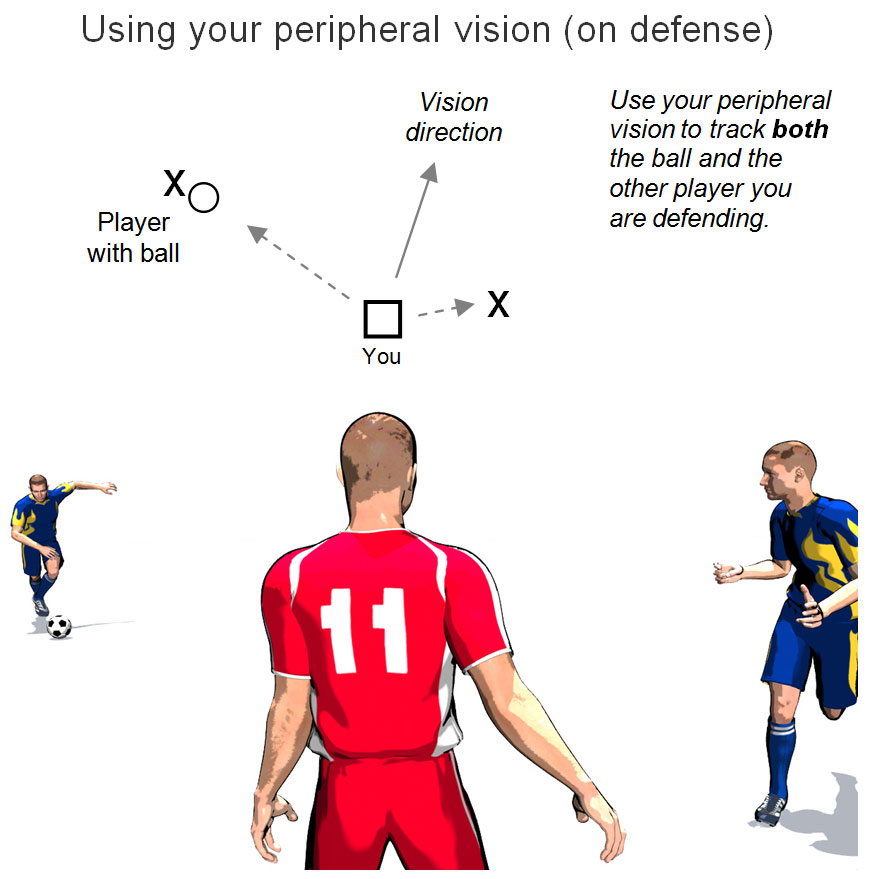
    Taking Wendy words in a player context: Focus on getting your players use your expanded field of vision in game situations. Use your inner eyes to visualise what you want to do and where you would like to go, while allowing your “outer” vision to encompass all that is around you. In possession encourage the player on the ball to always look long first and you they see short. Getting them to scan their environment ahead. A good exercise to see who is looking all around them is to stop the possession game and ask players to tell you who is behind them, to the left and the right outside of their field of vision. Another one is to play a SSG with no bibs, so both teams have the same colours. One common principal in football for this is to ‘get your head up’ and not be focused on the ball, whilst trying to think one step and making a quick decision early.  Ultimately it’s down to fear. Fear of making mistakes, fear of failure which as we know damages a players mindset and makes them not trust themselves and kills performance.

    Going peripheral with soft eyes is also very helpful in reducing stress, as it promotes a more relaxed, yet attentive, perspective and helps to free our breathing which is often constricted when we are feeling tense. I hope these information helps, it certainly gave me something to think about and answered a lot of what I was searching for.

    Find out more on Wendy’s Facebook page  or Website

    -End

    I always like to hear your opinions and views. If you feel you have something to say, please comment below or email me info@thecoachdiary.com If, you don’t have anything to add then please forward this on to a friend. As always, thanks for reading.

    I’m also on twitter @Coachdiary

  • Irish Based Catalan Elite Football Philosophy

    Irish Based Catalan Elite Football Philosophy

    Catalan Elite Football began this summer in Ireland. Based out of Parnells GAA in Coolock and running every Friday from 7pm to 9pm and catering for kids aged 6 to 14 years.

    Catalan Professional coach Marc Miquel writes about his experiences so far in Ireland, in his own words:

    Introduction
    After four months coaching in Dublin I’ve noticed many differences beetwen Football in the Catalan region and the football that is practiced here in Ireland. I can say that there’s a lot of work to do, its going to be a challenging process in order to reach the targets in which we have set for ourselves.

    “Our focus in Catalan Elite Football is to develop tactical qualities of the players as individuals”

    Our main focus is to change the mentality of Irish people and players both on and off the pitch. We want them to consider said that this process possible for us to develop more intelligent players.

    Our main focus in Spanish and Catalan football is to develop the cognitive qualities of the players, to use the brain in the game. In Ireland from my experience so far, players think about the game a lot less than that of Catalan players. Maybe one of the reasons is the fact that they do not have a professional league with professional players on their doorstep to watch on a weekly basis. For this reason I have found that players need continuous reminding of the concept of training. We hope that we can make a small difference towards this, like our Academy Director says,

    “every process starts with a little change.”

    This process will acquire different methods to make the things, develop the qualities that the smartest players have (based around tactical elements) or start to produce different players.

    “The players do not recognise the training as a training, it is more like going to enjoy time with their friends. They don’t think to improve as a players and as a team in every training, it appears this is the coaches problem”.

    Our focus in Catalan Elite Football is to develop tactical qualities of the players as individuals. The company’s founder, Colm Barron, studied the different football methodologies around Europe and specifically in Futbol Salou and the Tecnifutbol Academy. After meeting with Albert Vinas and studying the smartfootball methodology he decided with the support of Albert to reproduce the methodology in Ireland in the Catalan academy. In one of the last travels he visited Complex Esportiu Futbol Salou where I was working and spoke to both Albert Viñas (Complex boss) and Colm, they decided to give me the chance to help the academy to introduce the Catalan methodology. Our work started there….

    Trainings And Matches
    I’m gonna talk about the general level which we could see in our academy, in different pitches around Dublin and clubs where Catalan Elite Football started to work in (Knocklyon United, St. James Athletic and Park Celtic).

    “When I came to Ireland I imagined strong players with really good physical qualities, showing aggressively to the ball, but they do not! They aren’t aggressive to the ball, it’s hard to see two players fighting powerful for the ball”.

    Like I mentioned above the players do not recognise the training as a training, it is more like going to enjoy time with their friends. They don’t think to improve as a players and as a team in every training, it appears this is the coaches problem. Many of them are parents that find the players enjoyment to be more important, not the learning sense. Of course for us it’s really important that the players enjoy in the sessions, but they have to enjoy learning about the game with the games the coaches purpose. Our thinking is to help the players to develop their qualities within the trainings and out of it, as a player but as a person first. We understand the youth football as a person formation to develop useful skills for their life, trying to instil our passion for the game and the attitude to fight for your dreams and improve every day.

    The training mentality is to play all versus all running behind the ball without thinking anything more. I was surprised because I used small sided games (2v2/3v3…) as a real match in a different pitch size and they don’t understand this game as a match. We are trying to explain to the players that by using these types of games they can reproduce a similar competition game in unreal spaces, but they are going to touch the ball more which will allow them to improve as players.

    To review what I have seen in trainings, players don’t show passion and attitude for the game, and the tactical content is not introduced in the majority of the sessions. These things are some of what make the process harder, the process to understand the game. In order to create smart players, they must make mistakes within the sessions, they have to experience different game situations that they can find in the competition. Trying to reproduce the competition in the training where the players have to use the brain to beat opposite team.

    Related with the previous problem, they don’t have collective sense, team sense, because they play as an individuals inside the squad. If you think as an individual you just want to run closer to the goal to score but will never think as a team, and with this mentality it’s impossible to develop the cognitive element. For this reason there’s a lot of transitions in the games that I watch in Ireland and this seems to be the same in the national teams. The coaches want the ball far from their goal and if the striker is lucky he will get options to score. If not, the other team will try to clear again, for this reason it is rare that any team will control the game.

    What’s the problem if there’s a lot of transitions?

    The problem is that the players lose their positions and nobody is organised. Everybody want a to run with ball and they don’t think where the defenders are, where their mates are, and where is the best space to play. The collective options disappear.

    For the last part in this point I want to talk about the biggest surprise that I received. When I came to Ireland I imagined strong players with really good physical qualities, showing aggressively to the ball, but they do not! They aren’t aggressive to the ball, it’s hard to see two players fighting powerful for the ball. I think they have really good physical qualities which they have to transfer to the game and be aggressive to compete every ball, after that start to introduce technical and tactical elements to become better players.

    More from Miguel in the coming weeks…

    You can follow the Academy on Twitter @catalanelite Facebook at Catalan Elite football
    or straight to their website www.catalanelitefootball.com

    -end

    Part Two

    Competition System
    The competition has to be a part of the formation process for players. This competition needs to a part of both trainings and the games. I find it difficult to understand when parents struggle to accept the opinion on the levels of the players. All around the world in football and life, people are categorised by their current level. The best work with the best to become better, and other who are below that level at the time work harder to become a part of that group. This is soccer all over the world. It does not mean that the player of lesser ability at that time cannot improve past the others, it may just take more time.

    “Of course everybody always wants to win, but it doesn’t have to be the most important. If you lose you have to learn about your mistakes and if you win you should keep working in the elements that you made good”.

    The match day formation has a part of player learning. Practice in the match should be focussed on the work realized during the week. It’s a chance for checking if the players are improving and develop the competitive sense. Competition is a part of sport and players must learn to compete, not just compete to win because this thinking I feel is wrong. They have to use the competition to experience everything that is involved. The opposite pressure, the fans clapping, sharing your passion with the team members, sharing a dressing room, developing the cognitive and creative elements into the game because it’s reproduced in the game as a maximum expression.

    “We have competitive leagues from u8 in Spain. Again this is the real game, there is no problem with competitive leagues from the earliest age, the problem is the environment that surrounds this”.

    In this moment what appears to be the biggest problem is that everybody wants to win without focus in the players formative process. It’s a world problem, but the problem is in the adults not the kids, because the adults alter the kids mind. Of course everybody always wants to win, but it doesn’t have to be the most important. If you lose you have to learn about your mistakes and if you win you should keep working in the elements that you made good.

    The competition in Ireland is difficult to understand, the governing bodies doesn’t have the elements structured and the rules which they play are not really established. For example the youngest kids don’t have league qualification, this is not really important, but it can be used in the right way as feedback for the players and you can introduce different targets in their learnings.

    We have competitive leagues from u8 in Spain. Again this is the real game, there is no problem with competitive leagues from the earliest age, the problem is the environment that surrounds this. If the environment is professional and the parents are educated then there is no problem with this competition, in fact I think it is quite important for young players.

    In Ireland they split the players in four categories, 5, 7, 9 & 11 a –side. I think it’s a good idea for the players development to play in progressive players numbers, but sometimes they play 6v6, 6v5, 11v14 because the difference in the score is huge. The rules in the federation doesn’t seem really clear! Do you think it’s a good decision to create 9-a-side game just for one year (under 12’s)? I think no, because you have to set up one different size pitch just for one year??!! I’m not sure how this fits into the development model for players!

    I have never thought about the offside rule before, now I am thinking about it everyday. I think it’s an essential part of the game because the players must think in the game, if not they just can wait closer to the goal line. Offside is a rule from the earliest age in Catalonia, It’s a nice rule to learn to move into the space, work the defensive line as a team, make the passes in the right tempo with the right weight,… I have heard people say that the youngest players will “not understand” the offside rule. In our Catalan Academy we work with players from aged 6-15 and we introduce the offside rule in any tactical game related sessions of which there are many, and we incorporate offside. Now we have 7 year olds asking “can we play offside”, and they enforce the rule themselves. This is the real game and prepares the players for the real 11-v-11 game.

    The last element I’m going to talk about are the referees. It’s a controversial role in the football world but really important at the same time because the referee has to make decisions about the game. In Ireland, the coaches or parents are the referees in the 5-a-side, other categories have the referee but they don’t exit the sidelines in the youth football. I consider that the referee federation has to be connected with the football federation, to create a competitive and air environment like the structure we have in Spain or around different European countries.

    Marc Miquel
    Catalan Elite Football & Complex Esportiu Futbol Salou
    Cambrils (Barcelona), Spain.

    You can follow the Academy on Twitter @catalanelite Facebook at Catalan Elite football
    or straight to their website www.catalanelitefootball.com

    -end

    I always like to hear your opinions and views. If you feel you have something to say, please comment below or email me info@thecoachdiary.com If, you don’t have anything to add then please forward this on to a friend. As always, thanks for reading.

    I’m also on twitter @Coachdiary
  • PARENTS’ WARNING – FOOTBALL ACADEMIES – A SIDE OF FOOTBALL NO ONE TALKS ABOUT

    PARENTS’ WARNING – FOOTBALL ACADEMIES – A SIDE OF FOOTBALL NO ONE TALKS ABOUT

    This is a story written by Simon Bywater. It gives you a real insight into how players are sometimes treated at Academies in the UK. To think that a player with so much ability and highly recognised can be treated like this is unbelievable.

    I cant sit back and bite my tongue any longer.

    With the new football season just underway I wanted to highlight a side of football only a few see and even less talk about.

    10 years ago our 9yr old son was approached by a number of professional football clubs to join their academy programme.

    At the time it was all very exciting for him. Having thought long and hard over what decision to make he decided to join West Ham United. Given the way they welcomed him and the history of the club it swayed our decision. There was however one small problem for us as we lived over 75 miles from the training ground. The FA clearly stated in their rules that any player under 13 years of age wouldn’t be able to do this journey of over an hour. Where we lived it was impossible for us to be within 1 hour of a premier league academy, a process seemingly penalising boys from rural areas.

    “Don’t worry” the Club said, we can register him to a local address and support you with any travel costs as this is perfectly fine. We didn’t think anymore and assumed by their proposals that this was standard practice. I worked for myself and had to make massive sacrifices to get my son to training and games at the least four times a week. My Monthly fuel bill was in excess of £400 a month and we often got home after 11pm on school nights. Make no mistake it was a massive commitment.

    Our son started very well at West Ham and from the age of 9years old he began to “play up” age groups every season. The coaches were always on the phone to us especially when they got the impression he was unhappy with something. On one occasion they even got paranoid and suspicious that another club had approached us to get him to leave the club. At 15years old there was even a suggestion by staff that he might be selected for England Schoolboys. I was unhappy about this as it built hopes up of probable trials which didn’t materialise as he was ill with tonsillitis in the match the representative from England attended and was not asked for trials.

    The then very well thought of academy manager told my son and us that he was very disappointed he was not given a fair chance or even asked for trial. He was not as disappointed as a 15 yr old with massive ambition / hopes and dreams. This was another example of how they built up hopes, only for parents to manage it when  it didn’t happen.

    On reflection this theme of false promises began to increase and became a familiar pattern, but at the time we couldn’t see this. Despite phone calls and promises I never once saw any financial support to get him to the club for training having convinced us of this would be the case when getting him to sign. How could I turn around and say “no you can’t go anymore”. It would have broken his heart as an 11 year old and given our location in the country where else could he have gone for his football as West Ham would have sought compensation. So in effect  we were  caught in a Catch 22 situation over his registration if he wanted to leave.

    Family life  begins to revolve around the club. As a Parent school holidays are full of football tournaments / games and you have to be prepared to arrange things at minimal notice. Dropping family events is the norm. The sacrifices as a family will be unseen by most and certainly ignored by the club. With hindsight we were naïve but like many we couldn’t see it and had no one to ask advice from.

    At the age of 13yrs we were seriously considering pulling him out of the club given the travel commitments and financial pressures  on us as a family. The club representatives suggested that he could start living at the club house from Wednesdays to Saturdays which would benefit us from reduced travel costs and thus reduce demands on our son. The club certainly suggested it would be to his benefit if he wanted to keep progressing. ( I now know this was complete rubbish). The club loosely liaised with his school and it all seemed fine. Make no mistake the school were the “kingpins” to making it work for him and not the club.

    On the night we were being shown around the impressive club house we were suddenly interrupted by a phone call to discover that our sons best friend had tragically died in a freak accident. He was 13 years old when he died and our son has never forgotten this night when we had to race home from London to be with our friends. This had a major impact on our son and it is still seen today during goal celebrations.

    Things eventually settled down for a couple of years until he reached 16. He had been scoring lots of goals and had been playing very well. We found it hard to go to a home game without being pestered by agents asking us to sign up. I didn’t like this part of the game and it was all “hush hush,” conversations. We avoided these individuals who circled training grounds like vultures.

    The Sacrifices our son was making at home, school and within friendship groups was massive. He was balancing lots of travel, school and large training programmes. Through no help from the club he managed to get all his GCSEs albeit we paid for a private maths tutor to pull him through the study pressure as a result of his football commitments.

    Sixteen years of age is a very important age for a young player. It’s the time scholarships are awarded by clubs. There was lots of pressures from agents to sign and explore avenues with other clubs. We truly didn’t have a clue who to turn to for advice and nobody spoke about it. It was if it was some kind of a dirty conversation to have. At the time, our son wanted to remain loyal to West Ham and he chose not to have an agent at that time. To his credit he went in on his own and spoke to the academy director to discuss the offer of a scholarship. Some might think this is nothing, but it takes a bit of courage as a 15yr old to do this. He had been doing very well and the then director offered him a 2 year scholarship with a 1 year pro contract to follow.

    The two years as a scholar went very quickly which saw him featuring at seventeen years of age for the U21s, playing against older players like Raheem sterling and Jonjo shelvy at Liverpool. Ian Abrahams (moose) even suggested via twitter he had been man of the match for West Ham setting up all three goals. He played behind a closed door game at Upton Park with the first team against QPR. He was captain of the U18s and U21s and during 2013/14 (as an U18) became the countries 2nd highest goal scorer despite being a midfielder. He was also nominated for the Academy player of the year. Videos and interviews started to appear via You tube and on the clubs web site. He regularly featured in “the goal of the month” videos at the club given that the first team were having a bad season and not scoring many goals.

    As for our son everything seemed to be progressing well and at 18 years old he was really enjoying his football with a smile on his face.

    That was until disaster struck for a second time with another tragic shock. One of his first friends from the Academy House, and someone he looked up to and admired both as a person and player- Dylan Tombides  became unwell with testicular cancer and after a brave two year battle sadly died . It was another huge emotional blow. During one home game he walked out as captain of the U18s on behalf of the Club and laid a wreath in Memory Of Dylan. I know privately this was very very hard for him as it brought back so many memories. There was no support from the club and it was left to us to help him through this before and after games.

    At the beginning of the 2014/15 season (his 1st year as a pro at West ham), everything seemed fine and he had been training regularly with the first team. A new Academy director had come to the club to replace the outgoing Tony Carr.

    The new Academy director  spoke to our son about his goal scoring and heaping praise upon him but was worried why he only had a year left on his contract. It all looked very positive for our son to keep progressing and in December 2014 he was asked to attend the Bobby Moore Foundation annual event in London to represent the club. Standing up with other famous sports stars like David Seaman and Mo Farah he was introduced as a top upcoming U21 player within the club. There was no indication that he would be leaving the club or hadn’t been performing.

    He was at this time playing every game for the U21s in preseason against lower league first teams and doing well. However I began to notice during these Barclays U21s premier league games that the manager at the time seemed to have a difficult working relationship with the new Academy director. There was obviously something going on behind the scenes as I and other parents could sense the tension between staff. The new Academy director  had brought in his own son and given him a long contract. Standing in the crowd watching games and performances his son who was a couple years older than ours was glaringly below standard to all onlookers and mutterings of how he was offered a contract were rife.

    On one particular day The Academy director approached me outside Cambridge United’s ground where I was waiting for my son after he had just played for West hams U21s against Cambridge United first team. The Academy director  asked me to confirm that our son only had a one year left on his contract and that he suggested he wanted this extended as soon as possible. We took this as positive feedback and I got the impression The Academy director  was worried of losing our son at the end of his year contract, as other lads who weren’t making the team as regularly as our son were now on longer contracts.

    Over the weeks before Christmas 2014 our son started every game bar one for the U21 due to injury. Scoring a number of goals in the European competitions, he was progressing well or so it appeared. There was no feedback to him from staff at the club, other than praise for performances, which is well documented in TV interviews on the clubs website. I can quote, “ he can score goals with both feet and play in any position”.

    Not long after this, I had a conversation with my son and he informed me The Academy director  had called him into the office to find out who his agent was. My son didn’t have an agent at the time so The Academy director  advised that he would get one for him and would then extend his contract for a further 2 yrs. It all seemed like a conflict of interest so I advised my son to be careful and to explore all options for an agent. i.e One whom he could trust and build a good relationship with that had no affiliations to the club. We found a really nice guy, who had worked for the PFA and been a Police officer during a short career break from the game. We felt he was the ideal trustworthy person our son needed in the game.

    The Academy director was unaware of this and again asked our son that he would get a further 2year contract and an agent. That was until he found out our son had appointed this different agent. Less than two weeks after appointing his agent (January 2015), The Academy director  called our son into his office and told him that he wasn’t getting a new contract and was free to leave. Simple as that!

    To say this was a shock to our son was a massive understatement. Everyone around the club was shocked. The Academy director  couldn’t look my son in the face but assured him that he had wanted to keep him at the club but claimed Sam Allerdyce ( the manager at the time) was the only one at the club who had over ruled him despite coaching staff recommendations. Who could we believe and where did our son stand in all of this? He was devastated  and once outside the office door cried his eyes out .

    So in effect after 10 years of loyal and dedicated commitment to the club our son became a victim of this whole academy process. Sam Allerdyce was later sacked by the board and 6 months down the line our son is still exploring options in the hope he can find a new club or even new career.

    As it stands a good young technical player released from a premier league academy has very little chance unless they have a club which is prepared to loan them out. So as a parent you must be prepared for this. When you are released as a young untested Professional at 19 years old it literally kills your career overnight, despite any previous performances in the U21s and such like.

    “Why you might be asking”? Well its simply because lower league clubs can’t afford to pay or take a risk on a young untested player when there is little money in their annual budgets for squads.

    Nobody around West Ham believed my son when he announced he was being released. We are still getting messages as I write this article. Our phone didn’t stop ringing from people stating they had heard the news and couldn’t believe it. All the clichés came out, “one door closes another one opens ”, “he will have no problem finding a club and be snapped up”, “they have made a huge mistake”. Privately this didn’t ease any of the pain for him and he is still without a club. He has even had to tell agents through his LinkedIn account to leave him alone and stop making contact.

    So why this article?

    I want to warn other parents going down the academy football route. You will hear so much storytelling and false promises. Trust nothing you are told and always have a plan B outside football. Clubs and  The Football association need to be brought to account as they are manipulating naive parents and young lads year on year for their own advantages. Clubs will say one thing but do something completely different. One minute your top dog the next your bottom of the pile and your son could become very isolated over night for no apparent reason.

    Some will think I’m writing this article because I’m a bitter Dad because our son didn’t get an opportunity at West Ham. That’s not the case but this whole academy process does hugely affect a lads opportunities going forward once released.

    What I’m bothered about here is the way clubs conduct themselves during the Academy process. I say this because I was recently stood on the touchline in the midlands of a U21 trial game. I spoke to parents of lads from Villa, Chelsea, Fulham and Arsenal to name a few. They all had similar stories to tell. Young lads facing the depression of isolation having given everything to a club from the ages of 7,8 or 9.

    Don’t believe a word you are told by football clubs. West Ham have used our son, in effect to big themselves up about player development and then spat him out the back because it didn’t fit with certain staff when he chose a different agent.

    I don’t personally have any frustration about what has happened to my son, more a huge disappointment given his selfless great attitude and a Commando ethos he learned from me over years of dedicated effort.  To see him being discarded like trash while others of lesser attitude and ability move forward “for having the right contacts and agents” is deplorable.

    We are very grateful for a number of coach’s who have supported our son , especially Nick Haycock and Steve Potts . Our son has many unanswered questions, but nobody at the club through the past 3 years has ever sat him down to say where to improve his game prior to being “let go”. On the contrary, staff were telling him from the age of 18 he was on a three year programme of development until he was 21. Why then did it suddenly change at 19. It was certainly not performance related. I suspect the only reason he was let go by the club was because he didn’t get the right agent. Very much like Ravel Morrison and the many other young players following in similar footsteps.

    That however is for my new book and I would be keen to hear from other parents and players about their stories at academies from up and down the country.

    I just hope our son and the many other players going through the same battle get the chance they deserve in English football. I hope English Clubs can start looking past trying to find the next Ronaldo in one off trial games and concentrate on consistent technical quality with excellent attitudes and ability to face defeat and learn how to overcome it.

    Sadly having witnessed events in the past 12 months I have many doubts about English Football and the way its heading for our young English Players. There needs to be a massive change in the duty of care of our young player’s because years of promises in a player’s development can have a devastating effect when it comes to an end.

    As for West Ham, the only person to have called our son to ensure he was ok is Nick Haycock who was incidentally forced out of West Ham by a certain person who has his own son happily in the squad. It’s a real shame because the fans at the club are probably the most loyal and dedicated fans in the world and the young players certainly deserve better protection.

    YOU CANT WIN ANYTHING WITH KIDS- ALAN HANSEN

    Simon Bywater has written a number of books and is currently working on a number of writing projects in the UK and USA

    -End

    I always like to hear your opinions and views. If you feel you have something to say, please comment below or email me info@thecoachdiary.com If, you don’t have anything to add then please forward this on to a friend. As always, thanks for reading.

    I’m also on twitter @Coachdiary

  • Get your players ready for the game

    Get your players ready for the game

    The single most important thing before a game, is yours and the players game preparation. Creating good habits from an early age will help children carry them for life. I always start by reminding the players not to have sleep overs the night before a game or any event (good nights sleep) that’s important to them.

    If they want to have a sleep over on a Friday (match Saturday morning) what I say is don’t bother coming to play if you haven’t slept. After all, the commitment works both ways. This is my opinion and each to their own. This is not about winning or losing it’s about performing and as a coach I want to give every player the best opportunity to do just that.

    For instance research suggest, if we haven’t slept we can’t process the information as well as someone who has.

    Information processing: During sleep our brain has a chance to sort, prioritise and file all the information we have taken in during the day. Mental functioning decreases nearly twice as rapidly as physical performance, so the player may feel physically fit but chances are he/she can’t recall the tactical information you gave them yesterday during training, and they will struggle to make effective decisions during the match.

    Emotional stability: Even minimal levels of sleep loss result in an increased perception of effort. The player will feel more fatigued, his/her mood will have dropped and clearly they will not be in the type of mental state needed for a top performance. This information is vital for any player to be aware off at a young age and develop good habits. 

    The same goes for Hydration. Many kids arrive at the game/training not being properly hydrated. This is a huge factor – especially in the morning when most kids don’t even drink a drop. Lack of water in their bodies is known to make their legs feel heavy and lethargic after a warm-up and still will transfer to the game. Players need at least 3 glasses of water (1.5pints) before they arrive at the meeting point and another half a pint during the warm-up around 100-200mls just before kick off. They key to get the players sipping on water all day and especially on match or training days.  This action alone will make a significant difference to their levels of energy. 

    So….if you have a kid who went to bed late, got up late, didn’t have a decent breakfast or drink much (if any) water – you will not see a performance in the game anything like what he is a capable of. If 4/5 of your players turn up in that condition, you will have a significant team performance issue.

    The key thing is – these are ALL controllable factors and you must educate your players about the importance of good habits as part of game preparation. If all your players prepare correctly, you will see a significant improvement in intensity and for longer spells. If the other team’s players have not prepared as well – your team will have a significant advantage straight away.

    The water intake is the biggest one here and will make the biggest impact. Players will actually feel sharper and fresher. It affects their concentration levels and stamina levels. At half-time make sure they are sipping on water and getting good intakes. Water cannot be replaced by any other drink. Isotonic drinks are not required and should not be promoted in youth sport. As a coach it’s important that you practice what you preach, so let the kids see you drinking water also. 

    Ninety winks of energy

    Taken from an article on Newscientist  30th June 2016 “One way to banish mental fatigue and boost everything from reaction time to mental focus is to get plenty of sleep. The bad news is that almost no elite players are getting enough, according to sleep coach Nick Littlehales, who has worked with players at Manchester United and Real Madrid.

    “The global 24/7 demand for sport and on the players involved has created schedules that are putting recovery under real pressure,” he says.

    The problem with too little sleep is partly physical. Researchers point out that sleep deprivation increases levels of the stress hormone cortisol, and because cortisol stimulates the breakdown of protein as an emergency energy source, a lack of sleep could reduce muscle mass and slow down recovery after a match.

    Littlehales, though, says the main benefit of sleep is a mental one. “Sleeping well creates a positive mindset and confidence,” he says, and this can “unlock many other mental benefits, like alertness, awareness, information retention, listening, patience and decision-making”.

    His advice to players is to forget trying to get eight hours’ sleep a night: it’s not realistic. Plus, there is limited evidence that this is the right target to aim for. Instead, he tells players to aim for five bouts of 90 minutes’ sleep every 24 hours and not to worry too much about when they get it. That 90-minute period – which just happens to be the same length as a football match – is the time it takes to go through all five stages of the sleep cycle.

    If five bouts a night is not achievable, then it’s best to aim for as many as possible and add a nap or two during the day. Littlehales reckons this allows players to plan sleep around training, playing and other commitments, as well as to relax, knowing they have had enough rest to perform at their best”.

    Read it here > https://www.newscientist.com/article/2094697-football-on-the-brain/

    Dublin GAA

    Dublin GAA recently posted on their Facebook Game Development page about how their players prepare for a big game. They answered the following questions: 

    What do you expect the players to eat for breakfast?

    Porridge with some fruit is one of the best options for breakfast as it provides a good nutrient base. In general cereals contain a lot of added sugar and are not as healthy. Eggs and a homemade fruit smoothie is also a good option but not everyday as the smoothie contains a lot of natural sugar.

    Before the match starts how long is required before they eat before the match?

    Players can eat a meal no later than an hour and a half before the match which contains a mixture of high quality carbohydrates, protein, healthy fats and vitamins. An example of such a meal would be grilled chicken fillets with broccoli and rice. Before the warm up commences the players can eat some more good quality carbohydrates in the form of berries.

    Assuming that players are of average height and weight how much intake or fluids do they take before the game?

    Players should maintain a good level of hydration throughout the day but before a match players should be drinking about 1L of water over the hour preceding the match. This water can be consumed during the warm up as well to ensure the player is properly hydrated for the match.

    What would you recommend water or high energy drinks?

    Water is recommended as high energy drinks contain a lot of additives that aren’t good for the body. If the player’s diet is adequate water will be appropriate for hydration. High energy drinks such as Lucozade sport should only be used in a case where a player’s diet hasn’t been sufficient. Even in this case the drink should be watered down to avoid some of the effects of the sugar and to make it more palatable.

    During the duration of the game (90 minutes) including the half time break do the players eat or drink anything?

    During the game players should take a mouthful or two of water every ten minutes in order to replace the fluids lost through sweat. At half time the players should drink between 250ml-500ml of water in preparation for the second half, this can depend on how much water was taken in during the first half. Following a match players need to replace the lost fluids by drinking more water. The amount of water they should drink can be calculated by weight. Players should drink 150% of the weight they lost in ml, for example if a player lost 0.5kg then they should drink 750ml of water.

    After the game do you recommend shower, warm bath or indeed an ice bath would aid quicker recovery time and also how long after a match should the player have a meal and what should they eat?

    A shower is usually ok but after matches that were very tough on the players a bath might be recommended. I would not recommend ice baths at all; ice should only be used as direct application for injuries.  After a match players should eat within half an hour. Once again the meal should contain a mixture of high quality carbohydrates and protein. The carbohydrates help to replenish the energy stores in the muscles and the protein helps to aid recovery to damaged muscle.

    -End

    This article on how Icing injuries ( which has been a thing of the past for a long time now) is for long amounts of time is not recommended and here’s why, read  ICE AGE also read how Chocolate Milk is good for recovery.

    Edited 25.07.16

    References

    Spark by Dr John J Ratey & Eric Hagerman

    Dublin GAA Games Development

    -End

    I always like to hear your opinions and views. If you feel you have something to say, please comment below or email me info@thecoachdiary.com If, you don’t have anything to add then please forward this on to a friend. As always, thanks for reading.

    I’m also on twitter @Coachdiary

  • What’s with all the running?

    What’s with all the running?

    Pre-season for some reason means that you have to run the legs off the players, no matter what age. This is a blurb from Football coach Raymond Verheijen:

    Pre-season incompetence: Fatiguing non-football conditioning in morning followed by football training in afternoon with already tired player. Football is a ‘speed of actions’ sport. In other words, an intensity sport. It’s about the quality of training rather than the quantity. Players should start every training session totally fresh. In other words, with maximum speed of actions. So, no fatigue from previous session. Unfortunately, football is hijacked by clueless fitness clowns & scientific cowboys fatiguing players in morning before football in afternoon.

    Football coaches should understand periodisation/conditioning rather than non-football fitness coaches trying/failing to understand football. Fitness is an integral part of football. So, fitness is not something you need to play football but something you develop by playing football. By gradually increasing demands within football exercises (less space & time) players will be overloaded and eventually the body will adapt.

    • Overload in football exercises delivered by football coaches will result in increased football fitness & eventually better football (player).
    • Overload in non-football exercises delivered by non-football coaches will result in increased non-football fitness & better non-football (??).

    The problem of uneducated football coaches should be solved by coach education about periodisation rather than by non-football fitness coaches. Football coaches who don’t understand fitness assisted by fitness coaches who don’t understand football is like filling one gap with another gap.

    Raymond makes so many valid points here. As you would know from reading my blog my focus is mainly on youth sport and youth football. Over the last month (pre-season) all I have witnessed is coaches running kids all over the park. The most most significant point (in bold above). If you want to get your players fit then do exercises that involve the ball and overload their thinking also. Working the brain and feet is just as important as working the lungs.

    As a result football is an intensity sport, a speed of action sport and not an endurance sport. -RV

    Coaches need to ask themselves what’s the objective of the pre-season, what is your philosophy? Is it to have a team that is super fit or maybe you just want them to be very good at passing?

    Why not try and achieve both?

    As a coach you must set out your plan, priorities and the objective of pre-season. What’s important. The one thing you don’t need is injured players just as the season kicks off.

    Raymond recently stated in an interview: “If you keep doing this from day to day, week to week in pre-season, you accumulate fatigue and as a result the nervous system becomes slower and injuries become more likely because they’re still having to make such explosive movements in football training. So the one thing we should avoid in pre-season is accumulation of fatigue and by doing that you will reduce the injury risk significantly and when you reduce injuries you train and play with your strongest XI as often as possible and as a result you have maximum development of communication and teamwork”.

    You don’t need to run your players. Create training sessions where they are working in small spaces in overloads for 1 or 2 minutes with 3 minutes rest. For younger kids get them in exercises that includes the ball. The game is played in intervals. There is an action and then there is rest followed by another action. Running for long periods is not the game. Action followed by recovery followed by action and then recovery and so on. Sometimes there is no chance to catch you breath before the next action. Training must be specific to the game and the players age.

    Raymond went on to say: With intensity sport you don’t train the quantity, you train quality. You don’t train more, you train better, so the fourth mistake UK coaches especially make is that players accumulate fatigue in these double and triple sessions and haven’t recovered by the next day when you’re doing it all again, so what you’re doing is conditioning your players to play slow football. This is an argument for better coach education because the coach education in England and Scotland is very, very poor and as a result you have football coaches who don’t understand fitness because they don’t get the proper education and then they recruit fitness coaches or sport scientists who don’t understand football. These two people obviously have to work together and as a result you get all of these ridiculous non-football exercises.

    Another thing is many kids are football every day (quantity rather than quality in most cases) and running about with friends. These kids certainly don’t need to be running long distances but instead they might work for 30seconds to 1 minute try to maintain their fitness whilst also keeping them fresh. I revert back to game specific running.

    I suggest talking to your players in a 1v1 situation and find out what they’ve been doing during the off-season. For all you know they could have been doing duathlons for the last few weeks :). Based on the information you receive and the positions they play you may need to work these players a little less and give them more rest time. Others you might need to work more with less rest time. Training should be coached with maximum intensity so that the transition to the game is easy. Look to recreate scenarios with the maximum speed of actions. Demand the 100% from your players but also give them enough rest time to recover. Rest, recovery & hydration is equally as important as the intensity of the session.

    Summary 

    The main objective of pre-season is to have all your players back training at the same time. Organise as many friendlies as possible, this will stand to them team when the season officially kicks off.

    One of the golden rules in pre-season is NO conditioning session or physical testing on Day one. Players need 1st day to restart the engine. Also, never conditioning on consecutive days.

    At least one tactical day between conditioning days to avoid the accumulation of fatigue. To cut a long story short, with this approach your team will be as fit as any other team & look even fitter as their is no accumulation of fatigue. More importantly you will have significantly less injuries, so you can train and play more often with the  best players and develop your strongest team.”

    Your training should mirror the game, so don’t do anything that doesn’t resemble the game. Train less and play more… Good luck for the season ahead!!

    I’m waiting on a copy of Raymonds new book ‘How Simple Can It Be?’

    For more information on Periodisation check out Raymond Verheijen website and Facebook page 

    -End

    I always like to hear your opinions and views. If you feel you have something to say, please comment below or email me info@thecoachdiary.com If, you don’t have anything to add then please forward this on to a friend. As always, thanks for reading.

    I’m also on twitter @Coachdiary

  • New Season, New Level…Rejection or Selection??

    New Season, New Level…Rejection or Selection??

    So the season has only just ended for most and now it’s time to switch off from football before another season begins. Wait now….. it’s starting again!!

    As just as another season ends along come July 1st (open season). Which for people reading this outside of Ireland this is when players can trial for other clubs and potentially sign for whoever they like. As we know it’s not that simple.

    The team I coach has just moved up another level….the top level of schoolboy football on this Island (Others may think not) some might say. I spent 4 seasons with this team and we have come up four divisions year on year and finally we are at the summit. What makes this even more special is that we have only lost 3/4 players along the way…..Some had reached their level, some moved abroad and others to a different sport (GAA). Of the squad of 16, all are from the local area within 1-2 miles of the club and 12 have been with the club since academy or u9s.

    Previously, what I like the most about coaching outside the top level is, you don’t have to worry about coming back on July 1st with the players playing at a lower level it was less likely they would be snapped up by the so called top clubs.  I’m happy to say that we did come back July 1st because we had so many players looking to join us for a change. Success brings these problems.

    We have just completed a week of sessions looking at players with the final one this Wednesday (July 8th). We wanted to the give all the players the best opportunity to showcase their ability. So we scheduled the sessions around the players availability. In the sessions we included lots of ball control, possession games, rondos, 3v1, 4v2’s, 5v5 games as well as Cognitive exercises and finishing with 11-aside games.

    After Wednesday we will offer some players the chance to train with us and if they like still go and try-out for other teams. I want to be able to give these young kids the best opportunity to succeed. Unfortunately some of our own players will be dropping down for commitment reasons mainly. As for the rest of the squad, they have been planning for this for sometime now and the players are now both technically and tactically ready for the next level.

    “Young players have certain rights and specific needs that must be met by the coach, whilst learning the game”.

    New Players

    For the first time in 4 seasons, the phone hasn’t stopped ringing. Parent calling on behave of their sons and young confident players taking it upon themselves to call.  After some consultation, talking about our philosophy and training methods we invite the players to train for the week at first and longer if required.

    “My responsibility is getting all my players playing for the name on the front of the jersey, not the one on the back.”

    Of course a lot of parents thinks their child has the edge, however there are a lot of things that make up the type of player I like to work with. First and foremost they must be willing to learn, show 100% commitment and be respectful.

    “If you aren’t playing well, the game isn’t as much fun. When that happens I tell myself just to go out and play as I did when I was a kid”

    Switching Clubs

    The decision parents make for their child or in fact (as I found out this week) the child makes for himself, must have the child best interest at heart.  The child may be one of the best player at his current team and enjoys having that responsibility.  Moving to a another team, he/she may not be the number one player or have as much responsibility as before. He/she may find it hard not to be the center of attention anymore and this could have an impact on his confidence. Moving clubs is a big decision and not only for the player. The entire family can be affected in many cases.

    I have put together a list of things, parents might want to consider when moving clubs: 

    • Be as honest as possible with your current club, good coaches want to see their players progress even if it means to the club up the road. A coach/club should always leave the door open for any player who wants to see if they can move up a level by trying a new team. If players feels they are always welcome back, then it makes things easier for everyone concerned.
    • You must remember to be respectful to your current club and communicating will always make things better. People like to speculate, so best to get in there early and let the manager know.
    • Most elite teams have 3-4 players who stand out more than the rest, your child may have been one of these players at his last club and now finds himself down the pecking order. This sometimes can be hard to deal with and can hugely affect someone’s confidence but it’s something to be aware of. 
    • He/she may have to work his way into the starting line up, again this may not have been the case previously. Again this could have an affect on his/her confidence or desire to play.
    • A whole set of new players and coaches to become familiar with and sometimes at the younger ages this can be difficult to adapt too.
    • You may have to travel more. This means more commitment, more pressure to get to training, and will certainly cost you financially.
    • The coaching will most likely be different and may NOT be as enjoyable as before or may be even MORE enjoyable. Again another thing to think about.
    • Are the coaches experienced or just good talkers and poachers?
    • If you really want to know whether you’ve made the right choice for your child, you need to attend training. This is where you will see the coach in action. How the players are coached and how the players are being treated. Don’t be dependent on your kid to relay accurate information.
    • Do the the sessions looked planned, are they organised, fun, age and skill level appropriate.
    • Ask about the ratio of kids to coaches. Eight to ten kids per coach would be ideal. You definitely wouldn’t want it to be higher than 14 kids per coach. It’s virtually impossible to coach and impact a team on your own for a long periods of time.
    • What time will the team be training. I found over the years that some teams can train at the strangest times. Make sure you find out the training times as this may impact on other areas in your life. Summer and winter training times will likely be different and at different locations.
    • Most clubs have good facilities however not all teams at the club get to use them, so no harm in   checking to see where the team will be training.
    • Speak to other parents and ask them about the club and the coaches. You are putting your child in the hands of these people, you have a right to know.
    • If you aren’t satisfied, take a look at the what neighboring teams do. It may be worth a little extra drive time to get your kids in a better set-up.
    • Check to see what the managers plans are? Is he a win at all costs type manager or does he develop the kids properly and try to coach in the correct manner…. allowing the players to take risks and be expressive?  Make sure he is not just picking the bigger stronger guys over the smaller more ones. Proper coaching and encouraging kids to get on the ball, play and have fun….this will always win out in the long run.
    • If its the case that they have been asked to move from the B team to the A Team again consider all of the above.
    • Make sure he/she is really wanted and its not just a ploy to get his/her best friend to the club and using your child as a screen.
    • The child must want to move and not be forced or pressurised in any way. Change is good but it must be his/her decision not yours.
    • Once training with the new team, ask your child how he/she feels and then ask the question again after a few weeks training with the team.
    • Do not sign straight way, make sure your child is happy and you have examined all the logistics. Speak to the rest of the family. Again this might mean less time with your other kids. 
    • Before you commit, maybe sure you are 100% committed.
    • The number one priority is to make sure your child is happy and enjoying his/her football each every week.

    Playing

    Slide1 copyRemember if you child is not having fun and playing with a smile then they might be playing with fear  and this will prevent them from performing at their best and this will most likely lead to more mistakes and lack of confidence.  The most important thing for any child playing sport is that they are enjoying themselves and playing regularly and this includes getting time on the pitch. So make sure they are playing that is inline with their ability and allows them to perform at their best. For sure, they won’t always play well, (the kids have off days too) just like us but once they are having FUN, learning & playing with a smile, that’s all that really counts.

    Soccer in Ireland is a recreational sport, we don’t have professional academies or professional teams and a huge percentage of kids that play each and every week see it as a game they can play with their friends and nothing else.  They play because it’s FUN, they want to improve at it but are realistic about their ability.

    Being a sports parents is not easy and driving your child/children to and from training/games every week for 9 months of the year, is a huge commitment. The worst thing you can do is start missing work because of your child’s sport…. because you want that career more than they do. It has to be the perfect fit for you, the family and your child……..

    After all you have to consider he/she may not even get selected and let’s be honest about this, it’s virtually impossible to make a selection based on a few training session or games. Unfortunately that’s the the process and most coaches are taking a gamble whether they say YES or No… it’s mostly down to luck, nature and opinions. Rejecting new players can be just as hard as releasing old ones.

    So, remember to consider your life also (you have one), as well as your child’s.

    Good luck for the season ahead!

    -End

    I always like to hear your opinions and views. If you feel you have something to say, please comment below or email me info@thecoachdiary.com If, you don’t have anything to add then please forward this on to a friend. As always, thanks for reading.

    I’m also on twitter @Coachdiary

  • Playing With Confidence…

    Playing With Confidence…

    Confidence is a feeling and one that you cannot buy, wish or hope for. It comes from demonstrated skill, practice and previous success. The more confidence you have the more you will relax, focus and trust yourself in pressurised moments.

    Playing with confidence gives you the best chance to succeed and this will help you to reach your true potential and really that is all a player can ask of his or her self.

    Low Confidence

    People with low confidence generally are afraid of doing things that competition might require you to do. This will cause a player to be nervous, take very few risks and make mistakes. They will need enthusiasm from others to keep going. The value what others think and say of them which makes them fragile and overly sensitive.

    “In order to be a successful competitor you have to care”

    At the opposite end of this we have over confident which sometimes is actually fake confidence. Can be seen as bragging, taunting, drawing attention to themselves, being disrespectful and arrogant. These are generally a cover up for a lack or real inner strength.

    We have all witnessed the player who is so arrogant he/she depends on talking his/her game up when it starts to drop. When the arrogant player isn’t successful they blame the Coach, the manager, his/her teammates, the position or task, officials and anything else they can think of but themselves.

    Inner Confidence

    The very best players, those with inner confidence don’t have to tell people how good they are they know they are good because of all the hard work they put in before they walk onto that pitch. That quiet confidence and an inner belief is the sign of a fully prepared competitor.

    Yet many players  who come fully prepared can also get very nervous before performing. This can have an impact on them mentally and physically. The key here is to know what is making them feel this way and how to get over it.

    FEAR = False Evidence Appearing Real

    Fear of Failure

    Feeling the fear of success or fear of failure is not abnormal by any means; it comes with the territory.  Every athlete feels fear of failure at one time or another. Is the single biggest obstacle in a players way to success and reaching their true potential is the fear of failure. Failure damages mindset and makes them not trust themselves. It can lead to tension and can kill performance. The more we fear the more we fail. The more they fear making mistakes the more mistakes they make. The way around this is to control and alter ones mindset.

    Mistakes

    So we know that the best way to learn is to make mistakes. Every game we play comes with mistakes the key is to embrace them and learn from them. However that’s easier said than done. After all it takes a very strong mindset to go from mistake to mistake and not let it affect the performance.

    If you fear failure enough you will surely fail.

    Confident players have learned that they never really fail. Mistakes are just something that allows them to learn, make them stronger and more prepared and focused for the next time. They realise that mistakes are part of the process and the more they can take on the quicker they will reach their goals. The best way to overcome fear is to take action.


    Fear of Injury

    The fear of injury is very common amongst young players. If a player is thinking this way they will take fewer risks and don’t put themselves about on the pitch physically. They will get involved in fewer challenges and be not be as aggressive as the more confident player. The less risks you take the less success you will have on the field.

    “Practice is 90% physical and 10% mental. Competition is 10% physical and 90% mental” – Mark Spitz – Olympic Gold Medalist

    Fear of what others think

    Many players are more concerned with what others think and say about them than what they think about themselves. This is a true sign of a lack of confidence and again makes them nervous, under perform and lacking 100% focus.

    The confident athlete doesn’t let what others think or say affect their confidence. They have made a conscious decision about this. They are comfortable with who they are and know that the only thing that matters is that they have done their best to perform well. They are able to assess their performance by their own standards and nobody else’s. They don’t focus on the result but instead focus on their effort. The scoreboard (a source of feedback) is there but will not reflect on their performance or who they are.

    “One day of hard work is like one day of clean living, it isn’t going to make any difference” – Abe Lemons

    Dealing with it

    The most successful players admit to having overcome their fears. It is normal to be worried (I sit here typing this worrying about things but I try and push myself to overcome the fear of failing). Those players didn’t give into their fears, they faced them head on and took charge of it. By being in charge you will stop making excuses and be honest with yourself. The fist step to overcoming your fears becoming a confident player is to admit it and then identify what’s worrying you. Worries will hold you back until you ‘say’ what they are. Write them down and face them head on. Determination defeats fear every time.

    I always tell the players to keep a diary. Write down what went well and what didn’t go so well. Write down how they felt before, during and after the game. How many actually do this is your guess!! I’m guessing not very many.

    Questions they can ask like; Were you able to talk yourself up? What made you play with confidence or what made you play without confidence? How was your level of fitness? Did you make many mistakes? Were you mentally fatigued or physically fatigued? Did food or hydration have an impact?

    The answer to these questions whether they played good or bad will help the player make corrections quickly and they’ll be on the way to becoming a more confident all-round performer.

    Fear of Success

    Why do teams and players fail when the pressure gets to them?

    Often this happens because of high expectations put on them by adults, coaches and others. Success can’t always be repeated and some players have been known to fear it as they don’t want the increased pressure and attention that winning brings (hard to believe, I know) so they let negatives thoughts enter their head and talk themselves down. It’s about confidence and believing in yourself and your skills as an athlete.

    What happens, however when one feels afraid to succeed?  When you fail at a task you just try and figure out what went wrong, and then put a strategy together and then go make it right.  But for the timid and shy athlete success is a whole different can of worms.  Success can be intimidating, tough to handle, involves more challenges, responsibilities, and is sometimes threatening.  It’s the exposure that often causes the athlete to fear the success.

    John R. EllsworthA Master Mental Games Coach has come up with 5 ways to overcome fear of success:

    1. Ask yourself, Why am I killing my own success?”  Check in with yourself and if you have a journal take time to put your thoughts down in your journal. What is it that’s holding you back? A sports psychologist or mental game coach is an excellent resource that brings the skills to help you get to the “What, When, and Why” behind the fear.  Keep it simple. There is no need to figure it out, but just accepting or coming face to face with the fear is an excellent beginning.
    2. Preparation, Prepares for Peak Performance.  If you are procrastinating or wait to the last minute to get things done it could be that you are a perfectionist, have an attention deficit challenge, or you subconsciously or deliberately do things to limit success like partying, or being late to practice, or simply not working on skills. Practice is safe for the fear of success athlete, but when the time comes to actually perform is when the subconscious avoidance program starts to kick in.
    3. To have success you must first fail. I worked with a world class Olympic track and field sprinter that had a fear of success.  He had gone through a dry spell where he was not getting the results he was expected to get. He started doubting himself and started to fear what was expected of him.  The fear became so intense that he often failed, because he wasn’t sure what to do with his success once he got it.  Once he figured out his fear of success was the hurdle he had to overcome he welcomed the prospect of success by planning what to do with it once it came.
    4. You are #1.  So much of the fear of success or failure has to do with the “others” in your life.  The others are people you feel you need to please to feel good or be recognized as a true champion. I’m here to tell you, it’s not about them, but is totally about you and trusting in yourself.  If you focus on you it narrows the focus to the things you can control.
    5. Become multidimensional.  Accept yourself as someone that has a diverse array of skills.  As an athlete you may be a sprinter, but that does not mean you aren’t capable of mastering another skill or event.  Just because you are poor at math doesn’t mean you can’t be a math teacher.  See yourself in the world as a collection of talents rather than build your self-esteem around one aspect of who you are.

    John says “to solve the fear of success dilemma he asks the athlete to imagine what it’s feels like to succeed void of the attention, and the notoriety. Write down on paper or in your journal what imagined success feels like without any judgement.  Create as vivid a picture as possible using all the five senses”.

    He goes on to say, “creating what it feels like to have success on your own terms empowers the athlete to see success without stress and avoids predicting an imagined unpleasant future. Planning in advance how you would like success to look and feel places all the cards in your hands and empowers you to accept success on your terms.  This can be a very powerful tool in helping the athlete manage the feelings that come with being successful”.

    Conclude

    Ultimately it’s down to attitude. Attitude is a choice. Unlike skill, speed and strength attitude can be changed quickly. Players can go from a low confidence performer to having a growth mindset (competitors mindset) in a very short time. It’s up to them, no one else.

    I’ll end with this quote:

    “There is a choice you make in everything you do and you must always keep in mind, the choice you make, makes you”

    Recommended books by Dan Abrahams Soccer Brain for the Coach and Soccer Tough for the Player

    Ref: Psychology today, Protexsports

    – End

    I always like to hear your opinions. Please comment below or email me info@thecoachdiary.com, if you don’t have anything to add then please forward this on to a friend.

    Thanks for reading. I’m also on twitter @Coachdiary