Blog

  • EXPERT TALK: Dan Abrahams by FOOTBLOGBALL

    EXPERT TALK: Dan Abrahams by FOOTBLOGBALL

    This is one of the best interview and insights into football psychology I have had the pleasure to read. Certainly some very unique and smart questioning by Mark O’Sullivan.

    HERE IT IS….

    Dan Abrahams is a global sports psychologist helping people to high perform. His ability to de-mystify sport psychology is very evident in his brilliant book Soccer Tough where he introduces some simple but effective techniques that achieve quick results.

    His new book Soccer Brain is directed at coaches. In this book Dan gives us some tools and philosophies to help create a more effective player mindset and in turn help establish a better coaching culture.

    “Well that’s just football” and you think “Hmmm, that’s not football, that’s the way you’re approaching football.”

    FOOTBLOGBALL :You and Horst Wein have something in common. Neither of you come from football backgrounds but you both have managed to change how many of us think about and experience the game. Has the fact that you came into football from another direction been an advantage to you? Ie you are coming from a different angle?

    DAN ABRAHAMS : I think having formerly been a ‘non football man’ was, and has been, both an advantage and disadvantage. One of the drawbacks of sport psychology is the notion that you bring a pre-determined set of techniques into a sport without much prior knowledge of that sport, without understanding the language of the sport and without knowing the specific challenges the sportsmen and women in that particular sport face. Being a former pro golfer (both player and coach), golf is pretty easy for me to work in. When I started in football a decade ago I was pretty conscious of my lack of knowledge of football so I cut my cloth in non league and immersed myself in the football environment and its different communities – elite professional, journeyman professional, non league, grassroots, women’s football etc.

    So look, sure, if you’ve never played the game to any level and if you don’t coach it, you’ll possibly never have the same feel for the game like those who have. But at the same time I can only speak for myself and over the past decade I’ve spent thousands of hours at training sessions, talking with leading coaches, at matches and at conferences and workshops delivering and listening. I’ve spent thousands of hours researching the game. I spent dozens of hours in the Prozone suite at West Ham working with a number of clients – so I’m comfortable that I have a good grasp of football.

    In terms of advantages – coming in fresh can help you see things with a clarity that perhaps those who have been in the game since 8 years old don’t necessarily have. The number of times I’ve heard a client say to me “Well that’s just football” and you think “Hmmm, that’s not football, that’s the way you’re approaching football.” It’s easy for those who are embedded in the culture of football to just accept the game for what it is rather than cast a critical eye on trends, thoughts and practices. I am able to do that. I am able to look from the outside in and say “Really? I’m not sure about that. This can be changed and this can be seen differently.”

    FOOTBLOGBALL: For me your book Soccer Tough had many ” I knew that but never thought about using it that way” moments. It is a terrific resource for any player , coach or parent . Your new book Soccer Brain , how does it differ from Soccer Tough ? Is it aimed more at coaches ?

    DAN ABRAHAMS :Soccer Tough was aimed at players but naturally many coaches have picked it up and ‘run with it.’ Which is great! But I knew my next literary offering for the football community would be specific to coaches and centre on the coaching process. I hold a strong belief that the environment a coach creates is a prime mediator of development and performance. So I have written a book about creating a culture of success (development and performance.) It’s split into 4 sections: creating a culture of creativity, confidence, commitment and cohesion. It has loads of ideas for a coach at any level and at any age group.

    “The Toughest Profession of All” 

    FOOTBLOGBALL : ( Curve ball question 😉 ) I am developing an age related training strategy for my club. Not just age by date of birth but physical age as there can be gaps of up to 3 years physically between say two 14 year olds . Could we say the same in psychological terms about mental age and can you give advice on how we should begin to develop a more age related ( date of birth/mental / physical age ) strategy in mentoring players from a football psychology perspective ?

    DAN ABRAHAMS : From a practical perspective this would be enormously difficult to undertake and I think you’d be looking at some fairly questionable methodologies should anyone go about trying to do this. Of course this is in my opinion. But there are certainly things you can do to help players develop a high performance mindset approach. It starts with your own understanding of the mental side of the game. What many coaches don’t appreciate is that mindset is both a talent and a skill. This is something I write a lot about in Soccer brain. Just as there is physical talent, so there is mental talent. Take a cross section of 20 13 year old footballers and some will have greater mindset talent than others – they are naturally better at concentrating, are naturally more confident etc. Of course this correlates with physical talent – but there will always be players who have less physical talent but over come this with a natural propensity to want to develop and to want to win.

    So there is such a thing as mindset talent. Mindset is also a skill. Focus can be improved, as can confidence, determination, emotional management etc. This to me is where coaches need to improve in their ability to help players develop. Firstly just by recognising that mindset is a skill is a great start. Then you need the tools and techniques and the communication dexterity to help players in this area.

    To come back to your question – I would say the most appropriate thing for coaches to try to achieve at every age group is to examine the behaviours of those who have good mindset and look to develop those who have poor, maladaptive behaviours. This is key – what a lot of coaches don’t appreciate is that mindset can be seen behaviourally. For example a lack of confidence might manifest itself in ‘hiding’ on the pitch or a lack of vocals. Young footballers may be fidgety when you speak to them. This is because of their brain. If this is the case ask them to stay still and look at you while you speak. Ask them to practice paying attention.

    So in summary I’m not sure it’s about saying “This under 14 has a mental age of 11”. I don’t think ethically and scientifically you can do that. I think it’s about saying “This under 14 is demonstrating behaviours that are suggesting a lack of mindset talent. I need to help this player develop his/her mindset”.

    FOOTBLOGBALL : My personal view of the game in England is that it has for decades been slow to embrace anything that threatens its “traditional game and values”. Now the FA have put in to operation a new “Player Path” plan to help improve the poor state of the game at grassroots level with the aim of developing a better standard of player at senior level. how do you think that your area of expertise can help the English FA achieve their aims.

    DAN ABRAHAMS : I’d really just like to see psychology resources that hold more real world value for coaches and players. It’s easy to criticise football when it comes to sport science, and it’s fair to say football needs to be better (in England) at embracing new methodologies that arrive outside of it’s own environment/culture. But sport psychology needs to be better at developing strategies, formulas, philosophies, techniques and tools that are developed within football, are specific to the challenges faced in that environment, and are delivered in the language of football. I think I’ve had a little success in football because I’ve done just that. I don’t throw theory in front of a coach or player – I scaffold the theory and make it football specific and teach them in their language. That is so important and something we need to be better at.

    If I was a coach I’d constantly be saying “Next” and “Think”

    FOOTBLOGBALL : Children have a vast appetite for learning but in my opinion it dissipates dramatically when they enter our out of date education system. The same can be said for football where I think that the greatest conceit of coaching is that – young kids learn anyway, what is most important is the environment created by the coach and the coaches ability to not look at how he coaches but more how his young players learn . Would you agree ? And what tools would you suggest for that coach to use with his young group ( 6-9 year olds)

    DAN ABRAHAMS : If think for any age group environment is everything. But historically FA courses have been about technique and tactics. Again this is something i have tried to address in Soccer Brain. As I say in the book “ In coaching it is the brush strokes that mediate success not the palette itself.” Coaching never has been or never will be just about technique and tactics. That is instruction and of course it forms a part of what you’re trying to teach. Coaching is environment and culture driven. At any age there needs to be fun, freedom and focus. There needs to be caring, discipline and determination. These qualities are set by the coach. They are the soft skills that make the hard skills possible. I’m convinced that if all coaches in Britain fell in love with getting the soft skills right, the environment and culture right, then we’ll start producing more players at the elite level.

    I agree with your thesis – a part of the process of coaching is understanding how people learn – how the brain learns. It’s appreciating individual differences and striving to help every player irrespective of those differences. The intro title to Soccer Brain is called “The Toughest Profession of All” – because quite simply it is. Coaching is tough but some coaches stride around making it easy by just thinking that coaching is about drilling. Rubbish – coaching is player centred and driven by your coaching culture.

    FOOTBLOGBALL : At the heart of football coaching is a teacher and a learner. Where both need to be

    (a) Adaptable : The coach must show adaptability in response to changes in the players environment ( School , home , growth phase ) , The player must show adaptability to changes in his environment and be able to respond to changes that are happening live within a game.Often it is a woods from trees scenario for the young player. How can the coach bring greater clarity toward helping the player understand the changes in his environment both on and off the field.

    DAN ABRAHAMS : Let me answer this simply. On the pitch I believe a coach should be constantly communicating the notion of ‘Think’. I remember Steve Gallen at QPR Academy always saying “What next?” The nature of the brain of young players means that they tend to switch off. They do something and then switch off. They watch the game rather than think the game. If I was a coach I’d constantly be saying “Next” and “Think”. Help them build a habit of prediction. That is what football is – prediction. It’s not really a game of ‘moment’ it’s a game of ‘prediction’. What is Messi and Xavi? They are ‘The now and the next 10 seconds’. That is the foundation of game intelligence. Ask players to do this, to be like this. You can’t reinforce this notion enough.

    FOOTBLOGBALL : (b) Creative : How can the coach encourage creative thinking ?

    Certainly doing the above can help. The coach also needs to promote an culture of freedom. You can’t be creative if you play anxious. Allow mistakes to happen – in fact have an environment where players love mistakes. Freedom comes before focus – focus will be built over the years as long as you have a base philosophy of freedom.

    DAN ABRAHAMS : Creativity is also built from knowledge and mindset. Players should be students of the game. If there’s a clip of Gary Neville talking about how Raheem Sterling plays with his head up on YouTube how come there are young players out there who haven’t seen that clip? Resources are everywhere – you can’t create if you don’t know! In terms of mindset – promote the idea of imagery. Players should be rehearsing passages of play in their mind everyday. These should go from the mundane through to the complex. Create in your mind first – over and over. The it makes it more possible!

    FOOTBLOGBALL: Our brains by nature look to save energy by automising a process which can create a conflict between our comfort zone and our development. Discuss

    DAN ABRAHAMS : When we learn to drive we control the processes that operate/move the car. Over time these processes become less controlled and more automated. We pass our test and we drive in the most part unconsciously (with some attentional resources placed on the road ahead of us.) We drive for the rest of our lives at a certain standard ad within our comfort zone. But if someone was to come to us and say “I’m going to teach you to drive like Lewis Hamilton” then we’d have to come out of our comfort zone and start focusing on superior driving skills. We’d have to start thinking about our driving performance again – when to shift gear, at what point on the bend – what speed to go at around a hair pin etc. This will feel uncomfortable. It will feel reckless. It requires focus and effort.

    One of the most difficult skills for any sports person is to hold that juxtaposition – to go out and play freely and confidently, but to spend time during the week critically analysing performance and looking at what needs to go better. Footballers don’t spend enough time looking at areas to improve because it feels uncomfortable – it can diminish confidence. We are all subject to habits and patterns as we play – breaking them requires self awareness, focus, patience, hard work and discipline.

    I do believe this is one of the reasons why many young footballers don’t progress. They get into a certain maladaptive habits and patterns and either remain blissfully unaware that there is a problem or will avoid working on this area because it takes effort to change.

    A prime example is ball watching in younger players. If a player tends to focus on the ball too much without getting a picture of what’s going on around him it takes energy and effort and enormous willpower to change this. It takes a move out of his comfort zone to start checking his shoulders 10 times a minute.

    I could, if I wanted to name several very high profile midfielders who stopped working with me after about a month because I wanted them to THINK about their game and develop what I call a training script. I wanted them to start changing their dominant motor patterns that were leading in inefficient play. They were British and both have failed to progress – why? Because the feeling of change takes up so much resource from the brain that is was easier for them to not bother.

    This is where certain Barcelona players are so good. I’m unconvinced about the notion of “Just do it” on the pitch. To be the very best in the world you have to have some thought, some controlled processes on the pitch. It’s a fluid game that is constantly throwing problems at players – they need clarity of thought in the moment, but there must be some thought. As Xavi says “Think, think, think”.

    Many thanks to Dan for taking the time and effort to answer my questions.

    You can buy Soccer Brain by Dan Abrahams HERE

    =========================================================

    I hope you liked this interview, I certainly did and thanks to FOOTBLOGBALL for allowing me to share this interview.

    Follow Mark on Twitter @markstkhlm and Dan @DanAbrahams77 

    See also Helping the Brain to Win Games By Blueprint for Football

    Worth a read The Way Forward and The footballers who are all pay, no play.

    I always like to hear your opinions. Please comment below or email me info@thecoachdiary.com If, you don’t have anything to add then please forward this on to a friend. Thanks for reading.

    I’m also on twitter @Coachdiary

  • “We can offer more”

    “We can offer more”

    I had originally posted this on Facebook.
    “The absolute cheek of a coach from ‘you know where’ to approach one of our players directly after the final whistle and suggest he join them, as they can offer him more, to quote “Trials in UK”. The child is TWELVE,, Let me tell you something MR., I am 100x the teacher of the game, mentor and life coach you will ever be and to insult my club and all the volunteers who work hard for it, by suggesting we can’t assist in the development of children, is absolutely disgusting. However, after speaking to you, unaware of the fact that you had gone behind my back and approached our player, I don’t expect anything less from an imbecile like you. Ps the next time you send members of your club over to our side of the pitch and continually stare at our kids, I’ll take this further. Development of players is much more than erroneous promises”.
    Some replies suggested, I name and shame and asked of the location of events? 
    ” No point in saying, most can guess. It was down at Kells. I don’t want this to turn into witch hunt. I just wanted to highlight the fact its completely and utterly wrong to approach children like that, even if its within the so called rules. Not forgetting that there are plenty of great coaches working and doing fantastic things with community clubs all across Ireland. Working with kids is much than teaching them about the game”.
    To Conclude
    I watched a documentary about depression in football and its scary to think that it can begin at a very young age and its all related to winning and losing, achieving success, false hopes and the pressure of being a professional in the game. If youth clubs weren’t motivated by MONEY, kids would be allowed enjoy the game without pressure and focus more on fun and their schooling. Ultimately that should be the number one goal. Football is a short career, 15 to 20 years and many leave the game with little or no Education or experience of real life.
    ============================================

    I always like to hear your opinions. Please comment below or email me info@thecoachdiary.com If, you don’t have anything to add then please forward this on to a friend. Thanks for reading.

    I’m also on twitter @Coachdiary

  • FIFA Small Sided Games Pitch Dimensions

    FIFA Small Sided Games Pitch Dimensions

    Download the FIFA Approved Pitch Dimensions for the Small Sided Games

    Download The Coach Diary doc here SSG Pitch Dimensions

  • Fingal Festival of Football all set for  Saturday 17th August, AUL

    Fingal Festival of Football all set for Saturday 17th August, AUL

    Fingal County Council in partnership with the FAI are delighted to launch this year’s Fingal Festival of Football which takes place throughout Saturday 17th August at AUL, Clonshaugh.  The FFF, previously known as the Harmony Cup, is now in its 11th year and although the original competition was developed solely as a cross-border football tournament for boys only, it has over the years broadened to a more inclusive Fingal Festival of Football, catering this year for 30+ teams across five sections: boys, girls, Special Olympics, and Irish Street Leagues.

    This year will also see the running of the U10 and U12 Girls Soccer Festival which is held to promote the underage girls’ game, and an additional 100 girls are expected to attend on the day, to play a 5-a-side blitz and other fun events with the major emphasis on the fun and enjoyment of taking part.

    In speaking about the Girls Soccer Festival, Paul Keogh FAI/Fingal County Council Development officer said “we hope for a great turnout of girls for what is sure to be a great day out.  Girls can enter by forming teams, entering club teams or by individual registration. With the success of the Metropolitan girl’s league under the auspice of the NDSL it is an exciting time for girl’s football. Huge credit must go to Fingal County Council for incorporating so many strands of the game into one day”.

    ImageSenior Sports Officer of Fingal County Council, Niall McGuirk, commented “The Fingal Festival of football continues to grow and evolve each year. We believe this is a unique day of football with inclusiveness a key aspect. Previous years have shown a fantastic standard of play and we would encourage all who might be interested to come along”.

    The essence of the Fingal Festival of Football has not significantly altered from its original inception which is that it is not an ‘elite based’ football tournament but a community event providing a fun environment for young people to come together while enjoying their sport and an opportunity to meet people from different backgrounds, cultures and religious beliefs. This year teams will be travelling from all across Fingal county and the competition will also see teams from Louth, Meath, Northern Ireland & Wicklow.

    • For further information on the U10 & U12 Girl’s Soccer Festival contact: Paul Keogh Fingal/FAI Development Officer paul.keogh@fai.ie or 086-044 4435
    • For further information on the Fingal Festival of Football Event contact Niall Mc Guirk Senior Sports Development Officer niall.mcguirk@fingalcoco.ie or 087-120 6431
  • Elitism and why experts don’t like it.

    Elitism and why experts don’t like it.

    As we move away from non competition football at under age (SSG), it’s time we looked at our selection process. Meaning, why do we still grade (stream) kids at young at 9 & 10 and separate them into As, Bs and C teams?

    The Answer: Well, because we have always done that.

    “Approximately 99.8% of children will not make it to the professional level”

    Specialisation Fuels Elitism

    Some kids are early bloomers they enjoy success in sports because they develop faster, not because they have more ‘raw’ athletic talent. Some children – even if they appear to only be average athletes or lag behind his peers – may be late bloomers whose athletic talent will only become apparent later when they are 12/13; they may ultimately be more gifted athletes.

    Which leads me to discuss specialisation in a sport:

    One of the most dramatic developments in kids sports over the last ten or fifteen years has been the explosive growth, of  at earlier ages, of the number of highly selective, highly competitive sports teams (I’m referring to the so-called elite, select, premier and Development teams), and the related trend toward early specialisation (playing a single sport on all year-round and excluding all others).

     “Waiting to specialise until age 12 or 13, when the child is more physically and emotionally mature, helps ensure that he or she is participating in that sport because he or she wants to, rather than trying to fulfil a parent or coach’s dream,” Prof. Sickle explains, She notes that during this time period, parents should maintain a supportive role and be careful not to pressure their child to specialise in only one sport.”

    It’s crazy to think that parents are getting their children involved in academies as young as 3, 4 and even 5 years of age. In the increasingly winner takes all society, parents, coaches and clubs are desperate to get ahead of the rest. Looking ahead to future success in a sport or just keeping up with their neighbours. We have lost the playground.

    “Although there are sports programs designed for preschoolers, it’s not until about age 6 or 7 that most kids develop the appropriate physical skills or the attention span needed to listen to directions and grasp the rules of the game.”

    Many are under the illusion that playing for an Elite team is the only way to future success in a sport and it doesn’t help that Leagues, Coaches, Clubs and Representatives squads are fulling these illusions. Unfortunately very little study has been done in this area of sport in Ireland too erode this believe and that is why we continue to grade kids at young at 7, 8 and even 9. If we didn’t grade kids so young then parents wouldn’t be pressurised to getting their little ones involved so soon, but for most it’s a matter of competitive survival, my child is in the A team etc etc.

    “The number one reason (why they quit) is that it stopped being fun.”

    It’s time we rethink how we present youth sports to kids. 

    Last year the American Academy of Pediatrics challenged the conventional wisdom about the benefits of sports for young kids–namely, that it makes them better athletes and boosts their self-esteem.

    “Basic motor skills, such as throwing, catching, kicking, and hitting a ball, do not develop sooner simply as a result of introducing them to children at an early age.” – FACT

    The academy said. Too often, coaches teach skills that kids don’t have the physical maturity to learn. The result? Coaches get frustrated, and kids feel like failures, nobody wins! 

    Advantages for Early Bloomers

    Here are some of the advantages an early bloomer tends to receive:

    • More positive reinforcement and encouragement from adults;
    • Earlier and more extensive socialisation into sports;
    • Access to better coaching, facilities, and competitive experiences (i.e., places on “select teams”) and
    • The benefit of a “residual bias” from being viewed as a talented athlete at an early age.

    As a 2004 article in the Journal of Sports Behavior observes:

    Early selection for elite sport participants [thus] can become a self-fulfilling prophecy for athletes and coaches. Players begin to think of themselves as talented and are thus likely to invest more time and effort into their sport with predictable results. As the identity of previously selected players becomes known to coaches and administrators, they watch those players more closely lest they miss an elite performer.

    “Many studies have shown that specialisation in one sport at an early age, is actually detrimental to their performance.” “Certainly throughout later primary years and early secondary years – between the ages of ten and fifteen – kids should be given the opportunity to experience as many activities as they wish without pressure to select one or two to specialise in.” So says Dr. Martin Toms, Senior Lecturer in Sports Coaching at the School of Sport, Exercise & Rehabilitation Sciences at the University of Birmingham. See Early Specialisation

    Downsides to being early bloomer

    Although numerous advantages are conferred on an early bloomer, if your child experiences early success in sports, such success also has some downsides.

    An early bloomer:

    • Is often able to exploit his or her physical ability without having to work as hard at developing skills as less precocious players in order to stay competitive. When the others catch up physically, they may end up being better players because they have been forced to develop their skills while they grew into their bodies.
    • Often has to try to live up to heightened expectations; this may lead him to train and play more (e.g. multiple teams during the same season, for instance) than his young body can handle in order to live up to his reputation. Playing under this kind of pressure often leads to burnout and all that extra wear and tear on his body can lead to overuse injuries. We all know of kids who play for multiple teams.
    • May define himself by whether he wins or loses; if he or she is unable to maintain the success he had early in his sports career, if that self-image is shattered, the results can be disastrous and may lead them to quitting sports altogether.
    • May tempt her parents to push her to specialise too early and/or train too hard. Excessive training too often leads to burnout and/or overuse injuries, some of which don’t show up until high school or college, but can be traced to excessive training when the player was nine, ten or eleven. Parents need to avoid being lulled into valuing short-term success more than their child’s long-term future. If they don’t, they may be placing their child’s physical safety and emotional health at risk.

    Parenting Late Bloomers: Emphasise Skill Development

    If your child is an average athlete or lags behind his peers, he may be a late bloomer. Late bloomers receive markedly less social support and reinforcement from parents, coaches, and peers. Worse, the adults charged with the responsibility of evaluating “talent” – most of whom don’t understand developmental variability in children – may unfairly nip her career in the bud by concluding that he or she lacks the potential to play sports at the highest competitive levels. Denied a place on a elite, club, school, or secondary school team, the late bloomer is more likely to drop out of sports rather than keep playing until he/she blossoms (that is, achieves his full sports potential).

    Here are six important lessons for parents of potential late bloomers:

    1. Take a balanced approach. Do not to get too down if your child is not immediately a superstar or too high if he is. The important thing is that he continues to play, to develop and learn new skills.
    2. Emphasise the process and the journey, not the results achieved; therefore, avoid praising the outcome and instead praise effort;
    3. Help your child see herself as a whole person, not just as a player;
    4. Be realistic about possible reasons for early athletic success. Make sure your child understands that early success is not a guarantee of future success (and vice versa), working hard can be!
    5. Select a club that understands child development. Pick a club or sport that recognises that variability in the way children’s athletic talent develops by offering all children a chance to play as long as they want to.

    “Kids who delay sports specialisation are more coordinated and physically fit, studies show. Whether result of sports sampling or because better athletes play multiple sports is unclear.”

    Sampling sports Recommended For Most

    Based on their findings, the authors said it was “important that children before the age of 12 years [be] encouraged by their coaches, parents, and other training professionals to participate in sports other than just their ‘primary sport’, preferably in combination with many hours per week spent in their sports.”

    The study also recognised, however, that the fact that those who specialise early may experience a more rapid improvement in performance provides some support for those who argue in favour of early specialisation, at least in the case of sports, such as figure skating and gymnastics, in which athletic careers are shorter and attaining peak performance at a younger age may be advantageous.

    It therefore concludes that “an awareness on the part of coaches, parents, and training professionals of the advantages and disadvantages associated with early specialisation and early diversification” is essential.

    Elitism

    Many studies as far back as 1990 has proven that selecting the best over the rest at a young age generally has a negative impact on the so called weaker kids, but has absolutely no influences on the development of the ‘better’ kids.

    “The fact that it is close to impossible to predict with any degree of accuracy which players at age 8, 9 or 10 will be “stars” at age fifteen, sixteen or seventeen, makes more sense to mix the kids”.

    In fact there is no proof that forcing “best” players to play with those who appear at an early age to be less skilled somehow keeps them from developing their “talent.” – As Michigan State’s Daniel Gould observes in a 2004 article,

    “All children need coaches who are trained to be positive and encouraging,” and that “young athletes who play for such positive and encouraging coaches have higher motivation, enhanced self-esteem, lower anxiety and lower dropout rates than children who play for coaches without these qualities.”

    I can understand why we are still grading teams at age 9 and 10, because it’s something we have always done and no one has suggested otherwise. If it’s the case that the weaker players can’t play with better players then the same should be of the so-called “better” or “more talented” players do not deserve to play with “gifted” players. Grading should not commence until u12s level. Every child deserves the chance to play, have the best coaching, and to play on the best pitches. After all, every kids pays the same amount of money, so he/she deserves the best return for that amount.

    The fact that it is close to impossible to predict with any degree of accuracy which players at age nine, ten or eleven will be “stars” at age fifteen, sixteen or seventeen, makes more sense to mix the kids.

    “development is age related, it is not age dependent.”

    I would like to here your thoughts on this, do you think grading kids at age 8, 9, 10, is acceptable? Do junior schools still stream?

    ================================================================================

    Reference: Home Team Advantage: The Critical Role of Mothers in Youth Sports (HarperCollins 2006) by Brooke de Lench

    1. Franzen J, Pion J, et. al. Differences in physical fitness and gross motor coordination in boys aged 6-12 years specializing in one versus sampling more than one sport. Journal of Sports Sciences, DOI:10.1080/02640414.2011.642808 (available online ahead of print: 03 Jan 2012).

    2. Jayanthi N, Pinkham C, Dugas L, Patrick B, LaBella C. Sports Specialization in Young Athletes: Evidence-Based Recommendations. Sports Health: A Multidisciplinary Approach 2012;20(10). DOI: 10.1177/1941738112464626 (published October 25, 2012 ahead of print).

    See also the  The Beautiful Game

    ===========================================

    I always like to hear your opinions. Please comment below or email me info@thecoachdiary.com If, you don’t have anything to add then please forward this on to a friend. Thanks for reading.

    I’m also on twitter @Coachdiary

  • Scottish FA blogs

    Scottish FA blogs

    Here are two great blogs by the Scottish FA for anyone currently doing their badges.

    Positive Coaching Blog

    and

    Coaching Blog

    Club Together Conference 2013

    Tuesday, 23 July 2013

    Pat Bonner and Stig Inge Bjornebye are among the line-up of guest speakers at this year’s Club Together Conference at Hampden on Sunday, 18th August.

    The annual event provides those involved in grassroots football with valuable information on how to develop the game. Pat, who had an illustrious career with Celtic and Republic of Ireland, is now a UEFA technical instructor.

    He will present on goalkeeping coaching methods. Stig, who has played at the highest level with Liverpool and Norway, is now a development manager for youth football at the Norwegian Football Federation.

    He will be joined by colleague and director of grassroots football, Alf Hansen, to provide an insight into the success of their grassroots football programme. This will include a presentation on their community club environment and philosophy for developing young players.

    In addition, there will be a host of workshops with specialist presenters on the following areas:

    From Club to Hub – A focus on developing facilities and improving access in partnership with other parties.

    Growing Your Membership – Providing examples and ideas on how to grow and develop your club.

    It’s Your Future – Helping you set out, agree and deliver future plans for your club.

    The ‘F’ Words (Funding and Facilities) – A look at the current funding streams and innovative ways clubs can generate funds.

    Last year’s inaugural event saw 120 grassroots clubs represented as Andy Roxburgh presented on UEFA’s vision for grassroots football.

    To attend, please fill in the attached form on the ATTACHED and return by post to Ann Quinn, Football Development Department, Glasgow, G42 9AY.

    DOWNLOAD FORM: Club Together Conference 2013, Scotland

    Reference: Scottish FA Website

    Worth a read: England’s Way Forward

  • COACHTALK: Alf Galustian, Coerver Coaching

    COACHTALK: Alf Galustian, Coerver Coaching

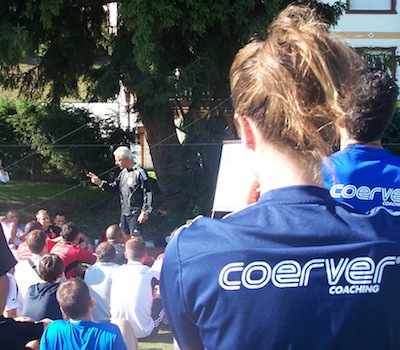
    I got to speak with the legend that is Alf Galustian before he headed off across the world to conduct another Coerver Coaching Workshop. Alf will be back in Dublin in a couple of weeks to head up the Coerver Youth Diploma at Tolka Park.

    When did you start coaching?

    I started coaching at 25,after a serious knee injury,and obtained my FA and USSF badges soon after

    What is Coerver Coaching?

    Coerver Coaching is two things:

    a) A Soccer Skills Teaching system,devised by Charlie Cooke and myself,inspired by the philosophy of Wiel Coerver,the great dutch coach.The System has continued to evolve since 1984.

    b) A Global Soccer Education business,that Charlie and I startled in the USA in 1984,with one camp. Today we have Coerver Coaching activities in 35 countries.

    At what age should a player start mastering their balls skills?

    In Coerver Coaching we have 4 “Golden Ages” for developing good skills:

    1) 4 – 6:This is an age where coordination and balance is being mastered,and in Coerver we use the ball to improve these,however,through fun games rather than drills

    2) 7-11 : This age group we focus on ball mastery and moves ( 1 v 1). Players learning thru repetition,again disguised by fun games or competition rather than drills

    3) 12 – 16: Here we focus on players using the skills effectively in games: The “When and where”. We have devised drills and games that allow the players many decision making options.

    4) 17-21: Here we focus on Position Specific Technical training and the use of technical practices to improve conditioning.

    Does Coerver Develop Game Intelligence?

    The Coerver Method is deliberate,planned practice of increasing difficulty. Every core Skill : 1v1/Running with the ball/Passing/First touch has 3 parts:

    1) Perfecting the skill through repetition

    2) Graduated Pressure Defending

    3: Full game pressure : this is the part that game intelligence develops. Each Coerver session devotes 30% of the total session time to this part of development.

    You’re working with kids all over the world, how do we compare to other nations on technical ability?

    I think we need to divide into Grassroots and “Elite ” Player. In Grassroots I think British and Irish kids, 8 to 16, are probably the same as in most European countries. I think Japan , USA and Australia of the countries I worked in ,are probably ahead of us.

    Regarding Elite player development,I have worked for 17 National Federations and many of the worlds top pro clubs. For example I would say between 7 and 11 kids at EPL clubs can be compared to any in the World. I think between 12 and 16 the gap widens; Spain. Italy,France,Germany especially are better. Not necessarily the best kids but producing more ( Its the depth that seems to be different)

    At what age should we coach to win?Alf G1

    I don’t think there is anything wrong with wanting to win. I believe in all sports competition is important. However, I think we should value performance more than winning up to 16 years old.

    Do you have any other thought on winning over development?

    I think its helpful if coaches can explain to parents why they value performance more than winning in the development phase. Once it is explained then you are more likely to get parents/kids support.

    What age should we move to 11v11 football?

    Most countries it’s 12 and up. I would agree with that

    If there was one thing you could change about kids football, what would it be?

    Again depends on the country,but for UK and Ireland,I would say correct coaches education for those working with 6 to 16 year olds.

    You’re a mentor to many many coaches, but do you have any mentors?

    Wiel Coerver . After him I have been lucky to have worked closely Gerad Houliier and Aime Jaquet France, Carlos Parriera Brazil, Juergen Klnismann Geramny; I have learnt from all of them

    What does the future hold for youth development in Ireland and the UK?

    Again I think in grassroots football we are on the right road; more debate,more funding,more opportunity. In the elite game,in my opinion, we are still behind; what we teach and how we teach. This is not a criticism on the very many good youth coaches at pro clubs; in fact I think they should be supported more ; more education and better salaries.

    The next Coerver Coaching Youth Diploma Course will be held at Tolka Park on 17th and 18th August.

    Venue: Shelbourne FC Tolka Park Dublin

    Date: 17/18 Aug 2103

    Cost: €229.00 incs new 5 set coerver dvd and all course books and certificate of attendance

    To book or for more information on coerver coaching contact Austin.speight@coerver.ie

    @coerveralf, @CoerverCoaching

    Next Up: Interviews with Lisa Fallon @lisafallonsport and Hugo Vicente @hrsvicente