Categories
Coaching Psychology

Sports Psychologist Alan Goldberg’s Bad Coaching Behaviours

If you’re reading this post it’s because you’re either into coaching or you’re someone who is into learning about what makes a great one.

Take a look at Dr. Goldberg’s list of examples – of behaviours that characterise ‘bad’ coaching. Here is some sound advice for anyone involved with coaching kids.

There are a lot of “coaches” out there who don’t have CLUE about how to really coach. Unfortunately these individuals consistently do far more damage to young people than they do good.

  • They tear down self-esteem rather than building it up. They create an extremely unsafe learning environment for their athletes. They use fear, humiliation and demeaning, disrespectful behaviors as “teaching” tools. They are emotionally and sometimes (indirectly) physically abusive. They directly and indirectly pressure athletes to continue to play when injured. They regularly kill the fun and passion that their athletes once had for the sport. These coaches have lost their way and strayed terribly far from the true mission of coaching.

You’re NOT a good coach when you call an athlete out in front of the team and tell that athlete, “You absolutely suck! You’re the worst short-stop, quarterback, setter, forward, keeper, etc. that I have ever seen!”

  • How is this kind of a comment constructive? Does it help a child understand exactly what he/she is doing wrong and what they need to do to fix it and improve? How does it help a child learn? Does it motivate an individual to want to work even harder to improve? Does it help that individual feel good about themselves?

You’re NOT a good coach if you think that your most important job as a coach is to win games.

  • I don’t care what kind of pressure to win that you face from the administration. If winning is your primary goal as a coach you have significantly lost your way and as a consequence, you’ll actually win less!

Your mission as a coach is to teach young people and help them grow as individuals so that they become better people in the world, both on and off the field.

  • There are far more important things at stake here than whether a kid wins or correctly learns the x’s and o’s. Good coaches teach their athletes how to be better people in the world and they use their sport as nothing more than a vehicle for this teaching. The winning and losing outcomes are completely secondary to the teaching of valuable life lessons (playing as a team and sacrificing individual needs for the betterment of the team, handling adversity & failure, mastering fear & obstacles, working hard towards a faraway goal, learning to believe in yourself, being a good sport, playing by the rules, etc.)

You’re NOT a good coach when you place the outcome of a competition in front of the physical and emotional welfare of your players.

  • If you pressure your athletes to play when injured or if you demean and ignore those athletes who are too injured to play, then you are engaging in physical abuse. Encouraging your athletes to play hurt so that the team can win is reckless behavior for you as a coach. When you do this you are directly putting your players at risk. You are NOT teaching them to be mentally tough! Playing through pain is NOT a sign of strength. That is a ridiculous MYTH!!!!! Instead, it’s completely ignoring your body’s early warning signs that something is very wrong.

You’re NOT a good coach when you allow players on your team to scape-goat and/or demean each other.

  • Good coaches create a safe learning environment. There is nothing safe about being on a team where teammates regularly criticize and yell at each other. There is nothing safe about being on a team when you are picked on or ostracized by your teammates. It’s the coach’s responsibility to set very clear limits to prevent these kinds of “team busting” behaviors. There should be no place for them on a winning team.

You’re NOT a good coach when you play favorites.

  • Good coaches treat their athletes fairly. They don’t operate with two different sets of rules, i.e. one for the “chosen few” and one for the rest of the team. Coaches who play favorites go a long way towards creating performance disrupting dissension on their squads.

You’re NOT a good coach when you tell your athletes that under no circumstances are they ever to tell their parents what really goes on in practice, and that if they do, they are being disloyal and disrespectful to their teammates coach and the program!

  • Coaches who tell their athletes these kinds of things are terribly misguided and are trying to hide something. What they’re trying to hide is their abusive behaviors! Telling kids not to ever tell their parents is what child abusers tell their victims!

You’re NOT a good coach when you treat your players with disrespect.

  • I don’t care what your won-loss record is or how many championships you’ve won in the past. When you treat pre-adolescent and adolescent athletes disrespectfully you are NOT a good coach. Great educators don’t teach in this manner. They value their students and make them feel that value, both as learners and individuals. Your position and reputation should not determine whether you get respect from your team. What does determine whether people respect you is how you ACT! Your behavior is what’s paramount. Good coaches earn their respect from their players on a daily basis, over and over again based on how they conduct themselves and how they interact with their athlete and everyone else associated with the program. If you think that you’re too important to earn respect, then you are distinguishing yourself as a bad coach!

You’re NOT a good coach when you don’t “walk the talk.” What you say to your players means nothing if it doesn’t come from who you are as a person.

  • Simply put, your words have to closely match your behaviors. Great coaches are great role models in that they teach through their behaviors. They don’t operate on a double standard where it’s OK for them to act one way but hold their athletes to a different and higher standard of behavior. If you as a coach teach through the maximum, “do as I say, NOT as I do,” then you have distinguished yourself as a poor coach.

You’re NOT a good coach when you refuse to take responsibility for your behavior, when you refuse to own your mistakes and instead, blame others for them.

  • The mark of a great educator is that they present themselves as human. They do not let their ego get involved in the more important task of teaching. Therefore when something goes wrong, they are quick to own their part in it. Good coaches take responsibility for their team’s failures and give their team and athletes full responsibility for successes. Bad coaches blame their athletes for losses and take the credit for the team’s successes.

You’re NOT a good coach when you play “head games” with your athletes.

  • If you talk behind their backs, play one athlete off against another or are dishonest in your interactions with your players then you are doing nothing constructive to help your players learn and grow as athletes and individuals. Telling a player one thing and then turning around and doing exactly the opposite is not how you go about effective coaching. For example, promising a player more playing time if he/she does A, B and C, and then keeping them on the bench after they do everything you’ve just asked of them is a psychologically insidious game that will kill your athlete’s love of the sport, crush their spirit and destroy their confidence. This is NOT how great coaches motivate their players!

Alan Goldberg, PhD, was the sport psychology consultant to the 1999 NCAA Men’s Basketball National Champion University of Connecticut Huskies, and the 2000 men’s soccer NCAA champions. He is the former Sports Psychology Consultant for the University of Connecticut Athletic Department. As a nationally-known expert in the field of applied sport psychology, Dr. Goldberg works with athletes and teams across all sports at every level, from professional and Olympic caliber right down to junior competitors. Dr. Goldberg specializes in helping athletes overcome fears & blocks, snap out of slumps, and perform to their potential. His book, Sports Slump Busting (LLumina Press), is based on his extensive experience getting teams and individual athletes unstuck and back on track. Outside of sports, Dr. Goldberg works with performing artists, sales and business people, test takers, and public speakers.

Thanks to Podium Sports Journal for the content. 

Do I need to say anything, I think Alan Goldberg has said it all!!

-End

I always like to hear your opinions. Please comment below or email me info@thecoachdiary.com If, you don’t have anything to add then please forward this on to a friend. Thanks for reading.

I’m also on twitter @Coachdiary

Categories
Psychology

Dan Abrahams: Saturday 8th March’14

Just one week to go before Dan arrives in Dublin. On Friday night Dan will be taking a private session with the NDSL Academy Teams, KDUL and MGL along with some other players. Saturday will be the turn of the Coaches to get some sports Psychology onto their CV.

Signed up so far are coaches from Limerick, Galway, Kildare, Cork, Donegal, Belfast, Laois, Wexford, Wicklow and Dublin.

Dan will be delivering a football psychology workshop emphasising techniques, tools and philosophies for coaches picked from his two international bestselling books, Soccer Tough and Soccer Brain.

Topics will include:

  • Developing player confidence;
  • Helping players deal with distraction and develop focus,
  • Leadership;
  • Team cohesion;
  • Effective training principles;
  • Coach creativity and much more.

The workshop will be a facilitation meaning it will be highly interactive with group work and a high volume of audience participation.

The Early Booker ends Friday 28th February > 

BOOK NOW

Supported By

FCC_Colour_Logo


DCSN Logo


I always like to hear your opinions. Please comment below or email me info@thecoachdiary.com If, you don’t have anything to add then please forward this on to a friend. Thanks for reading. I’m also on twitter @Coachdiary

Categories
Psychology

Winning Mentality by Gary Neville

You’ve got to work at it

A winning mentality is built up over a period of time. It’s not a case of being born with a good attitude and work ethic. It can grow inside you. You have to surround yourself with people that have accountability inside them. They want to win every single day. High standards have to be set.

Bring out the best in your players

The manager sets the tone for a winning mentality. It’s down to him to create a winning environment. Players blossom in an enjoyable atmosphere – one that encourages hard work and preparation. Every single week the manager has to make it clear that he never wants anything other than a victory.

Deal with disappointment

Winners understand that a game isn’t always going to go their way. You will face adversity, but you can’t get too down when you’re losing and get too carried away when you’re winning. The right mindset comes from having a belief in your ability and the confidence to overcome difficult moments.

Appoint lieutenants in the group

You need leaders in a dressing room. The manager can’t be in touch with the players all the time so he needs characters that are going to set an example with the way they behave, act and train. The players train and socialise together so the manager needs to make sure they’re buying into the ethos all the time, especially when he’s not with them. This is where leaders in the dressing room can really help.

Recruit winners

People want to know how Sir Alex Ferguson installed the drive to keep going every single year, to keep winning trophies – that relentless nature that exists at United. He recruited the right type of players – players that had his traits. When you grow up around big players, the best players, who fight every single minute they’re on the pitch you think, ‘How can I not follow that?’ You pick up their habits.

Neville was talking at an event for Vauxhall, the England sponsor. Keep up to date with news and comps at vauxhallfootball.co.uk@VauxhallEngland andfacebook.com/VauxhallEngland

=================================

I always like to hear your opinions. Please comment below or email me info@thecoachdiary.com If, you don’t have anything to add then please forward this on to a friend. Thanks for reading.

I’m also on twitter @Coachdiary

Categories
Irish Grassroots Football Psychology

EXPERT TALK: Footblogball with Michel Bruyninckx

Footblogball has continued he’s series of excellent interviews with brain centered learning coaches. I’m delighted to be able to post this on the TCD blog for you.

Footblogball: You have recently been working at AC Milan . Can you give us a brief insight as to what you were doing there and how responsive did you find the players and coaching staff to your methods ?

Michel: We have been working on cognitive readiness, perception and multi tasking. The players’ interaction and communication had to be improved. After 3 days the coaches already saw some changes. Both the coaches and players were reacting in a very enthusiastic way on the new drills. We have been invited back to show more of our concept.

Footblogball: Seeing as genetically influenced doesn’t mean genetically determined we can say that talent is not prepackaged at birth , but takes time to develop .One of the most important discoveries in recent years is that the environment triggers gene expression. Talent develops through the interaction of genes and the environment . How does your method help create the right environment for player development?

Michel: The environment delivers a mental and a physical framework. We work on the organization of both. Regarding the mental part we try to exclude stereotyping and too much competition between the players based on the differences regarding physical maturity. Also the fact we try to match learning in a better way with brain functioning has got an enormous influence on the learning processes.

Footblogball: Our brains grey matter that has been growing through our childhood shrinks dramatically in our teen years while at the same time white matter . made up of axon fiber connections between brain cells increases. This white colour comes from myelin something that you have referred to in previous interviews and is a key factor in regulating the speed in neural circuits so that they combine at the right time. As football is a flexible circuit activity where the player must understand and solve many problems and apply the right skill to these challenges , what advice would you give to a coach who wants to use a more brain centered approach to his coaching of young teenagers who have already been coached in a more traditional way?

Michel: The grow of myelin is based on repetition with variations (a combination of linear and non linear dynamics) but embedded in a structured and very visible football environment. A specific space mapping is indispensable to set up a logical line players will use to build up their knowledge – principle of retrieval structures. For the organization of each drill it is very important to combine the technical performance with the influence of time and space.

Footblogball: If 6-12 years is referred to as the “golden age for player development then could we not describe , with all that is happening in the brain , the teenage years as the – “Golden Age of Brain Development “?

Michel: First of all the “golden age for player development” must focus more on multi sports. A too early specializing is not good for the postural development of a player. So it depends on at what age a player starts to practice ball mastery and game development may not be understood as “competition” – the French federation decided to organize no more competition before the age of 14. Mastering a game means that players can go to more “decision making” themselves. You can’t expect them to do this in adequate way if they don’t have a well designed referential learning framework and through the fact their prefrontal cortex is not full grown they need the help of a coach.


Footblogball: We hear a lot about agility and speed in the modern game but for me and especially at youth level , perception and decision making should be trained at the same time otherwise there is a risk that there will be a break down in the connection between how the young player experiences training and the real game. Perception can improve a players agility while the ability to perceive and react quicker ( make a decision ) can help the speed in which an athlete can move in a new direction.

Can you discuss this statement?

Michel: I agree with your statement: we train too much “single focus”. If we train or coach our players continuously within our physical potential (more based on reacting than acting), we shall never match with the future game. A faster understanding of the brain when an action is developing will speed up decision making. Speed is no longer a pure physical matter but more and more a neuronal issue.

Footblogball:  Research suggests that young players only retain 18% of concepts that are learned passively but 68% of that which is learned actively , thus implying the need for a more player centered training rather than coach centered . Can suggest how by using your methods this can be achieved ?

Michel: Once they have the learning framework, we can ask them to train and coach themselves. We regularly make use of double tasking. Here the players take the lead using mathematical tasks and different languages. Concentration level needs to be high as Xavi Hernandez says: “Think, think, think etc….. “

Footblogball: When you work with a club at grassroots level the question of talent Identification always comes up. For me it is more a question of talent observation.

What environment does the club /coach create for the player ? Is it a winning first culture ? something that I associate with talent identification ( based on physical qualities, identify the best player now to win , short term. ) possibly creating extrinsic motivation. Where perhaps a “development culture “ OBSERVES talent and offers a safe , challenging and exciting environment and encourages intrinsic motivation therefore enjoyment and a more long term approach where the player takes more responsibility for his own develop

Michel: Player development is about learning NOT performing. It is a continuous follow up of the development of mental, physical, technical, cognitive and tactical skills.

All over the world most of the time early matured children are selected to be part of the highest competition and to prove they can WIN. I worked with many young players that have been sent away because they could not show immediately how to perform and win. Many of them are today pro players and at the highest level in Europe. There is no uniform learning model or perfect technique to teach a player how he or she has to do it. He has to learn to explore his or her own potential by his or her unique body and brain organization.

======================================

I hope you liked this interview, I certainly did and thanks to FOOTBLOGBALL for allowing me to share this interview with you.

Follow Mark on Twitter @markstkhlm and Michel on Facebook Cogi Training

======================================

Worth a read, see also Belgian Blueprint and Download Belgic Vision document Belgium Vision

======================================

I always like to hear your opinions. Please comment below or email me info@thecoachdiary.com If, you don’t have anything to add then please forward this on to a friend. Thanks for reading.

I’m also on twitter @Coachdiary

Categories
Coach Talk Irish Grassroots Football Psychology

EXPERT TALK: Dan Abrahams by FOOTBLOGBALL

This is one of the best interview and insights into football psychology I have had the pleasure to read. Certainly some very unique and smart questioning by Mark O’Sullivan.

HERE IT IS….

Dan Abrahams is a global sports psychologist helping people to high perform. His ability to de-mystify sport psychology is very evident in his brilliant book Soccer Tough where he introduces some simple but effective techniques that achieve quick results.

His new book Soccer Brain is directed at coaches. In this book Dan gives us some tools and philosophies to help create a more effective player mindset and in turn help establish a better coaching culture.

“Well that’s just football” and you think “Hmmm, that’s not football, that’s the way you’re approaching football.”

FOOTBLOGBALL :You and Horst Wein have something in common. Neither of you come from football backgrounds but you both have managed to change how many of us think about and experience the game. Has the fact that you came into football from another direction been an advantage to you? Ie you are coming from a different angle?

DAN ABRAHAMS : I think having formerly been a ‘non football man’ was, and has been, both an advantage and disadvantage. One of the drawbacks of sport psychology is the notion that you bring a pre-determined set of techniques into a sport without much prior knowledge of that sport, without understanding the language of the sport and without knowing the specific challenges the sportsmen and women in that particular sport face. Being a former pro golfer (both player and coach), golf is pretty easy for me to work in. When I started in football a decade ago I was pretty conscious of my lack of knowledge of football so I cut my cloth in non league and immersed myself in the football environment and its different communities – elite professional, journeyman professional, non league, grassroots, women’s football etc.

So look, sure, if you’ve never played the game to any level and if you don’t coach it, you’ll possibly never have the same feel for the game like those who have. But at the same time I can only speak for myself and over the past decade I’ve spent thousands of hours at training sessions, talking with leading coaches, at matches and at conferences and workshops delivering and listening. I’ve spent thousands of hours researching the game. I spent dozens of hours in the Prozone suite at West Ham working with a number of clients – so I’m comfortable that I have a good grasp of football.

In terms of advantages – coming in fresh can help you see things with a clarity that perhaps those who have been in the game since 8 years old don’t necessarily have. The number of times I’ve heard a client say to me “Well that’s just football” and you think “Hmmm, that’s not football, that’s the way you’re approaching football.” It’s easy for those who are embedded in the culture of football to just accept the game for what it is rather than cast a critical eye on trends, thoughts and practices. I am able to do that. I am able to look from the outside in and say “Really? I’m not sure about that. This can be changed and this can be seen differently.”

FOOTBLOGBALL: For me your book Soccer Tough had many ” I knew that but never thought about using it that way” moments. It is a terrific resource for any player , coach or parent . Your new book Soccer Brain , how does it differ from Soccer Tough ? Is it aimed more at coaches ?

DAN ABRAHAMS :Soccer Tough was aimed at players but naturally many coaches have picked it up and ‘run with it.’ Which is great! But I knew my next literary offering for the football community would be specific to coaches and centre on the coaching process. I hold a strong belief that the environment a coach creates is a prime mediator of development and performance. So I have written a book about creating a culture of success (development and performance.) It’s split into 4 sections: creating a culture of creativity, confidence, commitment and cohesion. It has loads of ideas for a coach at any level and at any age group.

“The Toughest Profession of All” 

FOOTBLOGBALL : ( Curve ball question 😉 ) I am developing an age related training strategy for my club. Not just age by date of birth but physical age as there can be gaps of up to 3 years physically between say two 14 year olds . Could we say the same in psychological terms about mental age and can you give advice on how we should begin to develop a more age related ( date of birth/mental / physical age ) strategy in mentoring players from a football psychology perspective ?

DAN ABRAHAMS : From a practical perspective this would be enormously difficult to undertake and I think you’d be looking at some fairly questionable methodologies should anyone go about trying to do this. Of course this is in my opinion. But there are certainly things you can do to help players develop a high performance mindset approach. It starts with your own understanding of the mental side of the game. What many coaches don’t appreciate is that mindset is both a talent and a skill. This is something I write a lot about in Soccer brain. Just as there is physical talent, so there is mental talent. Take a cross section of 20 13 year old footballers and some will have greater mindset talent than others – they are naturally better at concentrating, are naturally more confident etc. Of course this correlates with physical talent – but there will always be players who have less physical talent but over come this with a natural propensity to want to develop and to want to win.

So there is such a thing as mindset talent. Mindset is also a skill. Focus can be improved, as can confidence, determination, emotional management etc. This to me is where coaches need to improve in their ability to help players develop. Firstly just by recognising that mindset is a skill is a great start. Then you need the tools and techniques and the communication dexterity to help players in this area.

To come back to your question – I would say the most appropriate thing for coaches to try to achieve at every age group is to examine the behaviours of those who have good mindset and look to develop those who have poor, maladaptive behaviours. This is key – what a lot of coaches don’t appreciate is that mindset can be seen behaviourally. For example a lack of confidence might manifest itself in ‘hiding’ on the pitch or a lack of vocals. Young footballers may be fidgety when you speak to them. This is because of their brain. If this is the case ask them to stay still and look at you while you speak. Ask them to practice paying attention.

So in summary I’m not sure it’s about saying “This under 14 has a mental age of 11”. I don’t think ethically and scientifically you can do that. I think it’s about saying “This under 14 is demonstrating behaviours that are suggesting a lack of mindset talent. I need to help this player develop his/her mindset”.

FOOTBLOGBALL : My personal view of the game in England is that it has for decades been slow to embrace anything that threatens its “traditional game and values”. Now the FA have put in to operation a new “Player Path” plan to help improve the poor state of the game at grassroots level with the aim of developing a better standard of player at senior level. how do you think that your area of expertise can help the English FA achieve their aims.

DAN ABRAHAMS : I’d really just like to see psychology resources that hold more real world value for coaches and players. It’s easy to criticise football when it comes to sport science, and it’s fair to say football needs to be better (in England) at embracing new methodologies that arrive outside of it’s own environment/culture. But sport psychology needs to be better at developing strategies, formulas, philosophies, techniques and tools that are developed within football, are specific to the challenges faced in that environment, and are delivered in the language of football. I think I’ve had a little success in football because I’ve done just that. I don’t throw theory in front of a coach or player – I scaffold the theory and make it football specific and teach them in their language. That is so important and something we need to be better at.

If I was a coach I’d constantly be saying “Next” and “Think”

FOOTBLOGBALL : Children have a vast appetite for learning but in my opinion it dissipates dramatically when they enter our out of date education system. The same can be said for football where I think that the greatest conceit of coaching is that – young kids learn anyway, what is most important is the environment created by the coach and the coaches ability to not look at how he coaches but more how his young players learn . Would you agree ? And what tools would you suggest for that coach to use with his young group ( 6-9 year olds)

DAN ABRAHAMS : If think for any age group environment is everything. But historically FA courses have been about technique and tactics. Again this is something i have tried to address in Soccer Brain. As I say in the book “ In coaching it is the brush strokes that mediate success not the palette itself.” Coaching never has been or never will be just about technique and tactics. That is instruction and of course it forms a part of what you’re trying to teach. Coaching is environment and culture driven. At any age there needs to be fun, freedom and focus. There needs to be caring, discipline and determination. These qualities are set by the coach. They are the soft skills that make the hard skills possible. I’m convinced that if all coaches in Britain fell in love with getting the soft skills right, the environment and culture right, then we’ll start producing more players at the elite level.

I agree with your thesis – a part of the process of coaching is understanding how people learn – how the brain learns. It’s appreciating individual differences and striving to help every player irrespective of those differences. The intro title to Soccer Brain is called “The Toughest Profession of All” – because quite simply it is. Coaching is tough but some coaches stride around making it easy by just thinking that coaching is about drilling. Rubbish – coaching is player centred and driven by your coaching culture.

FOOTBLOGBALL : At the heart of football coaching is a teacher and a learner. Where both need to be

(a) Adaptable : The coach must show adaptability in response to changes in the players environment ( School , home , growth phase ) , The player must show adaptability to changes in his environment and be able to respond to changes that are happening live within a game.Often it is a woods from trees scenario for the young player. How can the coach bring greater clarity toward helping the player understand the changes in his environment both on and off the field.

DAN ABRAHAMS : Let me answer this simply. On the pitch I believe a coach should be constantly communicating the notion of ‘Think’. I remember Steve Gallen at QPR Academy always saying “What next?” The nature of the brain of young players means that they tend to switch off. They do something and then switch off. They watch the game rather than think the game. If I was a coach I’d constantly be saying “Next” and “Think”. Help them build a habit of prediction. That is what football is – prediction. It’s not really a game of ‘moment’ it’s a game of ‘prediction’. What is Messi and Xavi? They are ‘The now and the next 10 seconds’. That is the foundation of game intelligence. Ask players to do this, to be like this. You can’t reinforce this notion enough.

FOOTBLOGBALL : (b) Creative : How can the coach encourage creative thinking ?

Certainly doing the above can help. The coach also needs to promote an culture of freedom. You can’t be creative if you play anxious. Allow mistakes to happen – in fact have an environment where players love mistakes. Freedom comes before focus – focus will be built over the years as long as you have a base philosophy of freedom.

DAN ABRAHAMS : Creativity is also built from knowledge and mindset. Players should be students of the game. If there’s a clip of Gary Neville talking about how Raheem Sterling plays with his head up on YouTube how come there are young players out there who haven’t seen that clip? Resources are everywhere – you can’t create if you don’t know! In terms of mindset – promote the idea of imagery. Players should be rehearsing passages of play in their mind everyday. These should go from the mundane through to the complex. Create in your mind first – over and over. The it makes it more possible!

FOOTBLOGBALL: Our brains by nature look to save energy by automising a process which can create a conflict between our comfort zone and our development. Discuss

DAN ABRAHAMS : When we learn to drive we control the processes that operate/move the car. Over time these processes become less controlled and more automated. We pass our test and we drive in the most part unconsciously (with some attentional resources placed on the road ahead of us.) We drive for the rest of our lives at a certain standard ad within our comfort zone. But if someone was to come to us and say “I’m going to teach you to drive like Lewis Hamilton” then we’d have to come out of our comfort zone and start focusing on superior driving skills. We’d have to start thinking about our driving performance again – when to shift gear, at what point on the bend – what speed to go at around a hair pin etc. This will feel uncomfortable. It will feel reckless. It requires focus and effort.

One of the most difficult skills for any sports person is to hold that juxtaposition – to go out and play freely and confidently, but to spend time during the week critically analysing performance and looking at what needs to go better. Footballers don’t spend enough time looking at areas to improve because it feels uncomfortable – it can diminish confidence. We are all subject to habits and patterns as we play – breaking them requires self awareness, focus, patience, hard work and discipline.

I do believe this is one of the reasons why many young footballers don’t progress. They get into a certain maladaptive habits and patterns and either remain blissfully unaware that there is a problem or will avoid working on this area because it takes effort to change.

A prime example is ball watching in younger players. If a player tends to focus on the ball too much without getting a picture of what’s going on around him it takes energy and effort and enormous willpower to change this. It takes a move out of his comfort zone to start checking his shoulders 10 times a minute.

I could, if I wanted to name several very high profile midfielders who stopped working with me after about a month because I wanted them to THINK about their game and develop what I call a training script. I wanted them to start changing their dominant motor patterns that were leading in inefficient play. They were British and both have failed to progress – why? Because the feeling of change takes up so much resource from the brain that is was easier for them to not bother.

This is where certain Barcelona players are so good. I’m unconvinced about the notion of “Just do it” on the pitch. To be the very best in the world you have to have some thought, some controlled processes on the pitch. It’s a fluid game that is constantly throwing problems at players – they need clarity of thought in the moment, but there must be some thought. As Xavi says “Think, think, think”.

Many thanks to Dan for taking the time and effort to answer my questions.

You can buy Soccer Brain by Dan Abrahams HERE

=========================================================

I hope you liked this interview, I certainly did and thanks to FOOTBLOGBALL for allowing me to share this interview.

Follow Mark on Twitter @markstkhlm and Dan @DanAbrahams77 

See also Helping the Brain to Win Games By Blueprint for Football

Worth a read The Way Forward and The footballers who are all pay, no play.

I always like to hear your opinions. Please comment below or email me info@thecoachdiary.com If, you don’t have anything to add then please forward this on to a friend. Thanks for reading.

I’m also on twitter @Coachdiary

Categories
Psychology

Visualisation and Innonence

Leading Sports Psychology expert Dan Abrahams in his highly recommended book SOCCER TOUGH refers to a young Wayne Rooney visualising a perfect performance before going to bed the night before a game. 

Abrahams  says  that, visualisation if done in the right way can become a very important tool where this technique can be used  to help players develop a “rehearsal script“ to help them manage their thinking and build self-belief.  Seeing as the brain has a tendency towards a negative bias i.e to remember the things that go wrong, positive visualisation techniques can shift the players mindset to a more confident image.

This got me thinking about the innocence of street football from my childhood in Cork City Ireland as we dreamt up fantasy professional careers for ourselves, commentating as we played, copying our heroes, visualising our faultless performances in World Cup finals.  We were Brazils JOSIMAR hitting 30 meter thunderbolts (8 meters in street terms) past helpless goalkeepers and how did we celebrate…. YES like MARCO TARDELLI. I knew a lad who wanted to leave his hair grow long just so that he could play like Argentinas MARIO KEMPES. Hours were spent on our own in back gardens or on the streets  living out famous sequences from games that we watched on TV, all while the commentator in our head continuously found new superlatives to describe our incredible footballing deeds.  

In essence and innocence it can be argued that  we were using what modern sports psychologists refer to as positive visualisation techniques. It helped us learn the game, it helped us love the game, it helped us live and relive the game and it made us laugh … it was fun.

Then it all stopped. Adolescence came calling, we were expected  to  behave a certain way,  we became less creative as we fell into structured schooling with its standardised testing and structured football coaching with its adult expectations . We were expected to make less mistakes or at least cover up our mistakes. Failing was once part of our creative process  and now to paraphrase Becket, no more could we “Fail and fail better !”

Sometimes to develop as footballers we need to take a step back in years.

By Mark O Sullivan (UEFA B Academy coach at BOO FF Stockholm and sports director at espanyolfootball.com)

See Mark’s Blog FOOTBLOGBALL

Categories
Psychology Soccer Parents

Parents should be seen and not heard…!

We all have them and we all hate them (joke). Some of us have left teams because of them and others have even had them banned from the club. Yes, PARENTS, that’s who I’m taking about, the ones that rant and rage all game long (not all). The worst offenders are ego-driven parents who take personally any slights to their children on the pitch. All that a side, their are some absolutely brilliant parents out there who give up so much time to bring their kids to and from training etc and never interfere in their kids football, but these are mostly few in these times.

Maybe we should pre-warn parents and tell them, “you might get angry on the side lines and attached are some tips to deal with it’. Below are some excerpts from a study about parent behaviour on the sidelines, mostly from the US.

A recent study showed – by Jay D. Goldstein

Overall, about half of the parents in the study reported getting angry during games, and nearly 40 percent of the angry parents made their emotions known. These sideline expressions ranged from muttering or yelling comments to walking onto or near the pitch.

“Their own sense of their personal worth gets wrapped up in how their children are doing in these ball games,” said Edward Deci, a psychologist at the University of Rochester in New York. ” And so the parents feel intense, internal pressure to see their kids performing because the kids are like extensions of themselves.”

Coach: ” so what is your favorite position? “
Player: ” center midfield”
Coach: ” Interesting. Is that because you see yourself as a good playmaker? “
Player: ” No its because my dad is one side and my coach is on the other and sometimes if i’m in midfield, I can’t hear either of them. “

340 parents of 8- to 15-year-old soccer players were evaluated on personality and ego characteristics, feelings of anger and pressure, and aggressive behaviour.

The Results

  • 47% of parents reported no anger-causing events while watching their kids play.
  • 53% did get angry.

Of those who did feel anger, what made them flare up?

  • 19% blamed the referee.
  • 15% said they got angry at how their kid’s team played.
  • 7% said the opponents behaved badly.
  • 5% reported hostile remarks set them off.
  • 5% blamed coaches.

Researchers concluded that the effect of ego defensiveness and taking things personally was strongly linked to feelings of anger and aggressive actions. Those who were more “control-oriented” were more ego defensive. They viewed actions in the soccer game as attacks against them or their children.

“In general, control-oriented people are the kind who try to ‘keep up with the Joneses,'” Goldstein said in a news release.”They have a harder time controlling their reactions. They more quickly become one of ‘those’ parents than the parents who are able to separate their ego from their kids and events on the field.”

Goldstein calls parents who are more even-keeled and able to regulate their emotions “autonomy-oriented parents.” They get angry too, he says, and when they do it’s because their ego gets in the way.

“While they’re more able to control it, once they react to the psychological trigger, the train has already left the station.”

To ease anger on the playing field, Goldstein suggests these tips:

  • Take deep breaths (inhale for 4 seconds and exhale for 8 seconds).
  • Suck on a lollipop. (Occupies your mouth and reminds you that you’re there for your child.)
  • Visualize a relaxing experience like floating on water.
  • Repeat a calm word or phrase.
  • Do yoga-like muscle stretches.
  • Replace angry thoughts with rational ones, such as “This is my child’s game, not mine,” or “Mistakes are opportunities to learn.”
  • Don’t say the first thing that comes into your head. Count to 10 and think about possible responses.
  • If you did not see the game, first ask your child “How did you play?” rather than “Did you win?”
  • Praise your child’s effort, and then, maybe, comment on the results.
  • Use humor, but avoid harsh or sarcastic humor.


Conclusion

More needs to be done in the area of parenting in sport. Parents don’t shout over the teacher in school, so why do they feel they have the right to shout over the coach. How many times, have you seen a team where the coach has decided to have their defence drop when they lose the ball, so that the midfield can recover but then the parents on the sideline are screaming “press”, “press”? Johnny has no idea whether he’s coming or going and this distraction could be critical in the teams play.

Ask any child, ‘what they think about their parents shouting on the sideline’? and you will get some very interesting answers. Some that come to mind, “it’s so embarrassing”, “I hate it”, “he doesn’t know what he’s talking about”, “I wish they wouldn’t come to my games”

“By constantly coaching and correcting our kids in the game we are unconsciously, but almost certainly, guaranteeing poor and deteriorating performance. We are taking them away from that unconscious, focused mental state where they need to be to excel”. – Inside Soccer

Parents need to educate themselves with the help of the clubs and leagues on how to behave pitch side. I don’t understand how parents think it’s ok to verbally abuse children on a playing field yet they wouldn’t dream of telling a kid off in a playground. Well, just in case you didn’t notice or weren’t told ‘the football pitch’ is also a play ground, guys!

Just because things happened certain way when they were younger, it doesn’t mean it has to happen that way now. I think it’s about time some parents kept quiet and let the kids play….

PS. Was at a tournament on Saturday and some of the parents in the stands were a disgrace. In all my time coaching that was the worst I’ve heard. (One lady in particular, now names given)

Research: Inside soccer, University of Maryland,

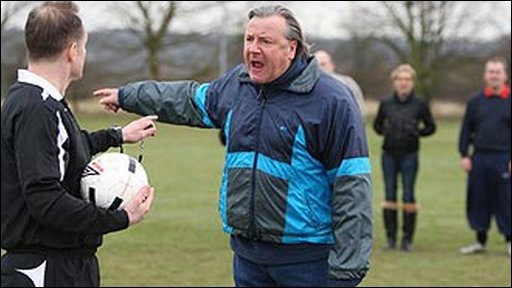
Pic and Video: shows top actor Ray Winstone playing a shouting parent for the English FA Video.

-End

I always like to hear your opinions and views. If you feel you have something to say, please comment below or email me info@thecoachdiary.com and if you don’t have anything to add then please forward this on to a friend.

As always, thanks for reading. I’m also on twitter  @Coachdiary